Key Takeaways
Covers voip phone number in depth
Covers voip number in depth
Covers what is a voip number in depth
Covers voip number vs virtual number in depth
Need a business phone number? Get a MeraTalk number in minutes, no contract required.
Get started freeWhat Is a VoIP Phone Number?
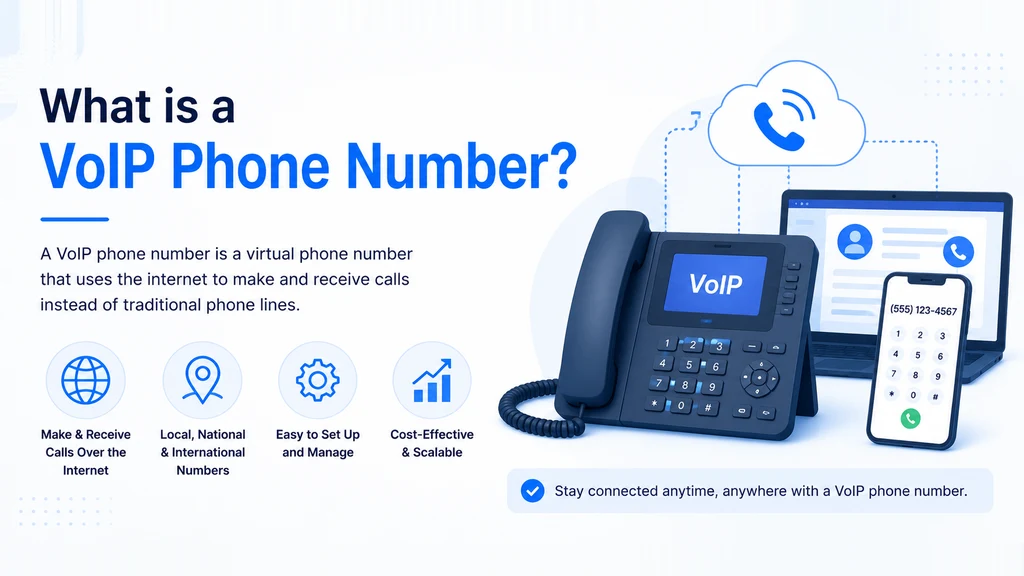
A VoIP phone number is a normal, dialable telephone number whose calls are delivered to your phone system over the internet using Voice over IP, instead of down a copper line to a fixed address. Callers dial it exactly as they would any other number. Nothing about the digits tells them, or the network, that the destination is software.
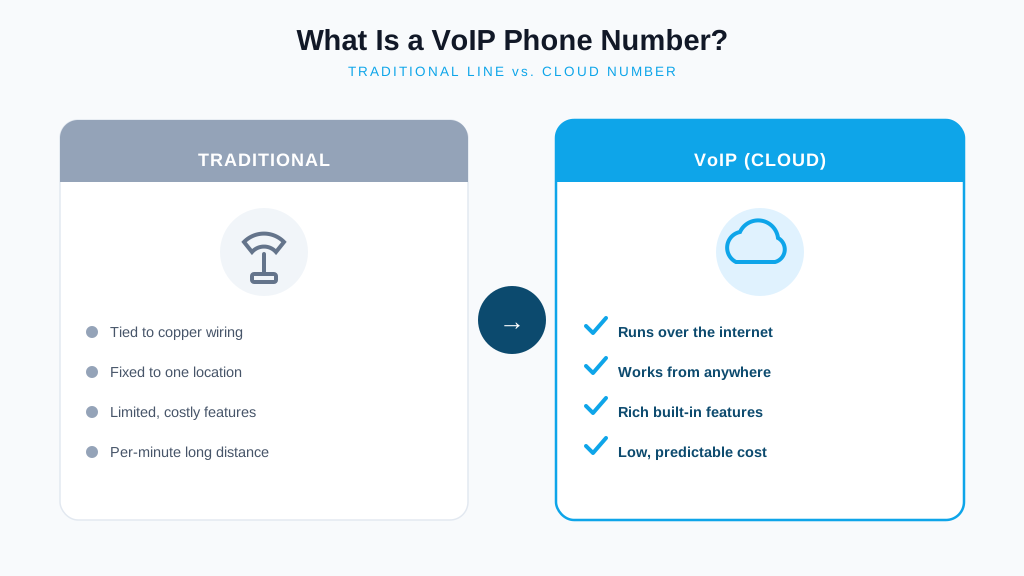
That is the part most explainers stop at. For a business buyer the more useful question is different: who actually holds the number, which carrier is responsible for it, and what do you keep if you leave? Those answers decide whether a VoIP number is a durable business asset or a rental you cannot take with you.
This guide follows a call from the moment it is dialed to the moment your phone rings, then covers ownership, porting, emergency calling, texting, caller ID and call authentication, and finishes with a comparison table and a list of questions to ask a provider.
What Happens When Someone Calls a VoIP Number
A VoIP number is still part of the public telephone numbering plan (E.164 format, a country code followed by the national number). Every number belongs to a carrier that is registered to route it, and the call has to reach that carrier before it can reach you.
- 1The caller dials. Their carrier looks up which network is responsible for the number you dialed, using the numbering data and routing tables the industry shares.
- 2The call is handed over. The caller's carrier delivers the call to the carrier of record for your number, usually as a SIP INVITE across an interconnect, or through one or more intermediate transit carriers.
- 3Your provider maps the number to your account. The carrier or its platform finds which customer, trunk, user or ring group the number is assigned to.
- 4Your provider sends SIP signalling to your endpoint. The softphone, desk phone, app or PBX that is registered to the number receives an invitation and rings.
- 5Media is negotiated. The two sides agree on a codec and exchange the audio as RTP packets, which is where jitter and packet loss start to matter.
Calls you place work in reverse, and the outbound leg is where termination routing and caller ID handling come in. If you are curious about the carrier side of that outbound path, our guide to wholesale VoIP termination explains how a SIP call reaches a normal phone.
Why this matters to a buyer
Every step has a party you depend on. If the numbers are held by a reseller that sits on top of another carrier, a fault or a dispute can pass through two companies before it reaches an engineer. Asking who the carrier of record is, and who can fix a routing fault, is not pedantic; it tells you how quickly a problem can be resolved.
Who Owns the Number: Carrier of Record, Reseller and You
Numbers are allocated to carriers in blocks, and carriers assign them to customers. In practice a number you use can sit in one of three positions:
- Directly with a carrier you contract with. The provider is the carrier of record and can port the number, update its records and troubleshoot routing itself.
- With a reseller or platform that obtains numbers through an upstream carrier. The service works the same day to day, but number changes, porting and fault handling depend on the upstream relationship.
- Held by you in the sense that you are the end user named on the account. You do not own the digits in a legal sense: telephone numbers are a regulated public resource, not private property, but you have the right to keep using a number and to move it, subject to the rules.
The practical test is portability. A number you can port out cleanly behaves like something you own. A number that is only usable inside one platform behaves like a rented extension. Before committing a marketing budget to a number, confirm which one you have.
For help choosing between types of business line, see our guide on how to get a business phone number, which compares what each option needs from you.
Get virtual phone numbers for your business — set up in minutes.
Number Portability: What You Can Take With You
In the United States, local number portability rules let a customer keep their number when moving between providers, and the FCC extended that to interconnected VoIP providers. The FCC's 2009 order set a one business day target for simple ports; ports that involve multiple lines, a PBX, or certain complex services are treated as non-simple and take longer. Toll-free numbers are ported through a separate process managed by their responsible organization.
The things that delay a port are almost always administrative: the name or address on the request does not match the losing carrier's records, an account number or PIN is missing, a number is under contract or has an outstanding balance, or a range includes a number that is not eligible. Gather a recent bill and the account PIN before you submit.
- Do not cancel the old service until the port completes. Cancelling first can release the number.
- Keep the number active at the old provider and confirm the port date in writing.
- Check in advance whether the new provider charges a fee to port a number out later.
- Ask what happens to the number if you stop paying: some platforms reclaim numbers quickly.
Emergency Calling and E911
Emergency calling is the area where a VoIP number differs most from a landline, so it deserves attention before you need it. A landline is wired to an address, so a 911 call tells dispatchers where to go. A VoIP number can ring anywhere, so the location must be provided another way.
US providers deliver a registered address with the 911 call (Enhanced 911). Two federal laws sharpen the requirements for business phone systems. Kari's Law requires that multi-line telephone systems allow users to dial 911 directly, without a prefix such as 9, and that a notification is sent to a designated contact. RAY BAUM'S Act Section 506 led to FCC rules that require dispatchable location information, such as a street address plus floor or room, to accompany 911 calls on systems covered by the rules.
Practical consequences: register the address of every site, update it the same day a desk phone or a worker moves, and decide how softphone users who travel will be handled. Also check that the provider tells you plainly what its emergency service does and does not do. Some platforms disable 911 for certain number types, so do not assume.
Rules and effective dates have changed several times, so confirm current requirements with the FCC's 911 pages and your provider before relying on a summary.
SMS, Caller ID and CNAM
A voice number is not automatically a texting number. Messaging runs on different rails and each carrier network and number type has its own registration regime.
- Local numbers: business texting on a local number in the US generally has to go through A2P 10DLC registration, which ties the brand and campaign to the number. Unregistered traffic is more likely to be filtered.
- Toll-free numbers: texting is enabled through a separate toll-free verification process.
- Short codes: used for high-volume messaging and leased separately.
Caller ID has two parts that people confuse. The number you present is the calling line identity. The name that appears next to it is CNAM, a database lookup performed by the receiving carrier, and not every carrier or handset displays it. Registering a business name takes time to propagate and will not display everywhere, so treat it as a best effort.
The number you present must also be one you are entitled to use. Presenting numbers you do not control is both a compliance problem and a quick way to be flagged.
STIR/SHAKEN and Why Your Number Gets Labelled
STIR/SHAKEN is the framework US carriers use to sign caller ID information so the receiving network can see how far to trust it. The originating provider assigns an attestation level when it signs the call:
- A (full): the provider knows the customer and has verified that the customer is entitled to use the number.
- B (partial): the provider knows the customer but cannot verify that they are entitled to use that number.
- C (gateway): the call entered the network from a source the provider cannot vouch for, such as an international gateway.
Attestation is one input among several. Analytics engines at the terminating carrier also weigh call patterns, complaint volume and answer rates, so a number with full attestation can still show up as 'Spam Likely' if it makes high volumes of short calls. For a business, that means two things: use numbers that are properly assigned to you through a provider that attests them correctly, and keep calling patterns clean. If your numbers are being labelled, ask your provider what attestation they sign and whether they can register the numbers with analytics vendors.
VoIP Number vs Virtual Number vs Mobile vs Landline
These terms overlap, which is why comparison pages disagree. Virtual phone numbers are best understood as numbers that are not tied to a particular line or device, and the delivery technology behind them is usually VoIP, so they are a subset of VoIP numbers rather than a competing option. This table separates what actually differs:
| VoIP number | Virtual number | Mobile number | Landline | |
|---|---|---|---|---|
| Delivered over | IP network via SIP | Usually IP, forwarded to any destination | Cellular network and SIM | Copper or fibre line to a fixed address |
| Tied to a device or place | No | No | To a SIM or eSIM | To a premises |
| Typical use | Business phone system, softphones, teams | Extra local presence, forwarding, tracking numbers | Individual reachability | Fixed office line |
| Portable between providers | Generally yes, subject to rules | Generally yes if it is a real carrier-assigned number | Yes | Yes |
| Emergency location | Registered address; needs maintenance | Often not supported or limited | Network-derived location | Fixed address |
| SMS | Depends on registration | Depends on registration | Native | Not usually |
The table is a general guide. Individual providers differ, so check each row against the service you are actually buying, especially for emergency calling and messaging.
VoIP Number Quality and Reliability
Voice quality on a VoIP number depends on the path between the two ends more than on the number itself. Latency, jitter and packet loss all affect how a call sounds, and a call that crosses several carriers is exposed to each of them.
- Use wired connections for desk phones and prioritise voice traffic on the router with QoS.
- Choose a codec to suit your bandwidth: G.711 sounds natural but uses more bandwidth, G.729 compresses more at some cost to fidelity, and wideband codecs such as G.722 improve clarity.
- Plan bandwidth for the busiest hour, not the average, and test jitter and packet loss before rollout.
- Protect the account: enable multi-factor authentication, use strong unique SIP credentials, restrict international dialing and set spend alerts so that toll fraud is caught early.
The original specifications for VoIP calling are maintained by standards bodies; the ITU's Voice over IP (VoIP) guide material such as H.323 is one reference, while most modern systems use SIP for VoIP calling signalling.
Questions to Ask Before You Buy a VoIP Number
Use this list to compare providers. The answers matter more than the monthly price.
- 1Are you the carrier of record for these numbers, or do they come from an upstream carrier? Who do I contact for a routing fault?
- 2Can I port the number out at any time, and is there a fee or a contract term that applies?
- 3How is E911 registered, how do I update an address, and how does it work for softphone and remote users?
- 4Is texting supported on this number type, and who handles A2P 10DLC or toll-free verification?
- 5What STIR/SHAKEN attestation do you sign for my calls, and are you registered in the FCC Robocall Mitigation Database?
- 6Can I set my own caller ID, and what proof of number ownership do you require?
- 7What happens to the number if the account is suspended or closed?
- 8What fraud controls are available, such as destination restrictions, spend caps and alerting?
- 9Which countries can I get numbers in, and are local presence requirements or documents needed?
A provider that answers these precisely and in writing is usually one you can work with. Vague answers on porting and emergency calling are the warning sign to take seriously.
Conclusion
A VoIP number is a real telephone number that happens to be delivered over IP. What separates a good one from a poor one is the surrounding detail: who the carrier of record is, whether you can port it, how emergency calling is registered, whether texting is enabled, and how calls are authenticated.
Check those points before you print the number on a business card or point an ad campaign at it, and the technology underneath will rarely be the thing that causes problems.
Ready to get started with what is a voip phone number?
Join thousands of businesses using MeraTalk for Wholesale Voice, VoIP, and phone number services.
Contact MeraTalk Today