Key Takeaways
Covers best voip wholesale carrier in depth
Covers voip wholesale carrier in depth
Covers top voip carrier in depth
Covers Wholesale VoIP carrier in depth
Explore MeraTalk's Wholesale Voice solutions — built for carriers, resellers, and enterprises.
Learn moreWhat Is a VoIP Wholesale Carrier?
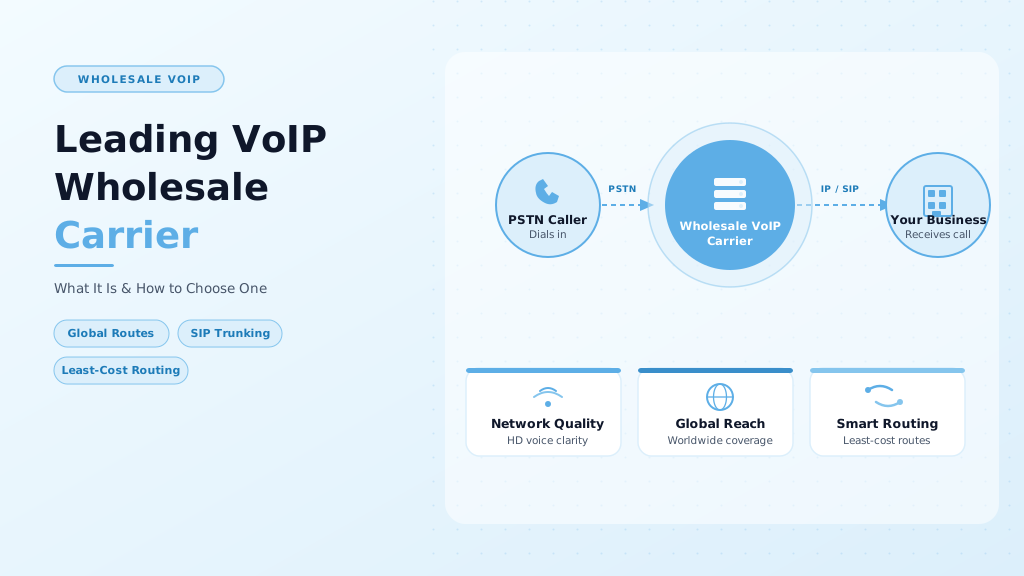
A VoIP wholesale carrier provides bulk call termination services to operators, resellers, and high-volume businesses. It does not serve individual consumers. Instead, it operates in the business-to-business tier of telecom — supplying the raw call routing capacity that downstream providers use to build their retail products.
The carrier holds interconnection agreements with networks worldwide. It manages routing infrastructure and gives customers access through SIP trunking or API-based interfaces. Customers buy this capacity at per-minute wholesale rates and route their traffic through the carrier's network.
The Difference Between a Carrier and a Reseller
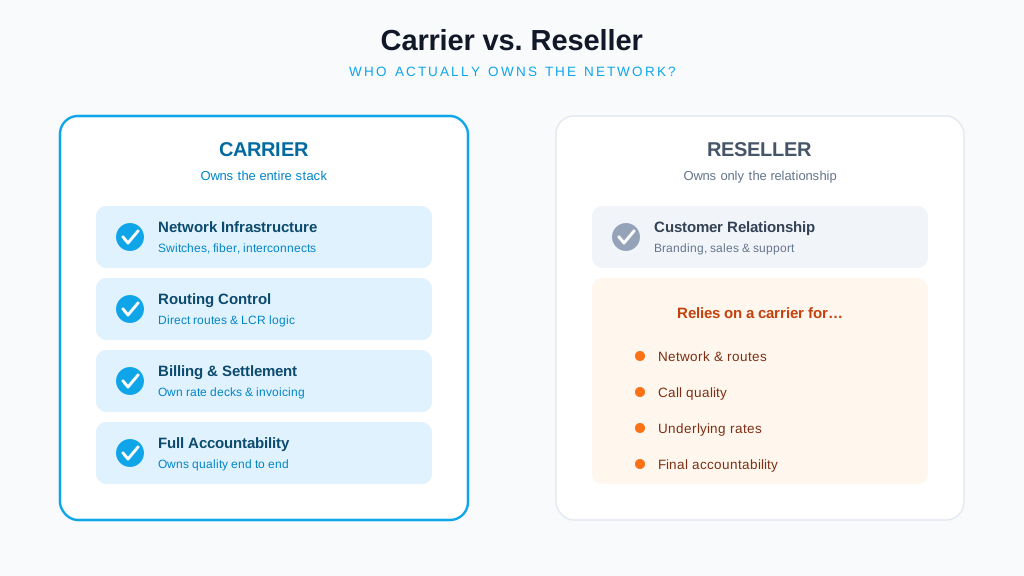
A carrier owns or directly leases network infrastructure. A reseller buys capacity from carriers and sells it to end-users without managing the infrastructure. This distinction matters for quality and accountability. A carrier can control the full routing path and fix issues directly. A reseller must wait on its upstream carrier to resolve problems.
What Makes a Leading VoIP Wholesale Carrier?
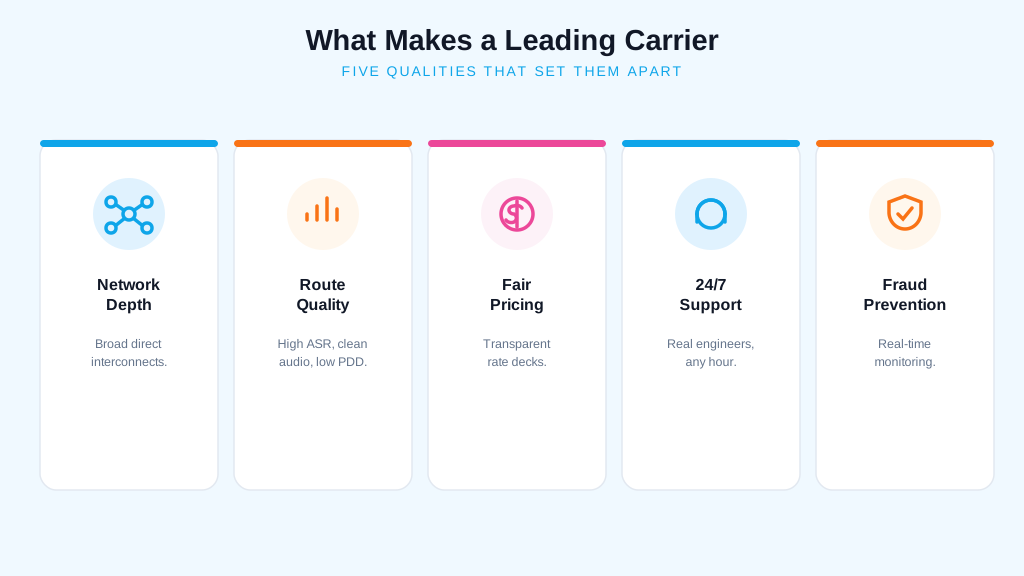
The wholesale VoIP carrier market is crowded. Hundreds of companies claim to offer competitive rates and global coverage. The carriers that stand out consistently share the same key traits.
Network Depth and Global Coverage
A leading carrier has direct connections with local carriers in the countries that matter most to its customers. Direct relationships cut out intermediate hops. This reduces cost, latency, and the chance of failure. Carriers that rely on transit routing through third parties cannot match the quality or price of those with direct local presence.
Route Quality and Monitoring
Top wholesale carriers run continuous quality monitoring on all routes. Real-time dashboards track answer-seizure ratios, post-dial delay, and call duration for every destination. When a route drops below threshold, an automated system reroutes traffic and alerts the operations team. Fixing issues before customers notice is a hallmark of a leading carrier.
Transparent and Competitive Pricing
Leading carriers publish clear rate decks and charge exactly what they state — no hidden fees. Per-second billing is increasingly standard among quality providers. Carriers that still bill in six-second increments or add connection fees are often less competitive overall.
Technical Support and SLA Accountability
A leading carrier offers support that goes beyond submitting a ticket. Direct access to network engineers, real-time status pages, and clear escalation paths show that the carrier takes responsibility for its service. Published SLAs with financial penalties for breaches signal genuine commitment.
Fraud Prevention Infrastructure
International Revenue Share Fraud (IRSF) is a serious risk in wholesale voice. A leading carrier invests in real-time fraud detection, anomaly monitoring, and automatic traffic blocking. These tools protect customers from fraudulent traffic that can create huge unexpected charges very quickly.
How to Evaluate a VoIP Wholesale Carrier
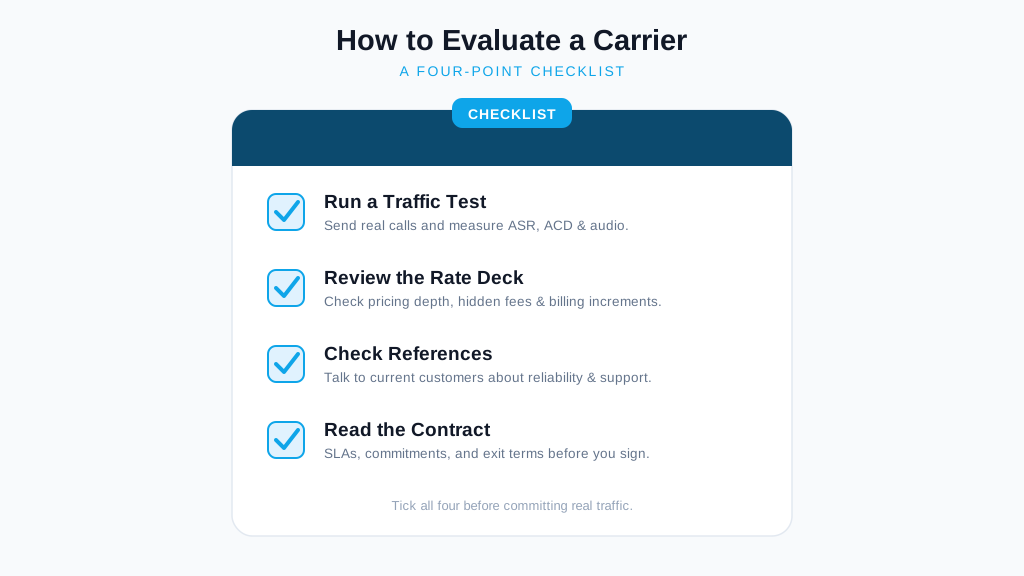
Before committing to a wholesale carrier, run a structured evaluation. This protects you from entering a poor commercial arrangement.
Request a Traffic Test
Before signing anything, ask to run test traffic through the carrier's network to your key destination countries. Measure ASR, ACD, PDD, and audio quality during the test. Quality claims on paper are easy to make — measured results are definitive.
Review the Rate Deck for Hidden Costs
Ask for a full rate deck and review it carefully. Look for billing increments, connection fees, monthly minimums, and surcharges for mobile vs. landline or geographic vs. national destinations. The lowest headline rate is not always the lowest total cost.
Check References From Existing Customers
Ask the carrier for references from customers with similar traffic profiles. Talking to existing customers about quality, support, and billing accuracy gives you insights that no sales pitch can match.
Evaluate the Contract Terms
Review minimum commitments, rate change notice periods, and credit terms. A carrier that demands large monthly minimums or long notice periods shifts risk onto you. Flexible terms with reasonable notice periods show a carrier that competes on quality — not contract lock-in.
Get Wholesale Voice termination with transparent wholesale pricing.
Building a Multi-Carrier Strategy
Experienced wholesale voice buyers rarely rely on a single carrier. A multi-carrier strategy — keeping active connections with two or three carriers for key destinations — gives you better pricing, route redundancy, and protection against outages or rate hikes.
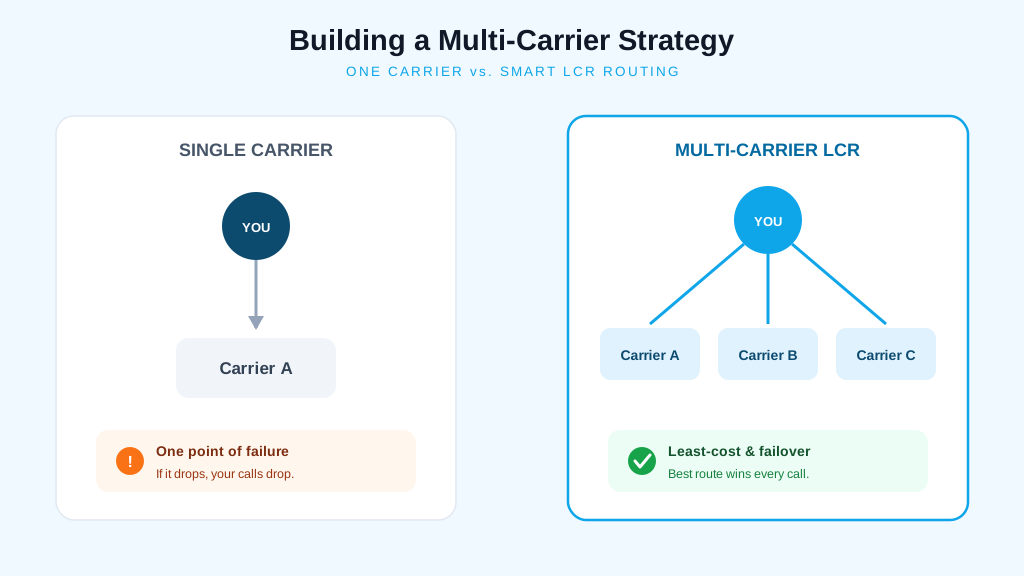
In a multi-carrier setup, least-cost routing (LCR) software sends each call to the cheapest route that meets quality thresholds. If one carrier raises rates or has quality issues, the LCR system shifts traffic to alternatives automatically.
The same redundancy logic applies to VoIP origination — spreading inbound DID traffic across multiple providers protects you if one origination partner has an outage.
When to Use a Single Primary Carrier
Smaller operations with limited technical resources may find it hard to manage multiple carrier connections. In that case, choosing one strong primary carrier with built-in failover and redundancy is a practical alternative.
The Interconnection and Onboarding Process
Once commercial terms are agreed, the technical relationship begins with interconnection — establishing SIP connectivity between the customer's switch and the carrier's network. A well-run onboarding follows a predictable sequence, and how smoothly a carrier executes it is an early signal of its operational maturity.
- 1Exchange of technical details — IP addresses, signaling ports, supported codecs, and capacity limits are documented by both sides
- 2IP whitelisting and authentication — the carrier authorizes the customer's originating addresses or issues SIP credentials
- 3Test call validation — both parties place calls to fixed and mobile destinations, confirming signaling, audio in both directions, DTMF, and correct caller ID presentation
- 4Rate deck loading — the customer imports the carrier's pricing into its own routing and billing systems
- 5Gradual traffic ramp — live volume increases in stages so quality can be watched at each step
Onboarding that stalls on missing documentation or slow engineering responses often foreshadows the support experience to come. For more, see post-dial delay.
Codec Choices and Their Impact on Audio Quality
The codec negotiated between networks decides how much bandwidth each call consumes and how the audio sounds at the far end. Wholesale routes commonly support a small set of codecs, and mismatches between them create transcoding — an extra processing step that adds delay and degrades clarity.
- G.711 — the uncompressed standard; excellent audio and universal compatibility, at the cost of higher bandwidth per call
- G.729 — heavily compressed; useful where bandwidth is constrained, but noticeably flatter audio and poor handling of music or tones
- Opus and wideband codecs — deliver richer, HD-quality audio where both ends support them, increasingly common on modern platforms
- Transcoding — converting between codecs mid-path; each conversion adds latency and shaves audio fidelity
Buyers should confirm which codecs a route supports end to end and prefer paths that carry the chosen codec without conversion — a detail that separates carriers managing quality deliberately from those simply passing traffic along.
Billing Reconciliation and Dispute Management
In a business where margins are measured in fractions of a cent, billing discrepancies are inevitable and reconciliation is a core operational discipline. Both sides generate call detail records for every call, and small differences in call timing, rounding, or rate application accumulate into real money at volume.
- 1Compare CDRs monthly — match the carrier's invoice against internal records for minutes, destinations, and applied rates
- 2Flag variances above an agreed threshold — tiny rounding differences are normal; systematic gaps are not
- 3Raise disputes within the contractual window — most agreements set a deadline after which invoices are deemed accepted
- 4Document everything — disputes settle faster when backed by exported CDRs and the rate deck version in force at the time
A quality carrier treats disputes as routine business, responds with its own data promptly, and credits verified errors without friction. Resistance to transparent reconciliation is a commercial warning sign worth taking seriously.
Call Authentication and Compliance Trends
Regulators worldwide are tightening rules on caller identity, and the wholesale layer sits squarely in scope. In the United States, the STIR/SHAKEN framework requires carriers to cryptographically attest to the caller ID on traffic they originate or pass along, and unsigned traffic increasingly faces filtering or labeling by terminating networks.
The practical consequence for buyers is that a carrier's compliance posture now affects deliverability. Traffic routed through carriers with weak attestation practices is more likely to arrive flagged as spam or blocked outright — regardless of how legitimate the calls are. Robocall mitigation registration, know-your-customer checks on new accounts, and cooperation with traceback requests have become baseline expectations rather than differentiators.
When evaluating partners, ask directly how they sign traffic, how they vet their own upstream and downstream relationships, and how they respond to fraud traceback requests. Clear answers indicate a carrier built for the regulatory environment ahead.
Capacity Planning for Growing Traffic
Wholesale interconnects are provisioned with finite capacity — a maximum number of simultaneous sessions and calls per second. An operator whose traffic grows past those ceilings sees calls rejected at peak hours, which looks to end customers like random failure. Capacity planning keeps growth ahead of that wall.
- Track peak concurrent calls and calls-per-second, not just monthly minutes — ceilings are hit at the busiest moment, not on average
- Watch seasonal and campaign-driven spikes — outbound campaigns and holidays can multiply normal peaks
- Request capacity increases before utilization becomes critical — carriers need lead time to expand session limits
- Distribute overflow across secondary routes — a multi-carrier setup absorbs bursts a single interconnect cannot
The best carrier relationships include regular capacity reviews, where forecast traffic is shared in both directions and interconnect limits are adjusted before they pinch — a quiet habit that prevents the loudest kind of outage.
Conclusion
A leading VoIP wholesale carrier stands out through network depth, quality management, pricing transparency, and real accountability for service levels. These are not marketing claims — you can verify them through traffic tests, rate deck analysis, reference checks, and contract review.
Wholesale voice partnerships are long-term relationships. They directly affect your call quality and operating costs. Taking time to evaluate carriers properly before committing pays off for years in better quality, lower costs, and fewer headaches.
Ready to get started with leading voip wholesale carrier?
Join thousands of businesses using MeraTalk for Wholesale Voice, VoIP, and phone number services.
Contact MeraTalk Today