
Key Takeaways
Covers Wholesale Voice business model in depth
Covers Wholesale Voice provider business in depth
Covers start Wholesale Voice business in depth
Covers Wholesale VoIP business in depth
Explore MeraTalk's Wholesale Voice solutions — built for carriers, resellers, and enterprises.
Learn moreWhat Is a Wholesale Voice Business?
A Wholesale Voice business is a company that buys and sells large volumes of call termination capacity — the infrastructure that routes telephone calls from one network to another and delivers them to the final destination. Rather than serving end-users directly, a Wholesale Voice business serves other telecom operators, VoIP providers, and resellers who in turn serve retail customers.
The business operates on margin: purchasing call termination from tier-1 and tier-2 carriers at bulk rates, aggregating routes from multiple sources, and reselling that capacity to downstream customers at a markup. Volume is everything in this business — margins per minute are thin, but high call volumes generate substantial revenue.
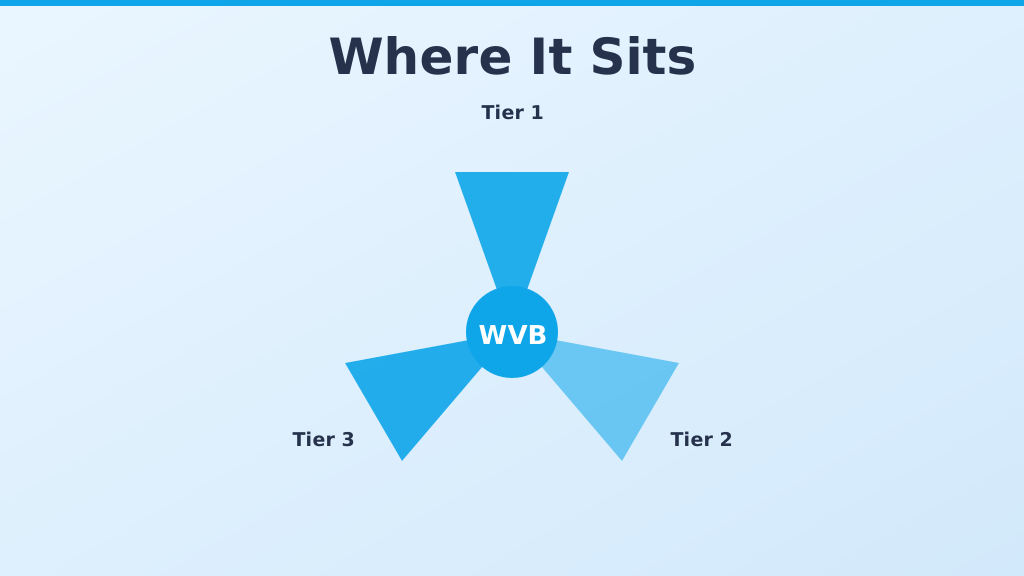
Where Wholesale Voice Sits in the Telecom Stack
The global telecom industry operates in layers. At the top are tier-1 carriers — companies like AT&T, Deutsche Telekom, and BT — that own physical network infrastructure spanning continents and oceans. Below them are tier-2 carriers that buy capacity from tier-1 networks and resell it. Wholesale Voice businesses typically operate at the tier-2 and tier-3 levels, aggregating routes from multiple sources and providing competitive access to smaller operators who lack the volume to negotiate directly with tier-1 carriers.
How the Wholesale Voice Business Model Works
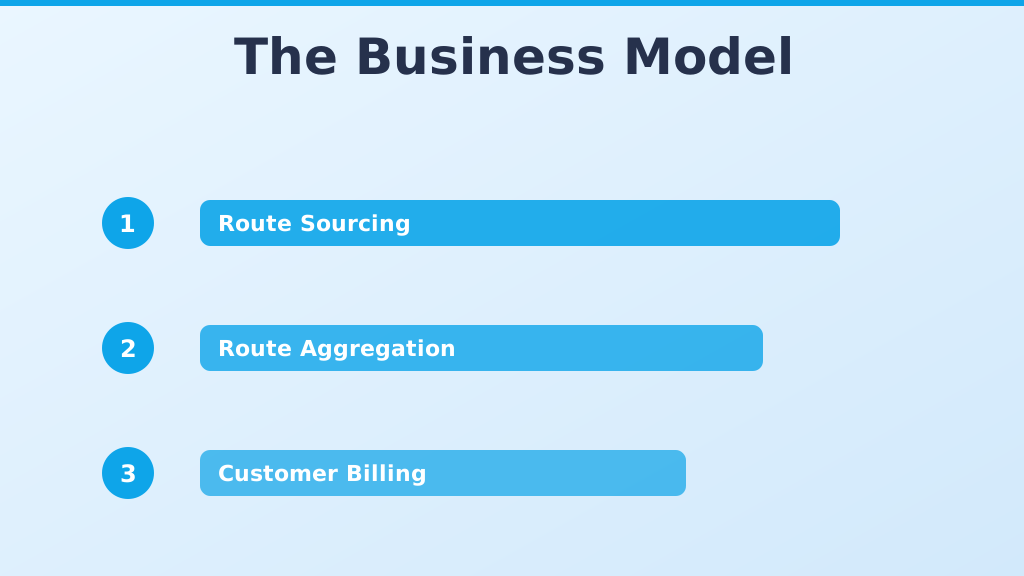
The Wholesale Voice business model has three fundamental components: route sourcing, route aggregation, and customer billing.
Route Sourcing
Wholesale Voice companies negotiate interconnection agreements with multiple carriers in each target country or region. These agreements specify the per-minute rate, quality parameters (such as answer-seizure ratio and post-dial delay), and traffic volume commitments. Having multiple route options for each destination is essential — it provides both redundancy and competitive leverage to offer the best combination of price and quality.
Route Aggregation and Management
A Wholesale Voice platform, typically a Class 4 softswitch, manages hundreds or thousands of routes simultaneously. It applies routing logic — least-cost routing (LCR) sends each call to the cheapest available route that meets quality thresholds — and monitors quality metrics in real time to detect degraded routes and fail over to alternatives automatically.
Customer Billing
Customers are billed on a per-minute basis, typically in six-second or one-second increments. Billing systems track call detail records (CDRs) for every call, calculate charges, and generate invoices. Margins in Wholesale Voice are often measured in fractions of a cent per minute, so accurate billing is critical.
Key Revenue Drivers
- Call volume — higher volumes reduce per-unit costs and improve margins.
- Route quality — premium routes command higher resale prices from carriers that need guaranteed quality.
- Geographic coverage — broader destination coverage attracts customers with international traffic.
- Pricing competitiveness — thin margins require operational efficiency and scale to remain profitable.
Typical Wholesale Voice Rates and Margins
Rates vary enormously by destination and traffic quality, but these ranges reflect what operators typically see in the market for termination:
| Traffic Type | Typical Rate Range | Typical Margin |
|---|---|---|
| Tier-1 destinations (US, Canada, Western Europe) | $0.002–$0.006/min | $0.0005–$0.002/min |
| Tier-2/3 destinations (Latin America, Africa mobile) | $0.01–$0.08/min | $0.002–$0.01/min |
| Premium verified-CLI routes | $0.02–$0.15/min | $0.005–$0.03/min |
| Bulk grey-market routes | $0.001–$0.01/min | $0.0002–$0.001/min |
These figures are illustrative — actual rates shift constantly with carrier capacity, regulatory changes, and currency movements, and any serious cost model should be built from live rate decks rather than published averages.
Get Wholesale Voice termination with transparent wholesale pricing.
Where to Source Routes: Marketplaces and Wholesale Carriers
New entrants rarely negotiate directly with tier-1 networks on day one. These are the common starting points for sourcing routes:
| Provider | Type | What It's For |
|---|---|---|
| BICS | Global wholesale carrier | International voice, messaging, and IPX interconnect |
| Tata Communications | Tier-1 wholesale carrier | Global voice termination with extensive route coverage |
| IDT Express | Wholesale VoIP carrier | Self-service route access for smaller operators, no minimum commitments |
| Deutsche Telekom Global Carrier | Tier-1 wholesale carrier | Premium European and global termination routes |
| iBasis | Global wholesale carrier | Voice and A2P messaging termination across 220+ countries |
Most new operators start with self-service platforms like IDT Express to build volume and a billing track record before qualifying for direct tier-1 interconnects with better rates.
What You Need to Start a Wholesale Voice Business
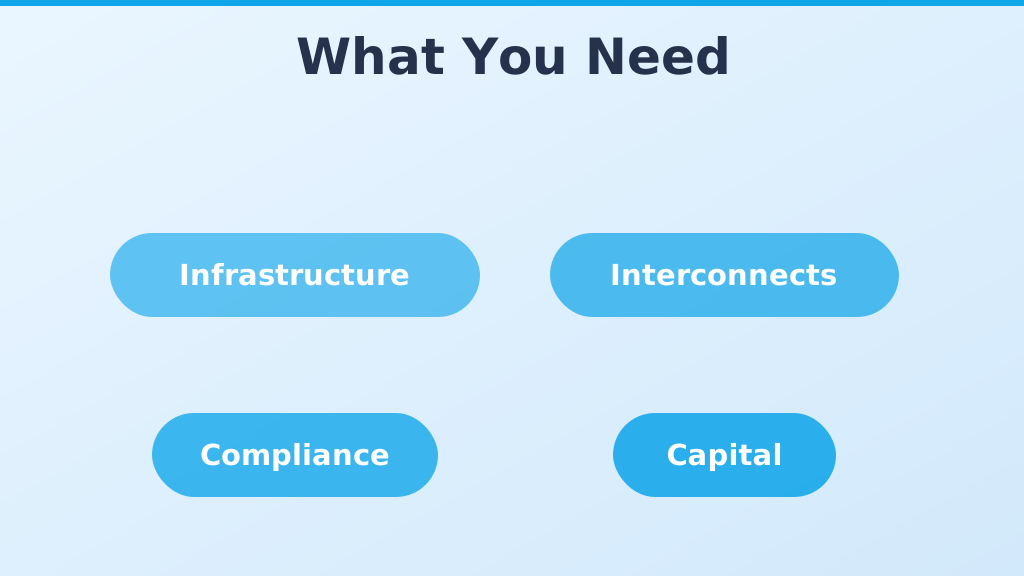
Starting a Wholesale Voice business requires technical infrastructure, carrier relationships, and capital. Here is a realistic breakdown of the requirements.
Technical Infrastructure
The core technical requirement is a softswitch — software that performs call routing, protocol conversion, and billing functions. Class 4 softswitches like PortaBilling, VOS3000, and Asterisk-based platforms are common choices. The softswitch must be hosted on reliable servers with low-latency internet connectivity, typically in a data center close to the carrier networks you are interconnecting with.
Carrier Interconnections
You need interconnection agreements with at least two or three carriers for each destination you plan to serve. Initial negotiations are challenging for a new entrant because carriers prefer to work with established players who can demonstrate traffic volume. Starting with a few high-volume destinations and building a track record before expanding is a practical approach.
Regulatory Compliance
Wholesale Voice businesses are regulated in most jurisdictions. In the United States, operating as an interexchange carrier requires FCC registration. In the European Union, national telecoms regulators impose their own licensing requirements. Compliance with anti-fraud frameworks — particularly STIR/SHAKEN for call authentication — is also required in many markets.
Capital Requirements
The initial capital requirements for a Wholesale Voice business include server infrastructure and hosting ($5,000 to $50,000 depending on scale), softswitch licensing ($10,000 to $100,000+ for commercial platforms or custom development costs for open-source), carrier deposits (many carriers require prepayment or credit deposits), and working capital for the payment cycle gap between customer billing and carrier payment.
Challenges in the Wholesale Voice Business
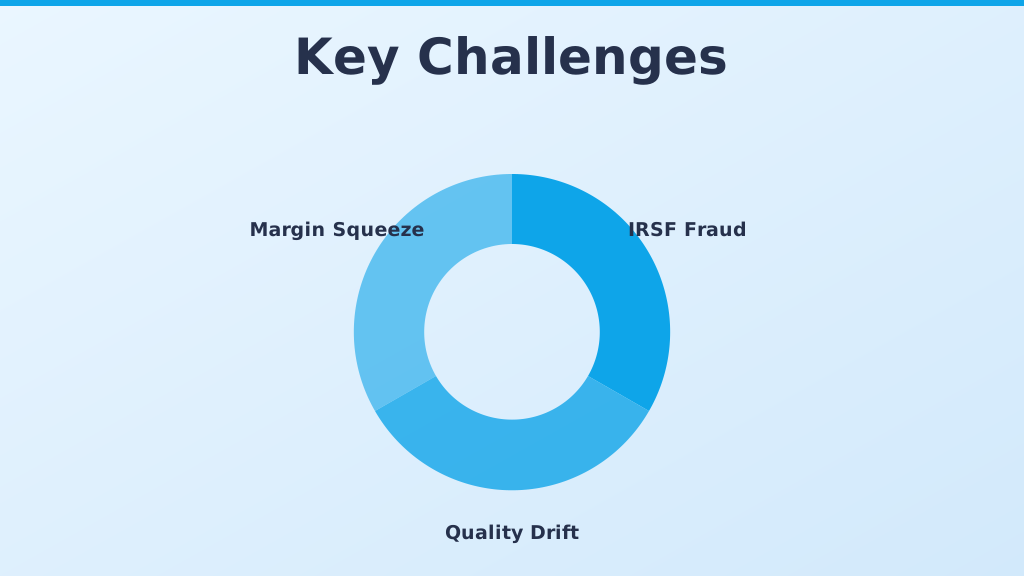
The Wholesale Voice industry is competitive and operationally demanding. Understanding the key challenges before entering the market helps you plan for them.
Fraud
International Revenue Share Fraud (IRSF) and traffic pumping are endemic to the Wholesale Voice industry. Fraudulent actors exploit open systems to route large volumes of traffic to premium rate numbers, leaving the transit carrier with an enormous bill. Robust fraud detection and rate limiting are non-negotiable for any Wholesale Voice operation.
Route Quality Management
Route quality degrades over time as carrier networks change. A route that delivered excellent answer-seizure ratios and clear audio three months ago may have deteriorated. Continuous monitoring of quality metrics and active management of the route table is an ongoing operational requirement.
Margin Compression
Per-minute rates in Wholesale Voice have declined consistently for two decades. Businesses that do not continuously work to reduce their cost per minute — through better carrier negotiations, higher volumes, and more efficient routing — find their margins eroded by the market.
Choosing a Market Niche Before You Launch
New entrants that try to be everything to everyone rarely survive the thin margins of the wholesale market. Established operators almost always started with a defensible niche — a segment where they could offer genuinely better routes, service, or terms than incumbents.
- Regional specialist — deep, high-quality routes into one country or region where you have local carrier relationships or language advantages.
- Destination-type specialist — focus on mobile termination, toll-free origination, or another traffic type with distinct routing economics.
- Customer-segment specialist — serve a specific downstream market such as call centers, calling-card operators, or emerging UCaaS platforms with tailored terms.
- Quality-tier specialist — offer premium direct routes with verified caller ID for customers who cannot tolerate grey-route risk.
A clear niche also simplifies carrier negotiations: it is far easier to build credible volume on a handful of destinations than across an entire A-Z rate deck. For more, see answer-seizure ratio.
Finding and Winning Your First Customers
Route supply means nothing without traffic to fill it. Early customer acquisition in this industry runs on credibility — downstream buyers are trusting a new operator with live production traffic, so proof matters more than promises.
The most productive early channels are industry communities and events where operators trade routes, direct outreach to small VoIP resellers and calling platforms who are underserved by large carriers, and partnerships with softswitch or billing vendors whose customers need route suppliers. Offering free test traffic windows lets prospects measure your quality themselves — measured ASR and audio quality on a prospect's own destinations is the strongest sales argument available.
Start with modest commitments and impeccable billing accuracy. In a market where disputes are common, an operator whose invoices always match the customer's own call records builds a reputation that spreads quickly through a tightly networked industry.
Operational Metrics Every Operator Should Track
Because margins are measured in fractions of a cent, wholesale operators live and die by their dashboards. A small set of metrics, reviewed daily, exposes almost every emerging problem.
- Margin per destination — revenue minus carrier cost for each route; destinations can silently flip negative when an upstream rate changes.
- ASR and ACD per route — falling answer rates or shortening call durations flag quality degradation before customers complain.
- Traffic concentration — the share of volume coming from your largest customer; heavy concentration is a survival risk if that customer leaves.
- Dispute rate — the portion of invoices challenged by customers; a rising trend points to CDR or rating problems.
- Days sales outstanding — how quickly customers pay versus how quickly carriers must be paid; the gap defines your working capital need.
Automating alerts on these numbers turns operational management from firefighting into routine maintenance.
Building the Team: Roles That Matter Most
A wholesale operation can start lean, but certain functions cannot be skipped — they can only be combined into fewer people at the beginning and separated as volume grows.
The core roles are a NOC or operations engineer who watches routes and handles carrier escalations around the clock, a carrier relations manager who negotiates rates and sources new routes, a billing analyst who owns CDR reconciliation and dispute handling, and a commercial lead who manages customer accounts and pipeline. Fraud monitoring deserves a named owner from day one, even if it is a shared duty, because response speed determines the size of any loss.
Founders commonly cover several of these roles themselves at launch. The important discipline is documenting procedures as they are created, so each role can be handed off cleanly when the traffic justifies a dedicated hire.
Scaling From Startup to Established Operator
Growth in this industry follows a recognisable path: prove quality on a few routes, expand destination coverage, then climb the carrier hierarchy as volume gives you negotiating leverage. Each stage has its own priorities.
- 1Consolidation stage — stabilise your initial niche, eliminate loss-making destinations, and build twelve months of clean billing history.
- 2Expansion stage — add adjacent destinations and a second customer segment; upgrade switching capacity and redundancy ahead of demand.
- 3Leverage stage — use demonstrated volume to renegotiate upstream rates, secure direct interconnects on top routes, and reduce dependence on intermediaries.
- 4Diversification stage — layer complementary services such as DID supply, SMS capacity, or managed SIP trunking to deepen customer relationships.
Operators that scale successfully treat infrastructure and compliance as investments to make slightly ahead of need — retrofitting either under pressure is far more expensive than building it early.
Conclusion
A Wholesale Voice business operates in a demanding but viable segment of the global telecom industry. Success requires technical competence, strong carrier relationships, disciplined cost management, and robust fraud prevention.
For operators who build the right infrastructure and carrier relationships, Wholesale Voice provides a scalable revenue model with global reach. The key is entering with realistic expectations about margin levels and the operational discipline required to manage a high-volume, low-margin business effectively.
Ready to get started with Wholesale Voice business?
Join thousands of businesses using MeraTalk for Wholesale Voice, VoIP, and phone number services.
Contact MeraTalk Today