

Introduction
Global VoIP traffic now exceeds 1 trillion minutes annually — and the businesses growing fastest are the ones buying voice capacity in bulk, not paying retail per-line rates. If your organization is still managing high call volumes on traditional telecom contracts, you are very likely overpaying for every minute.
Wholesale voice services allow businesses to purchase large volumes of voice minutes at deeply discounted rates by routing calls over IP networks through a provider’s infrastructure. Providers sell bulk telephony capacity to resellers, enterprises, and call centers, who then use or resell those services at competitive margins. The result is lower communication costs, better global reach, and the ability to scale without rebuilding your infrastructure.
This guide covers everything your business needs to know: how wholesale voice works, which organizations benefit most, the main service types available, and the key factors that separate a strong provider from a costly mistake.
Key Takeaways:
- Wholesale voice services deliver bulk communication capacity at reduced per-minute rates — ideal for resellers, enterprises, and call centers running high call volumes.
- The best providers combine specific, verifiable guarantees — such as 99.99% uptime SLAs, FCC licensing, and 100+ global routes — with scalable infrastructure your business can grow into.
- Choosing the right provider means evaluating network coverage, compliance standing (including STIR/SHAKEN and FCC registration), pricing transparency, and the quality of technical support — not just the headline rate per minute.
What Are Wholesale Voice Services?

Wholesale voice services are specialized communication solutions that allow businesses to purchase large volumes of voice minutes at discounted rates. Providers route calls across multiple carrier networks using VoIP technology, delivering cost-effective and high-quality connections for both domestic and international traffic — including international toll-free services that have become a baseline expectation in today’s market.
At their core, these services involve one company supplying bulk voice communication capacity to other businesses. Those businesses then use the capacity for their own operations, or resell it to customers under their own brand. The model works because high-volume purchasing unlocks rates that individual businesses simply cannot negotiate on their own.
What separates a good wholesale voice arrangement from a bad one comes down to three things: the quality of the underlying network, the reliability of call routing, and the compliance posture of the provider. With STIR/SHAKEN enforcement tightening and the FCC’s Robocall Mitigation Database requirements now actively enforced, partnering with a non-compliant carrier creates real risks — including calls being blocked before they ever reach your customers.
Businesses that get this right benefit from a communication infrastructure they control and scale on their terms, without the capital costs of building and maintaining their own carrier network.
How Do Wholesale Voice Services Work?
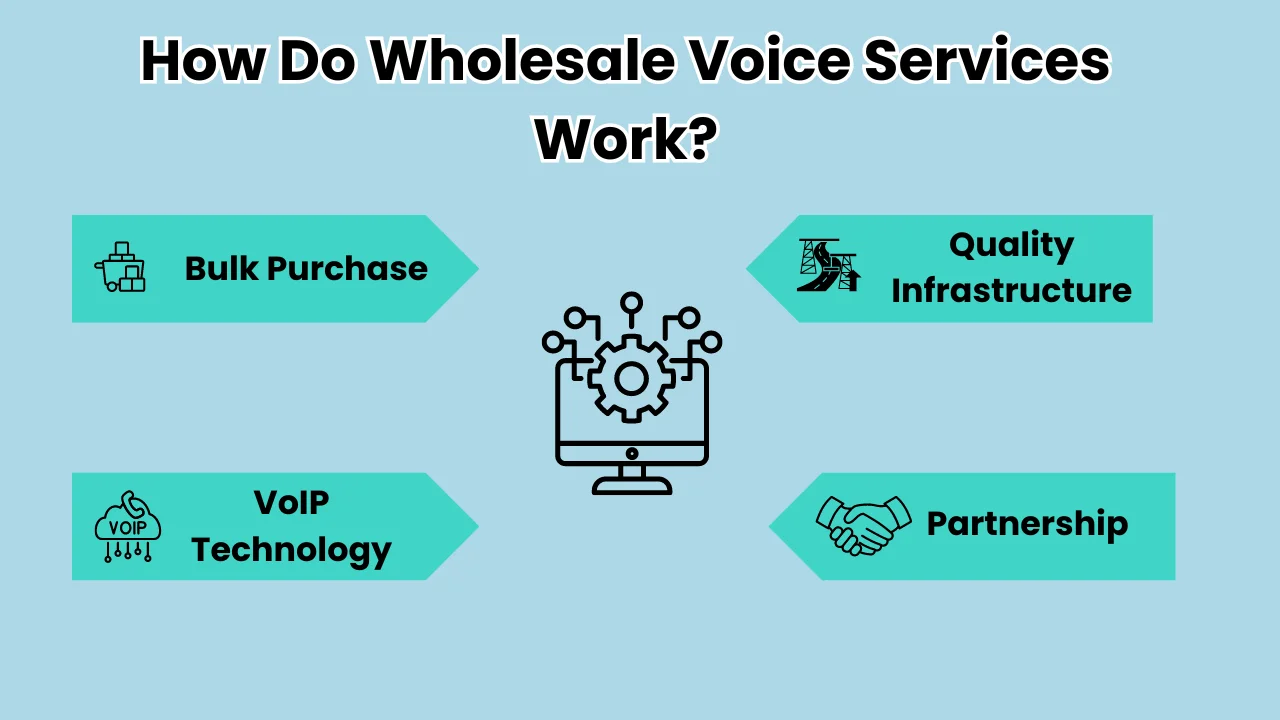
Wholesale voice services operate by connecting businesses to large blocks of carrier-grade telephony capacity through IP-based networks. The wholesale provider acquires that capacity directly from network operators, then makes it available to customers through SIP trunking, VoIP termination, or DID origination — depending on what the business needs.
Here is what the process looks like in practice. A reseller or enterprise signs an agreement with a wholesale provider and connects their PBX or softswitch via SIP. Calls are then routed intelligently across the provider’s network — prioritizing quality routes, minimizing latency, and failing over automatically if a route degrades. The provider manages all the underlying infrastructure: network connections, routing logic, numbering, and billing.
The business on the other end gets access to a suite of management tools — call routing controls, DID number management, real-time reporting, and usage analytics — without needing a team of network engineers to keep everything running.
One important operational reality: the quality of this experience depends heavily on which routes the provider uses. CLI (Calling Line Identification) routes that pair with STIR/SHAKEN-authenticated caller ID deliver measurably better answer rates than unauthenticated non-CLI routes. This distinction matters more than ever post the FCC’s June 2025 STIR/SHAKEN rule update, which requires all obligated providers to use their own certificates directly — closing a loophole that some providers had been using to appear compliant without full implementation.
Who Can Benefit from Wholesale Voice Services?
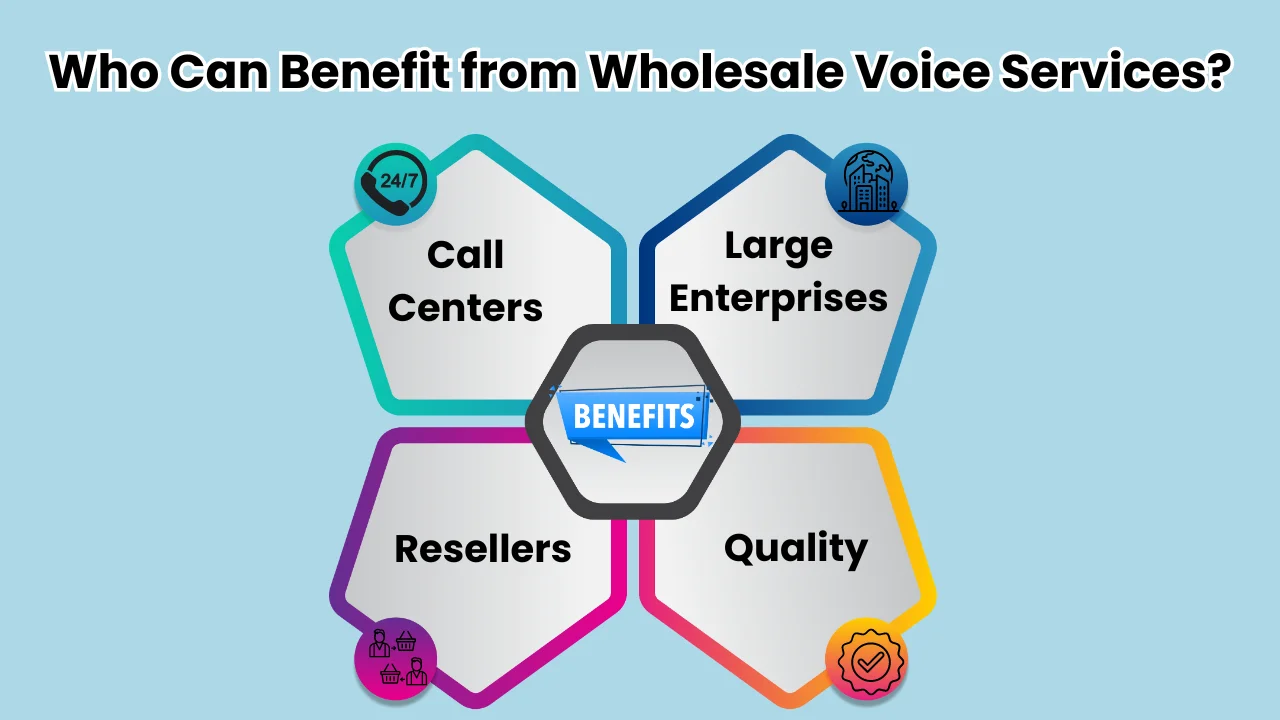
Wholesale voice services deliver the most value to organizations with high call volumes, complex routing needs, or a business model built on reselling communication services. Three segments consistently see the strongest return.
Resellers
Resellers are the backbone of the wholesale voice market. They purchase bulk capacity at discounted rates, then package and sell those services to their own customers — often with custom branding, localized numbers, and white-label billing.
The economics work because resellers can offer their customers competitive per-minute pricing while maintaining healthy margins. The key to making this sustainable is a wholesale provider that combines transparent pricing with genuine reliability. A reseller’s reputation is only as strong as the network underneath it.
What smart resellers evaluate beyond the rate card:
- Whether the provider is registered in the FCC’s Robocall Mitigation Database — non-registered carriers risk having their traffic blocked by upstream carriers, which means your customers’ calls don’t connect.
- The provider’s support structure — when a call routing issue emerges at 2 a.m., you need a live engineer available, not a ticketing system.
- Flexibility to scale capacity up or down without penalty, so resellers can respond to customer growth without over-committing.
Large Enterprises
Large enterprises use wholesale voice services to support communication across multiple locations, regions, and time zones — at a fraction of the cost of managing separate telecom contracts in each market.
A multinational company connecting offices across North America, Europe, and Asia-Pacific through a single wholesale voice provider can eliminate the complexity of managing dozens of local carrier relationships. It can also standardize call quality, centralize reporting, and build in redundancy that individual market contracts rarely offer.
The practical impact is significant:
- Connecting remote teams and international offices over a unified, managed network — rather than stitching together local PSTN contracts.
- Reducing international calling costs, often by 30–50% compared to traditional telecom arrangements.
- Scaling communication capacity to new markets without the lead time of traditional carrier provisioning.
Call Centers
Call centers live or die on call volume and connection quality. A dropped call, a degraded voice path, or a blocked number can erase hours of agent productivity. Wholesale voice services give call centers the infrastructure to run thousands of concurrent calls reliably, with the routing intelligence to optimize agent performance.
The challenges call centers face are specific: high peak-hour traffic demands, strict latency requirements, and the need for carrier-grade reliability during campaigns. Wholesale voice addresses these through:
- Dynamic call routing that distributes load across multiple routes, avoiding congestion during peak hours.
- Real-time monitoring tools that surface quality issues before they affect agents or customers.
- Support for predictive dialing and outbound campaign management at scale.
What Are the Advantages of Wholesale Voice Services?
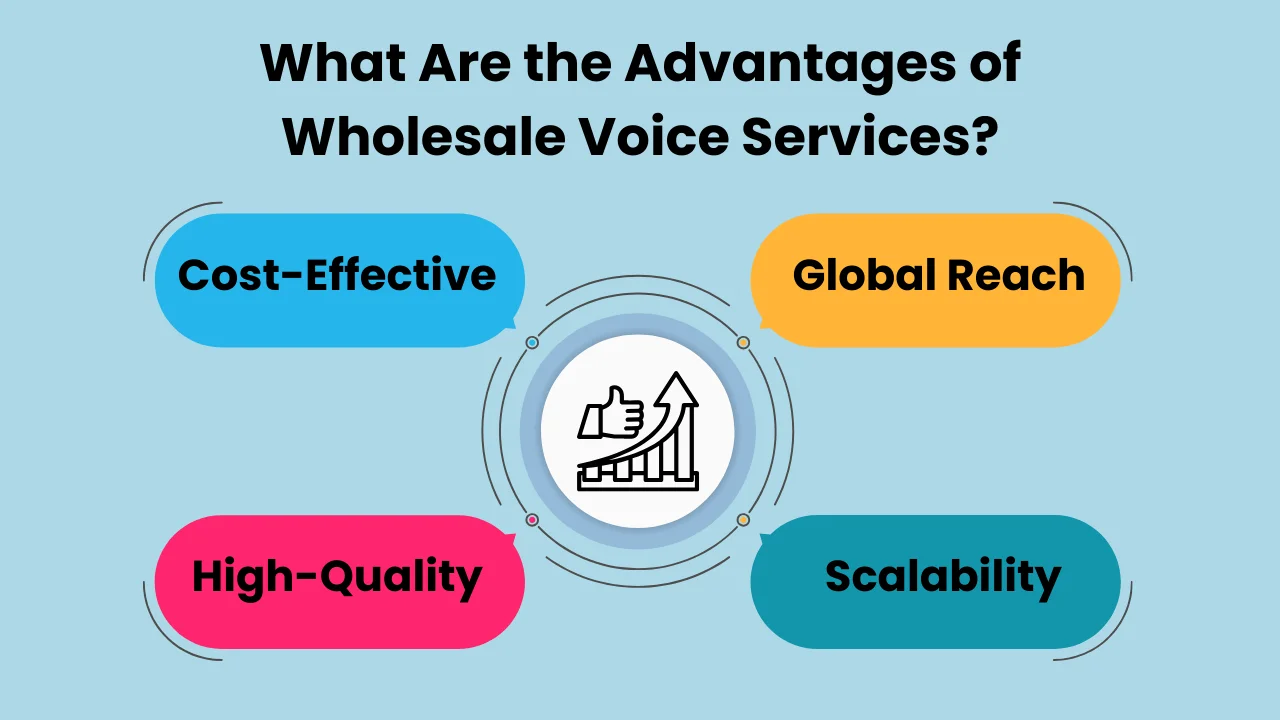
The case for wholesale voice is straightforward when you look at what it actually delivers versus what traditional telecom contracts provide. Four advantages stand out.
Cost-Effective Communication
The most immediate advantage is price. Wholesale voice providers acquire carrier capacity at volume, which means they can offer per-minute rates that retail telecom simply cannot match. Businesses running substantial call volumes — whether inbound support, outbound sales, or international communications — typically see savings of 30–50% compared to conventional service agreements.
The cost structure is also more transparent. Wholesale pricing models are usually consumption-based, so you pay for what you use rather than maintaining fixed line contracts that sit idle during low-traffic periods. For businesses with seasonal demand spikes, this flexibility alone can justify the switch.
One important caveat: always calculate total cost of ownership. The lowest per-minute rate does not automatically mean the best value. Factor in setup fees, minimum commitments, support costs, and the real cost of poor call quality — dropped calls and low answer rates have a direct revenue impact that a cheap rate card cannot offset.
High-Quality Voice Calls
High call quality in wholesale voice is not a given — it is an outcome of the routes a provider uses and the infrastructure they maintain. The best providers deliver HD voice with less than 1% packet loss and sub-150ms latency on their core routes. That level of performance requires active route monitoring, not just passive provisioning.
Key technologies that drive voice quality include SIP trunking for IP-based call delivery, and intelligent call termination methods such as:
- Load balancing across redundant routes to prevent congestion-related quality drops.
- Enhanced error correction at the codec level, reducing the impact of packet loss on perceived call quality.
- Prioritized bandwidth allocation so voice traffic is never competing with lower-priority data flows.
The practical impact is cleaner conversations, fewer callbacks, and customer interactions that don’t start with “Sorry, can you repeat that?”
Global Reach
Wholesale voice providers maintain interconnections with carriers across multiple continents. That global footprint means businesses can route calls to virtually any destination without managing local carrier relationships in each country.
For businesses expanding into new markets, this removes a significant operational barrier. Instead of negotiating local termination agreements before launching in a new region, you inherit your provider’s existing network coverage. This enables:
- Lower international calling rates — often 40–70% cheaper than retail long-distance.
- Local DID numbers in foreign markets, giving customers a familiar, local number to call without requiring a physical presence in that country.
- Consistent call quality across regions, backed by SLA commitments rather than best-effort routing.
Scalability
Traditional telecom provisioning is slow. Ordering new lines, waiting for circuit installation, managing capacity limits — these create friction that wholesale voice eliminates. With a good provider, adding capacity is a configuration change, not a procurement event.
This matters most during growth phases or seasonal demand peaks. A retail business running holiday campaigns, a call center staffing up for a product launch, or a reseller onboarding a large new customer — all of them need to scale fast. Wholesale voice supports that by:
- Allowing rapid capacity increases without infrastructure changes on the provider’s side.
- Enabling scale-down during quiet periods, so you are not paying for idle capacity.
- Offering pricing models that flex with actual usage, rather than locking you into fixed commitments.
What Are the Different Types of Wholesale Voice Services?
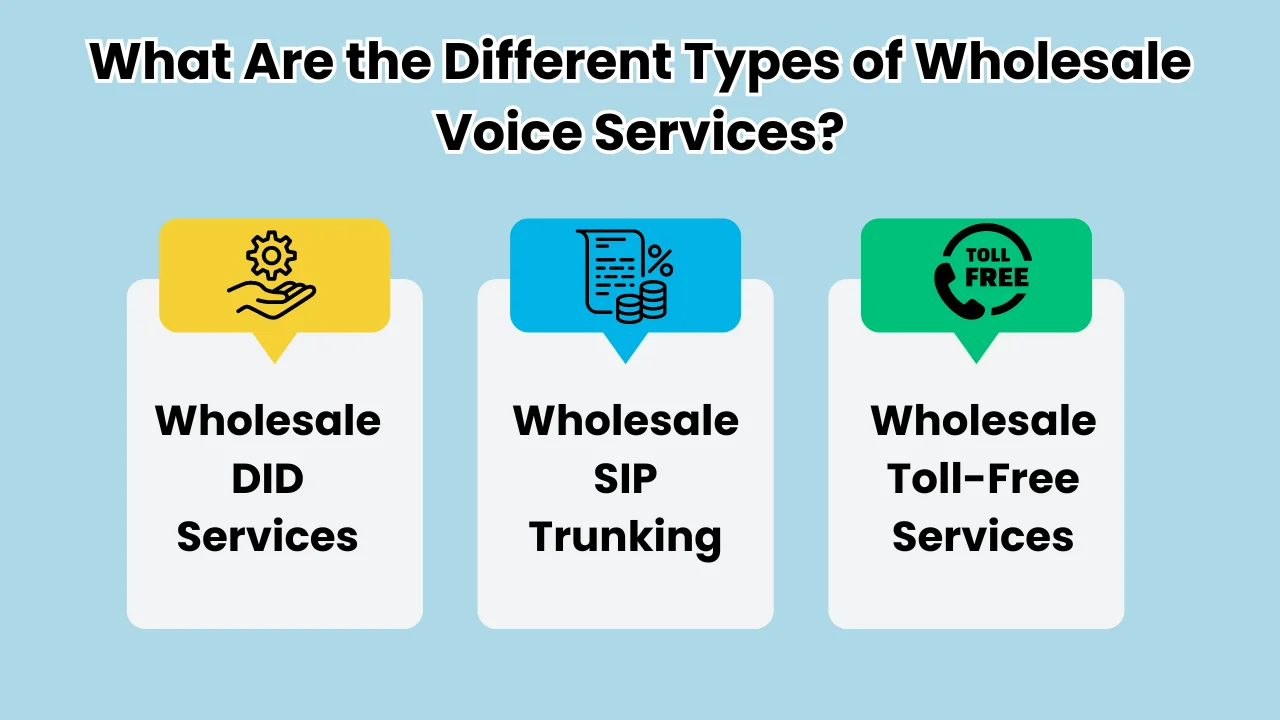
Not all wholesale voice services are the same. The three core categories serve distinct use cases, and most businesses will use more than one.
Wholesale DID Services
Wholesale DID (Direct Inward Dialing) services allow businesses to assign individual phone numbers that route directly to specific extensions, departments, or agents — without requiring a separate physical line for each number.
For resellers, DIDs are the foundation of local number provisioning. Offering customers a local number in their target city or country — even when the business operates from a single location — builds trust and increases answer rates. The operational benefits extend further:
- Cost efficiency — calls route over IP, eliminating per-line PSTN charges for inbound traffic.
- Scalability — adding new DIDs is a software operation, not a hardware installation.
- Flexible routing — assign different numbers to different teams, track campaign performance, or reroute numbers instantly without a carrier ticket.
- Better customer experience — local numbers generate higher inbound response rates than unfamiliar toll or geographic codes.
Wholesale SIP Trunking
Wholesale SIP trunking connects a business’s existing PBX or UC platform directly to the PSTN via IP — replacing physical phone lines with a managed IP connection. It is the engine behind most modern business telephony deployments.
The advantage over traditional ISDN or PRI connections is both economic and operational. SIP trunks eliminate the cost of physical circuits and allow businesses to dynamically adjust the number of concurrent call channels based on actual demand. For multi-site enterprises, a single SIP trunk agreement can replace dozens of local PSTN connections. Key benefits include:
- Lower long-distance costs, as calls route over IP rather than the traditional PSTN for the bulk of their journey.
- Flexible channel scaling — add or remove concurrent call capacity without hardware changes.
- Access to advanced call features: forwarding, voicemail-to-email, conferencing, and analytics built into the trunk configuration.
One compliance consideration worth noting: SIP trunking deployments in the US need to account for Kari’s Law and Ray Baum’s Act requirements for emergency services routing — a detail that matters especially for multi-location enterprise deployments.
Wholesale Toll-Free Services
Wholesale toll-free services allow businesses to offer customers a no-cost inbound calling option — absorbing the call charges themselves in exchange for greater accessibility and higher inbound contact rates.
For customer-facing operations, toll-free numbers remain a trust signal. They communicate permanence and professionalism. At the wholesale level, businesses acquire toll-free capacity at bulk rates and either use it directly or resell it as part of a broader service package.
- Enhanced accessibility — removing the cost barrier means more customers reach out when they need to.
- Brand trust — toll-free numbers signal an established, customer-first operation.
- Marketing integration — unique toll-free numbers per campaign enable precise attribution and ROI tracking.
How to Choose the Right Wholesale Voice Services Provider?
Choosing the wrong wholesale voice provider is an expensive mistake. Poor call quality, surprise fees, compliance gaps, and inadequate support all have direct business consequences. Here is what to evaluate seriously before committing.
Network Coverage and Quality
Network quality is the foundation of everything else. A provider quoting low rates on poor routes will cost you more in lost calls and customer complaints than you save on per-minute fees.
Evaluate three things specifically:
- Geographic coverage — does the provider have direct interconnections in the markets you operate in, or are they routing through intermediaries that add latency and reduce quality?
- Route type — CLI routes with STIR/SHAKEN authentication consistently deliver better answer rates and regulatory compliance than unauthenticated alternatives. Ask providers explicitly what percentage of their traffic runs on authenticated CLI routes.
- Uptime SLA — look for providers committing to a specific number, like a 99.99% uptime SLA, not a vague promise of “high reliability.” The difference between 99.9% and 99.99% uptime is 8+ hours of potential downtime per year versus under 1 hour.
Competitive Pricing
Pricing in wholesale voice is rarely as simple as the advertised per-minute rate. Before committing, build a full cost picture that includes:
- Whether the advertised rate applies to the routes and destinations you actually need, or just a subset of low-traffic corridors.
- Minimum monthly commitments and how they compare to your realistic usage volume.
- Setup and porting fees for DIDs and trunk configuration.
- Early termination penalties if you need to adjust or exit the agreement.
Providers worth working with will show you a transparent rate deck upfront — not a “contact us for pricing” that only reveals the full picture during contract negotiations.
Customer Support and Service Level Agreements
When call routing fails, you need help immediately — not a 48-hour ticket response time. The quality of technical support is one of the most important and least-evaluated criteria in provider selection.
Look specifically for:
- 24/7 NOC (Network Operations Center) access with live engineers who can diagnose and resolve routing issues in real time, not just a help desk that escalates to someone who escalates to someone else.
- Clearly defined SLA response times for different severity levels — a P1 outage affecting all traffic should have a response commitment measured in minutes, not hours.
- Proactive monitoring — the best providers alert you to degradation before you notice it in call quality complaints.
Providers like MeraTalk combine a 99.99% uptime SLA with 24/7 NOC support backed by live engineers — a combination that matters most when something goes wrong at the worst possible time. Their dual FCC 214 and 499 licensing and Robocall Mitigation Database registration also ensure that traffic routes cleanly in the US market without blocking risk.
Flexibility and Scalability
Your communication needs will change. A provider locked into rigid capacity tiers will become a constraint as your business grows. Evaluate whether a provider can:
- Scale capacity up rapidly in response to demand spikes — seasonal surges, campaign launches, or rapid customer growth.
- Scale down without penalty during slower periods, so you are not paying for headroom you do not need.
- Integrate with your existing PBX, softswitch, or UCaaS platform without requiring a full infrastructure overhaul.
Additional Features and Services
Beyond core voice termination, the best providers offer tools that help you manage, optimize, and grow your communications operation:
- Real-time call monitoring and quality dashboards — so you can identify degrading routes before they generate customer complaints.
- Analytics and reporting — call volume trends, answer rates, cost-per-route breakdowns, and campaign attribution data that inform business decisions.
- API and integration capabilities — the ability to connect wholesale voice services into your CRM, contact center platform, or billing system without manual data handling.
Frequently Asked Questions About Wholesale Voice Services
What are wholesale voice services and how do they differ from retail VoIP?
Wholesale voice services provide bulk voice minute capacity to businesses at reduced per-minute rates, typically through agreements that require minimum usage commitments. Retail VoIP sells individual line subscriptions directly to end users at higher per-minute or per-seat rates. The key difference is scale: wholesale buyers get carrier-grade pricing and infrastructure access that retail plans do not offer.
How much can businesses save by switching to wholesale voice?
Businesses with high call volumes — particularly international traffic — typically save 30–50% compared to traditional telecom contracts. The actual saving depends on your call mix, destinations, and current rates. Providers should offer transparent rate decks that let you model savings against your real traffic patterns before committing.
What is STIR/SHAKEN and why does it matter for wholesale voice?
STIR/SHAKEN is a framework for authenticating caller ID on VoIP calls. The FCC requires US-based voice providers to implement it. Calls that cannot be authenticated are increasingly blocked or flagged by carriers and mobile networks. Partnering with a wholesale provider that maintains full STIR/SHAKEN compliance protects your traffic from unnecessary blocking and improves answer rates on outbound calls.
What should I look for in a wholesale voice provider’s SLA?
A credible SLA specifies an exact uptime commitment — 99.99% is the standard for carrier-grade services — along with defined response times for outages by severity, remediation procedures, and credit terms if the provider misses their commitments. Vague language like “best effort” or “high availability” without a specific percentage is a red flag.
What is the difference between wholesale DID services and SIP trunking?
DID services provide individual phone numbers that route inbound calls to specific destinations, without requiring a physical line per number. SIP trunking connects your existing PBX to the PSTN via IP, handling both inbound and outbound call traffic across multiple channels. Most businesses use both together: SIP trunks carry the traffic, DIDs provide the numbers assigned to that traffic.
Do wholesale voice providers need to be FCC-licensed?
Yes. Providers carrying US traffic should hold both FCC 214 and 499 licenses, which authorize international and domestic VoIP services respectively. They must also be registered in the FCC’s Robocall Mitigation Database. Without these, traffic routed through the provider carries a risk of being blocked by downstream carriers enforcing compliance requirements.
Can a small business use wholesale voice services, or is it only for large enterprises?
Wholesale voice is most cost-effective for businesses running meaningful call volumes — typically 5,000+ minutes per month. Below that threshold, retail VoIP plans often make more sense because wholesale agreements may come with minimum commitments that don’t pencil out at low volumes. That said, resellers can give smaller businesses access to wholesale-equivalent pricing by aggregating volume across their customer base.
Conclusion
Wholesale voice services give businesses a smarter way to handle high-volume communication — lower per-minute costs, global routing, and scalable infrastructure without the overhead of building your own carrier network. The businesses that benefit most are those running real call volumes: resellers, enterprises managing multi-location operations, and call centers where every connection matters.
The provider you choose makes the difference between a cost advantage and a reliability liability. Prioritize concrete SLA commitments (99.99% uptime, not “high availability”), verified compliance credentials (FCC 214 + 499 licensing, Robocall Mitigation Database registration), and 24/7 NOC support from engineers who can act fast when routing issues arise.
MeraTalk offers wholesale voice services built on that foundation — with transparent pricing, 100+ global voice routes, dual FCC licensing, and a support structure designed for carriers and enterprises that cannot afford downtime. If you are evaluating providers, it is worth including on your shortlist.
Explore wholesale voice options at meratalk.com — or contact the team directly to get a rate deck tailored to your traffic profile.