Key Takeaways
Covers voice carrier business in depth
Covers Wholesale Voice carrier business in depth
Covers voip wholesale carrier in depth
Covers bulk voice carrier in depth
Explore MeraTalk's Wholesale Voice solutions — built for carriers, resellers, and enterprises.
Learn moreWhat Is a Wholesale Voice Carrier?
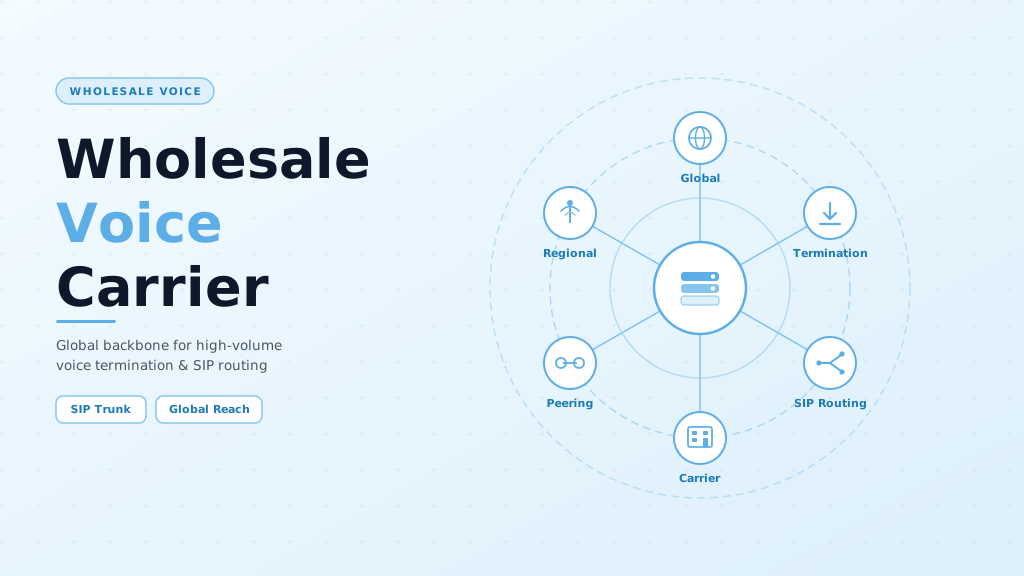
A Wholesale Voice carrier is a telecom company that buys and sells large volumes of voice traffic between networks. It does not sell phone plans to consumers or businesses. Instead, it runs the infrastructure layer that connects networks. It routes each call from the originating carrier, through a transit carrier, to the terminating carrier — until the call reaches its destination.
Every phone call you make crosses at least one wholesale carrier before it reaches the person you called. This market is the invisible engine of global telephony. It works at a scale most businesses never think about. You only need to understand it when you build communications products or run high call volumes.
Carrier Tiers Explained
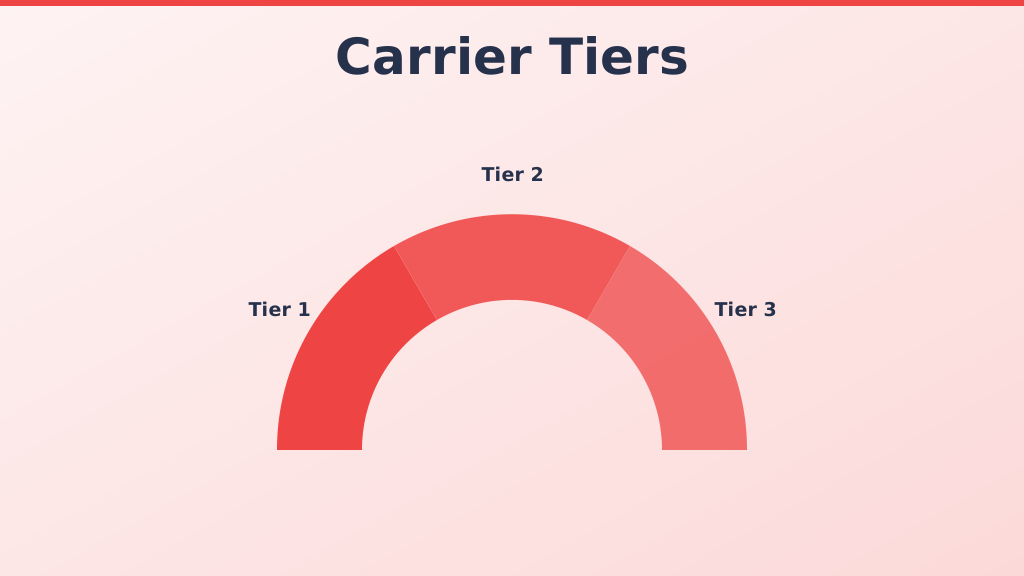
The Wholesale Voice carrier market has three tiers. Each tier reflects how much physical network a carrier owns and runs.
Tier 1 Carriers
Tier 1 carriers own the physical backbone. That means undersea cables, transcontinental fibre, and national switching facilities. Each one peers directly with every other Tier 1 carrier, at no cost between them. Examples include AT&T, Lumen Technologies (formerly CenturyLink), Tata Communications, and NTT. Tier 1 routes give the best call quality and the lowest latency. But you can only access them at high volume.
Tier 2 Carriers
Tier 2 carriers own regional infrastructure. They add reach by buying transit capacity from Tier 1 networks. Together, owned and rented routes let them reach most global destinations. Most enterprise-grade cloud phone providers work this way, MeraTalk included, with direct Tier 1 and Tier 2 relationships.
Tier 3 Carriers
Tier 3 carriers own little or no physical infrastructure. They buy wholesale capacity from Tier 1 or Tier 2 providers and resell it. Their customers are often specific regions or market segments. Tier 3 routes are common in least-cost routing. The trade-off is less consistent call quality.
Key Benefits of Wholesale Voice Services
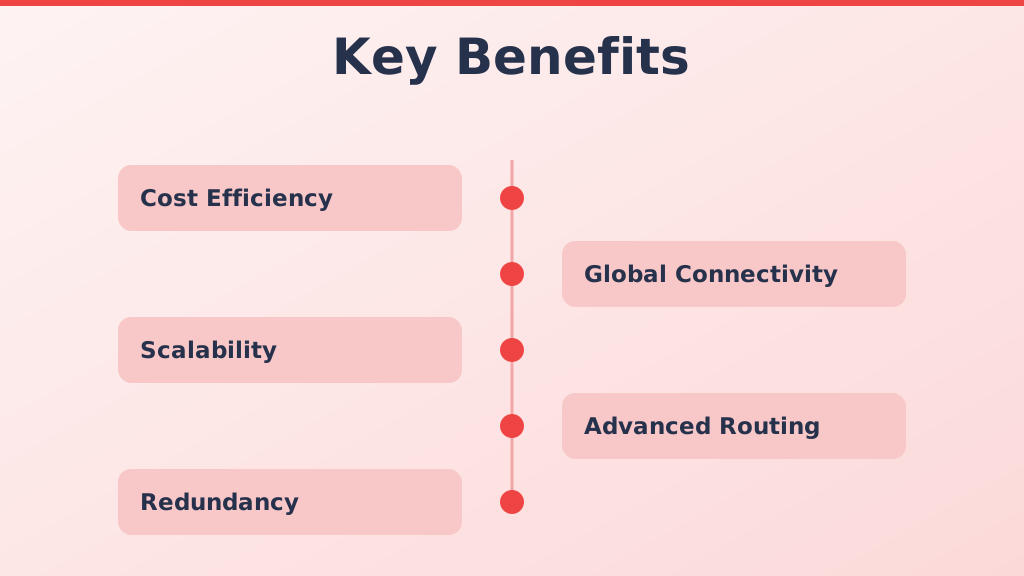
- Cost efficiency — bulk purchasing drives per-minute rates down to fractions of a cent on major routes.
- Global connectivity — single carrier relationships can provide access to destinations worldwide.
- Scalability — capacity adjusts dynamically to call volume without infrastructure investment.
- Advanced routing — carriers use least-cost routing, quality-based routing, and geographic routing to optimise calls.
- Redundancy — enterprise carriers maintain multiple redundant routes for each destination.
Get Wholesale Voice termination with transparent wholesale pricing.
How Wholesale Voice Routing Works
A call from a VoIP platform enters the carrier routing chain. First, the originating carrier receives it. Next, it passes the call to a transit carrier — usually a Tier 1 or Tier 2 network with a route to the destination. Finally, the transit carrier hands the call to the terminating carrier. That is the network where the called number lives.
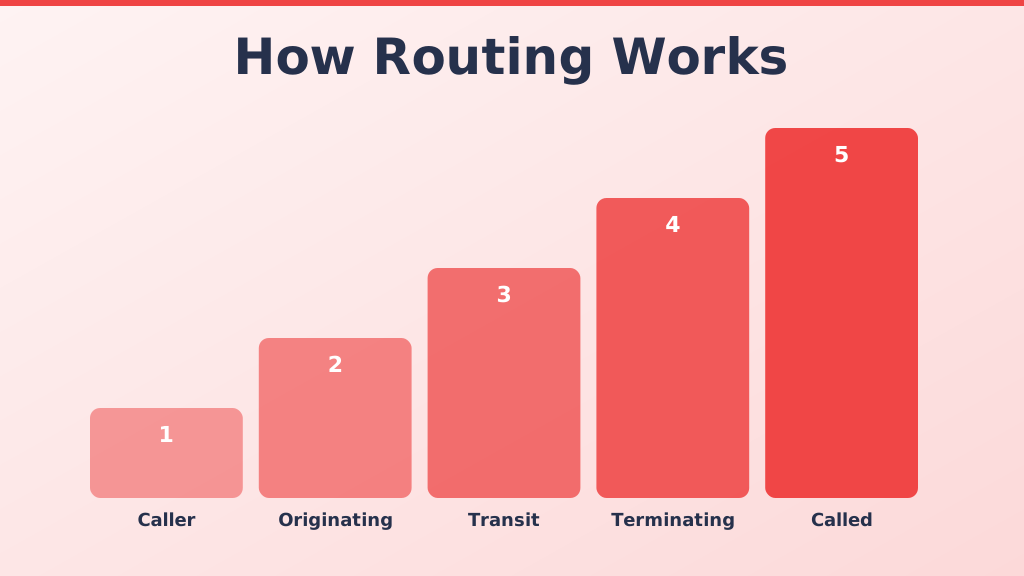
This all happens in milliseconds. Automated routing tables and least-cost routing algorithms do the work. Commercial deals between each pair of carriers set the price. The technical protocols — mainly SIP and SS7 — control how calls are signalled and connected.
SIP Trunking and Wholesale Voice
Modern Wholesale Voice runs mostly over SIP (Session Initiation Protocol) trunks. SIP trunking replaced older TDM (Time Division Multiplexing) circuits as the main way carriers connect. It is more flexible, cheaper to run, and easier to scale. Businesses reach Wholesale Voice carriers in one of two ways: directly through SIP trunking, or through a UCaaS platform that manages the SIP relationships for them.
What to Look for in a Wholesale Voice Carrier
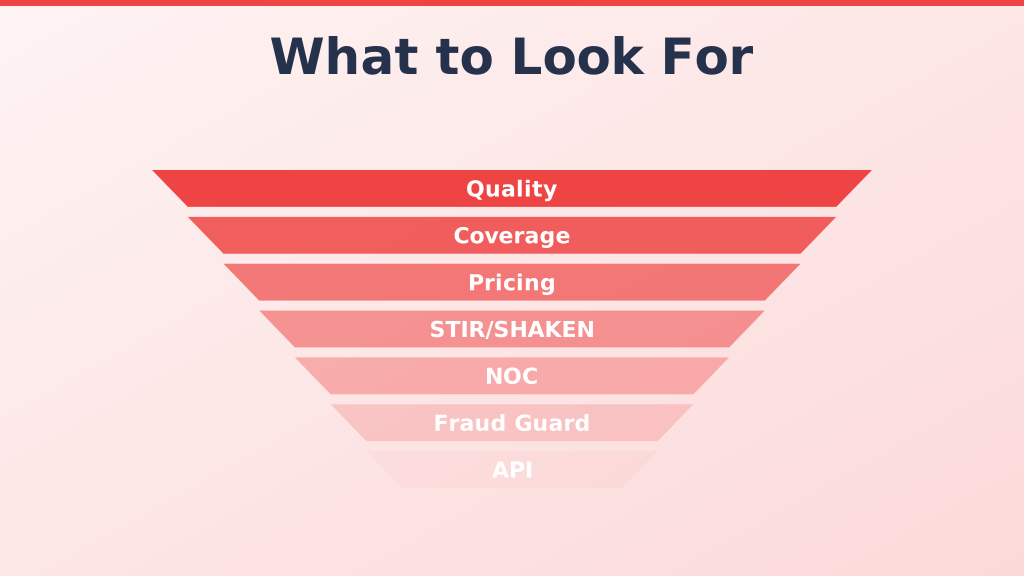
- 1Network quality — direct Tier 1 peering on your highest-traffic destinations.
- 2Destination coverage — confirmed coverage across all countries your business calls.
- 3Pricing transparency — published rate cards with clear change notification processes.
- 4STIR/SHAKEN attestation — critical for US outbound calls to maintain deliverability.
- 524/7 NOC support — enterprise-grade carriers provide round-the-clock network operations monitoring.
- 6Fraud protection — real-time anomaly detection to prevent IRSF and toll fraud.
- 7API and technical integration — modern carriers offer APIs for dynamic routing management.
Wholesale Voice at MeraTalk
MeraTalk runs on Wholesale Voice infrastructure with direct carrier relationships across several tiers. This delivers call quality on par with enterprise carrier deals, through an accessible cloud phone platform. Most businesses do not want to manage their own carrier relationships. With MeraTalk's UCaaS platform, they get wholesale-grade voice without the complexity of direct carrier contracts. For more, see SIP trunking.
Wholesale Voice Services and Solutions: What a Carrier Typically Provides
People use 'wholesale voice services' and 'wholesale voice solutions' loosely, but in practice a carrier's offer breaks into a few distinct products. Knowing which one you are buying keeps quotes comparable.
- Termination — delivering your outbound calls to numbers on other networks, priced per minute by destination. A-Z coverage means routes to virtually every destination.
- Origination — delivering inbound calls from the public network to your platform, usually through DID or toll-free numbers.
- SIP trunking or interconnect — the technical connection that carries traffic in both directions, often with a limit on concurrent calls.
- Route quality options — for example CLI and non-CLI routes, which differ in how reliably the caller's number is delivered and in price.
- Routing and rate management — least cost routing, rate decks and the controls that decide which route a call takes.
- Fraud and compliance controls — traffic monitoring, blocking of high-risk destinations and caller authentication such as STIR/SHAKEN for US traffic.
When you compare carriers, ask each one to quote the same bundle: the same destinations, route type and billing increment. A lower headline rate on a different route type is not a like-for-like comparison.
How the Wholesale Voice Carrier Market Is Structured
The wholesale voice market is a chain of carriers and resellers rather than a single marketplace. At the top are carriers that own network infrastructure, below them are regional carriers, and below those are resellers and platforms that buy capacity and sell it on. A call can pass through several of these hands between the caller and the called party, and each handoff is a wholesale commercial relationship.
For a buyer, the practical question is how many hands a route passes through. Fewer hops usually means better and more consistent quality, while a longer chain can lower the price but adds delay and more places for a call to fail. The carrier tiers described above are the quickest way to judge where a supplier sits in that chain.
Buyers fall into a few groups: resellers who resell minutes, platforms such as UCaaS and cloud contact center providers, and large enterprises or call centers with their own volume. Their priorities differ. A reseller focuses on margin and rate flexibility, while a contact center focuses on caller ID delivery and answer rates, which is why the same carrier can suit one buyer and not another.
The Interconnection Process: How Onboarding Works
Setting up a new carrier relationship follows a fairly standard sequence. Knowing the steps in advance helps businesses plan realistic timelines.
- 1Commercial agreement — both parties sign an interconnect agreement covering rates, billing increments, payment terms, and dispute procedures.
- 2Technical exchange — each side shares SIP signalling addresses, supported codecs, capacity limits, and security requirements such as IP allowlists or TLS.
- 3Test phase — a small set of test calls runs across key destinations to verify signalling compatibility, audio quality, caller ID delivery, and CDR accuracy.
- 4Limited production — an initial slice of live traffic flows while both sides compare billing records and quality metrics.
- 5Full production — traffic scales to contracted volumes once test and reconciliation results are clean.
The commercial step is usually the slowest. The technical work often takes just days once both engineering teams are involved. Businesses that prepare traffic forecasts and technical details before talks begin move through the process much faster.
How Carriers Measure Route Health
Carriers manage thousands of routes at once. To decide which routes carry traffic and which get suspended, they rely on a small set of statistical measures.
- Answer-seizure ratio (ASR) — the share of call attempts that connect; a sustained drop on one destination usually means a downstream problem.
- Average call duration (ACD) — unusually short calls across a route often indicate audio quality problems driving early hangups.
- Post-dial delay (PDD) — the wait between dialling and ringback; long delays point to overloaded transit nodes or excessive routing hops.
- Network effectiveness ratio (NER) — separates genuine network failures from calls the recipient simply declined, isolating carrier-side faults.
Automated systems watch these values around the clock. When a route breaks a threshold, they reroute traffic. For buyers, there is a simple lesson here. Ask any prospective partner which thresholds trigger automatic rerouting. The answer shows whether quality is truly engineered or merely advertised.
Switching Carriers Without Disrupting Live Traffic
Businesses outgrow carrier relationships. Rates stop being competitive, quality slips, or coverage needs change. The switch itself is risky only when you treat it as an abrupt cutover.
The safer pattern is parallel operation. Bring the new interconnect fully live while the old one still carries production traffic. Then migrate destinations in stages, starting with lower-stakes routes. Give each migrated slice a comparison window. During it, check quality metrics and billing records from the new route against the old baseline. Only after every destination passes does the old relationship wind down. Even then, many operators keep a small fallback connection through one final billing cycle.
Contract terms decide how smooth this can be. Review the notice periods, minimum commitments, and early termination clauses in the outgoing agreement first — before you write the migration plan, not after traffic has started moving.
Carriers and Number Portability
Number portability lets you keep a phone number when you change providers. It depends on infrastructure that carriers run behind the scenes. When a number is ported, ownership records move between carriers through a regulated process. Routing databases are then updated so future calls reach the new network.
This matters at the wholesale layer. Routing a call to a ported number requires a database lookup at the moment of the call. Some carriers skip these lookups or cache them poorly. They then misroute calls to the number's old network, and the failed connections look like random quality problems. Well-run carriers look up every relevant call in real time and hide this complexity from you.
For businesses, the takeaway is simple. Porting numbers between platforms is a routine, regulated process, and a good carrier partner handles the coordination. Your job is small: keep account records accurate, and do not cancel service before the port completes.
Ready to get started with Wholesale Voice carrier?
Join thousands of businesses using MeraTalk for Wholesale Voice, VoIP, and phone number services.
Contact MeraTalk Today