Introduction
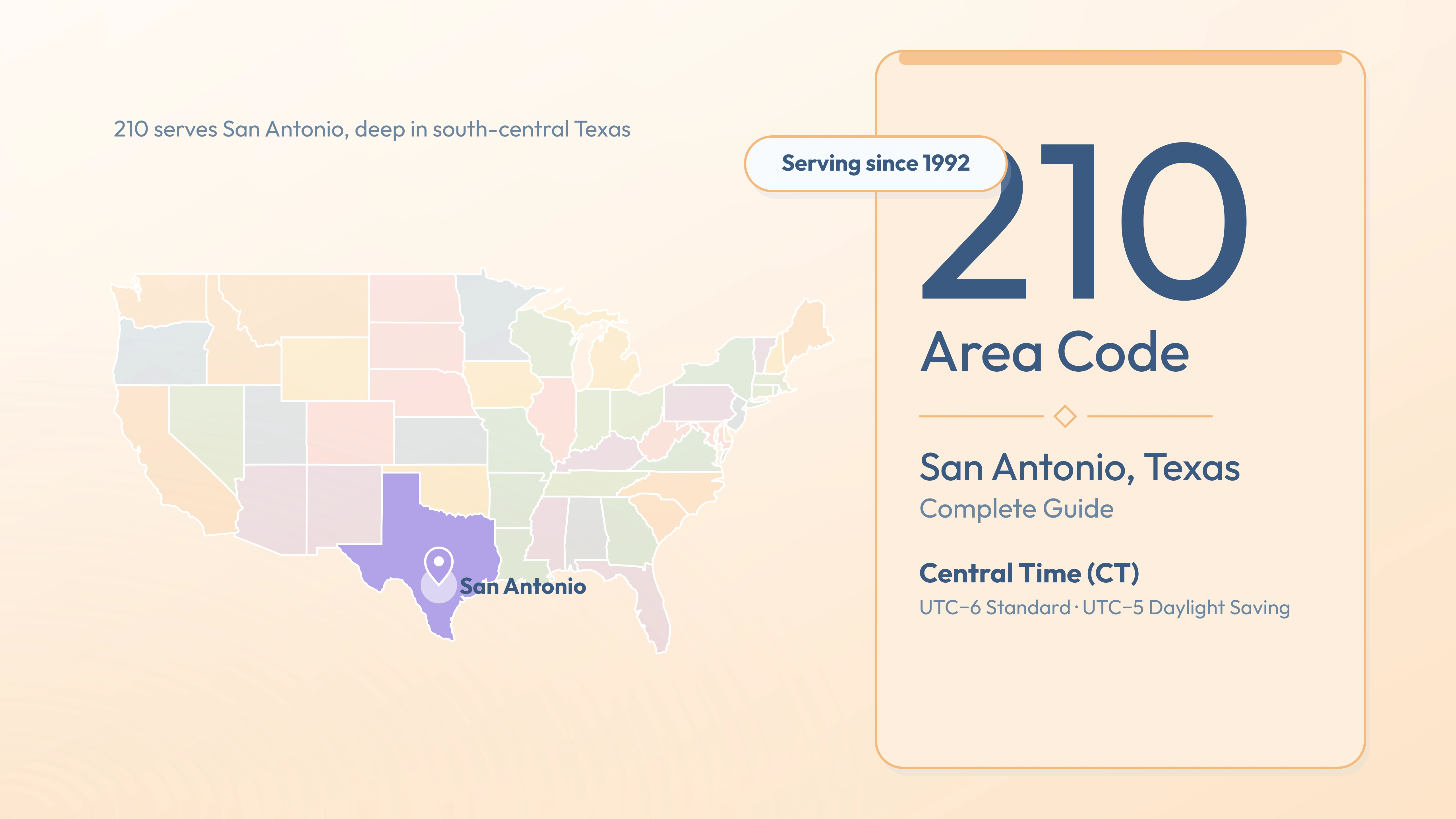
The 210 area code is the telephone code for San Antonio, Texas. It covers most of Bexar County and small portions of the neighboring Comal, Guadalupe, Medina, Atascosa, and Wilson counties, all on Central Time. The 210 prefix belongs to San Antonio the way the River Walk and the Alamo do — it is one of the few prefixes in Texas devoted almost entirely to a single city.
Introduced in 1992, when explosive growth forced the region out of its old shared code, the prefix quickly became a point of local pride, stamped on murals, team merchandise, and small-business signage across the city.
This guide lays out the full picture: what the code covers and how it came about, the districts and communities inside its footprint, how the 726 overlay changed local dialing, the neighboring codes that ring the city, the industries that drive the San Antonio economy, and the simple steps any business can follow to activate a local number.
Key Takeaways
Covers where is the 210 area code in depth
Covers 210 area code location in depth
Covers 210 vs 726 area code in depth
Covers get a 210 phone number in depth
Need a business phone number? Get a MeraTalk number in minutes, no contract required.
Get started free210 Area Code at a Glance
The 210 area code covers San Antonio, Texas, and most of Bexar County. The 726 overlay shares the same footprint.
- Location: San Antonio and most of Bexar County in south-central Texas
- State: Texas
- Main cities: San Antonio, Alamo Heights, Converse, Schertz, Cibolo, Helotes, Universal City
- Time zone: Central Time (UTC-6 standard, UTC-5 daylight saving)
- Overlay or split: 726 overlay on the identical footprint
- In service since: 1992
- Dialing: ten digits for all local calls
What Is the 210 Area Code?
The 210 prefix serves San Antonio and the surrounding communities of Bexar County in south-central Texas. It arrived in 1992, carved out of a larger regional code as the city's demand for phone lines surged. The territory was later trimmed again when the surrounding Hill Country ranch land received its own code, leaving 210 tightly wrapped around the metropolitan core — an unusually compact, city-shaped footprint by Texas standards.
The 726 overlay now shares that same footprint, so all local calls are dialed with ten digits.
- Dialing format: (210) 555-0123
- International format: +1 210-555-0123
- Time zone: Central Time (CT) — UTC−6 Standard, UTC−5 Daylight Saving
- Year introduced: 1992
Where Is the 210 Area Code? Cities & Communities
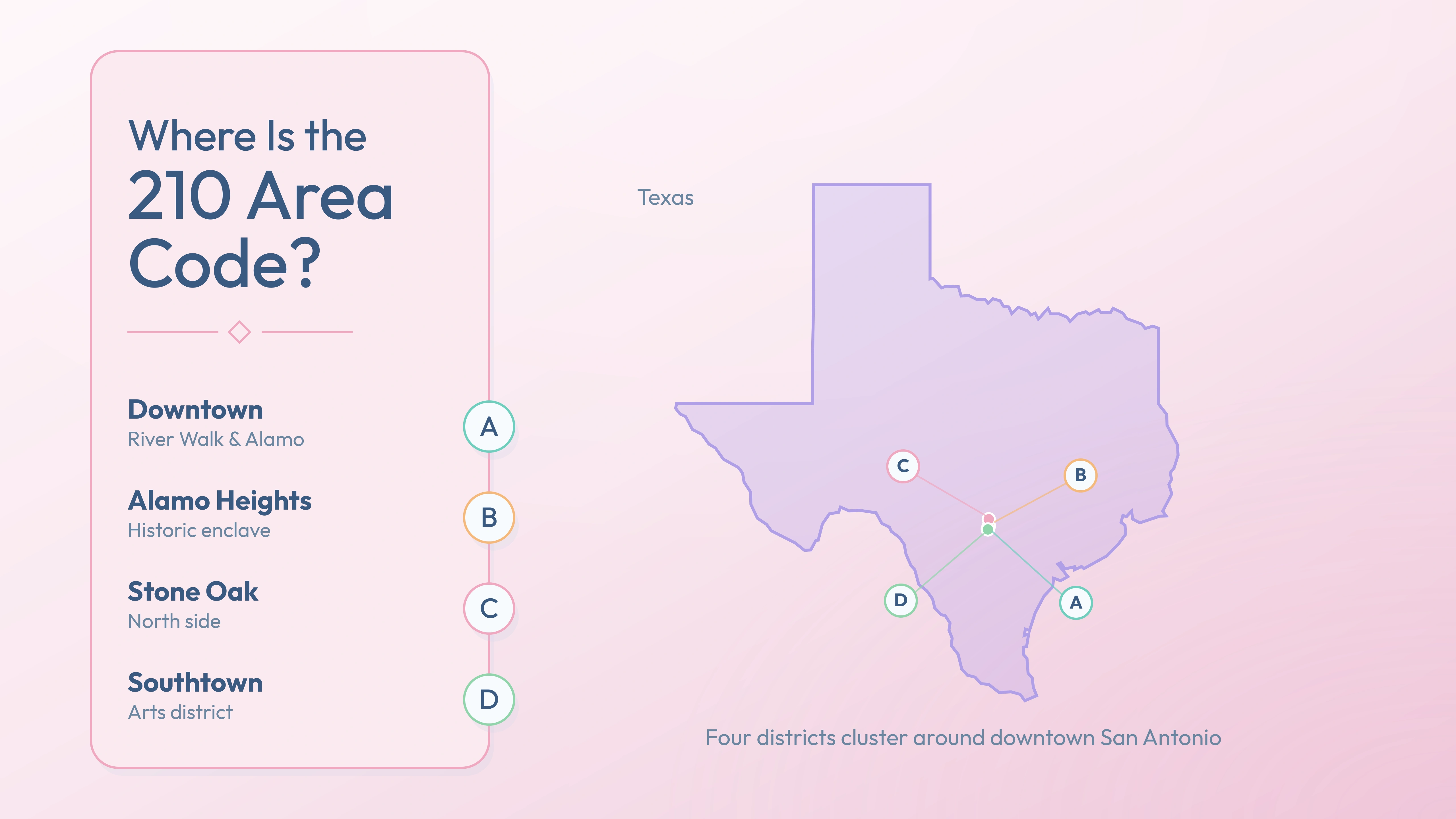
Because the code hugs the San Antonio metro so closely, its geography is best understood through the city's own districts — from the tourist heart along the river to the master-planned neighborhoods of the far north side. The communities below show the range packed into those three digits.
Downtown
Downtown San Antonio holds the city's two signature landmarks: the River Walk, with its stone pathways and cafe-lined banks below street level, and the Alamo, the most visited historic site in Texas. Hotels, convention traffic, and civic offices keep downtown lines among the busiest in the region.
Alamo Heights
Alamo Heights is a historic enclave just north of downtown — an independent municipality surrounded by the city, known for its early twentieth-century homes, boutique shopping along Broadway, and long-established professional practices.
Stone Oak
Stone Oak anchors the city's north side, a fast-growing area of medical campuses, corporate offices, and newer residential communities along the Highway 281 corridor. Much of San Antonio's recent commercial expansion has pushed in this direction.
Southtown
Southtown is the city's arts district, stretching south of downtown through the King William historic neighborhood. Galleries, studios, and an energetic restaurant scene have made it the creative counterweight to the corporate north side.
Counties and Communities the 210 Code Serves
The prefix wraps tightly around the San Antonio metro but also reaches a ring of incorporated suburbs. Anyone checking whether a local number will land in the right market can use the list below as a quick reference for the communities the code covers.
- Bexar County core — San Antonio, Alamo Heights, Terrell Hills, Castle Hills, and Windcrest
- Northeast suburbs — Converse, Universal City, Schertz, Cibolo, and Kirby
- West and northwest edge — Leon Valley, Helotes, and Shavano Park
- Shared 726 overlay territory — every community above can also receive a 726 number on the identical footprint
Get a local number in this area code for your business — set up in minutes.
210 Overlay and Nearby Area Codes
As San Antonio kept growing, the supply of numbers in the original city code began to run short. Rather than split the city in two, regulators added the 726 overlay — a second code laid over the exact same territory. Existing numbers stayed unchanged, new lines began drawing from 726, and ten-digit dialing became mandatory for every local call.
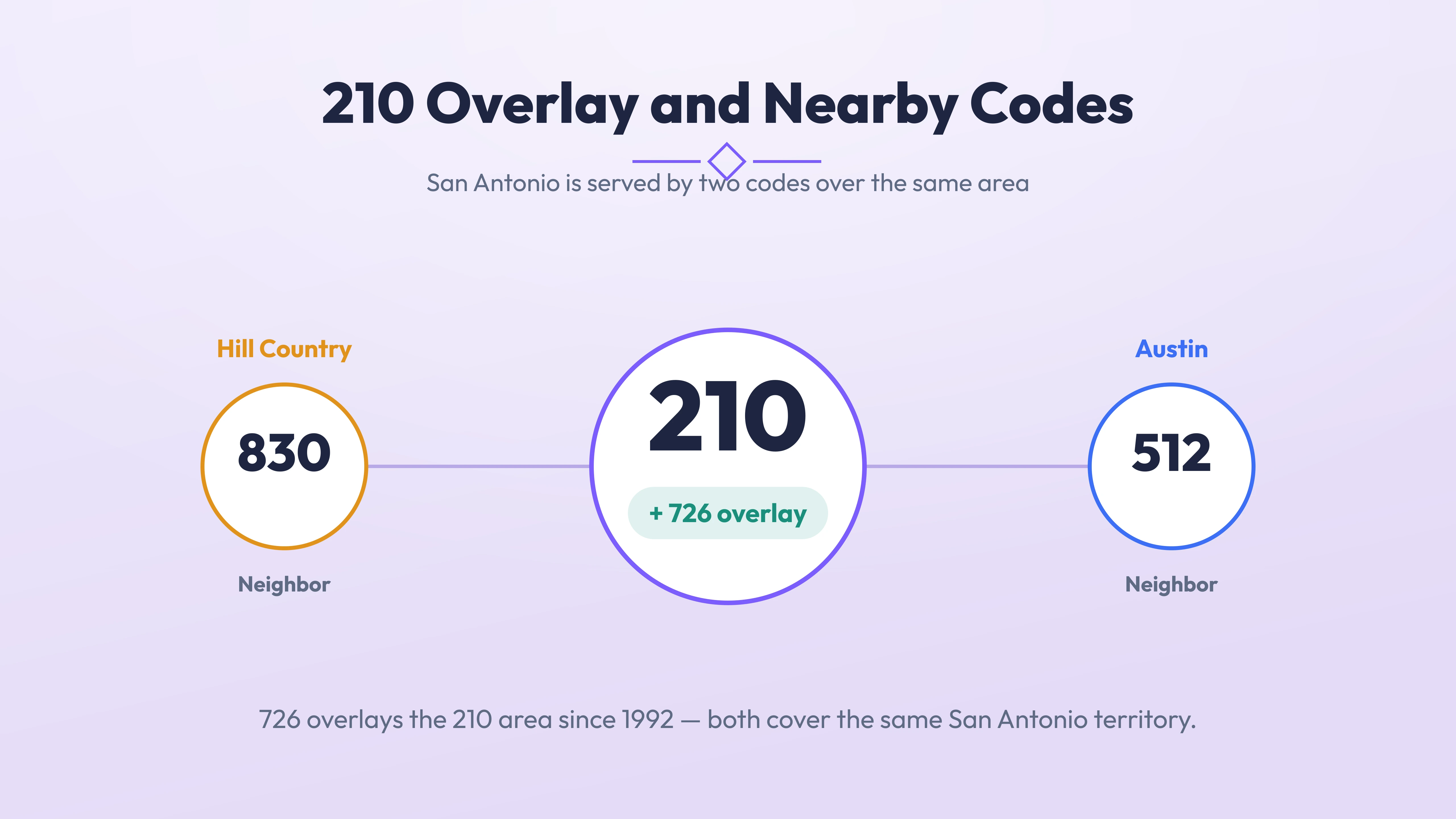
- 210 — the original city code from 1992, still the badge of San Antonio identity
- 726 — the overlay sharing the identical footprint, common on newer lines
Around the metro, the neighboring codes each mark distinct territory. The 830 code wraps the Hill Country towns and ranch land that surround Bexar County on nearly every side, while 512 belongs to Austin, San Antonio's fast-growing neighbor up Interstate 35. Elsewhere in the state the same pattern of city-defining prefixes repeats — the 713 area code plays the identical role for Houston that 210 plays here.
For businesses courting San Antonio customers specifically, the original city code remains the clearest local signal.
210 Time Zone
San Antonio and its prefix sit squarely in Central Time (CT) — UTC−6 during Standard Time and UTC−5 during Daylight Saving, which runs from mid-March to early November. The city keeps the same clock as Dallas, Houston, and Chicago, aligning it with the broad commercial middle of the country.
The Central clock is a genuine scheduling advantage: mornings overlap with the East Coast while afternoons still reach California comfortably. A San Antonio number tells callers the phones answer on Texas time — squarely in the middle of the American business day.
The San Antonio Economy and Business Scene
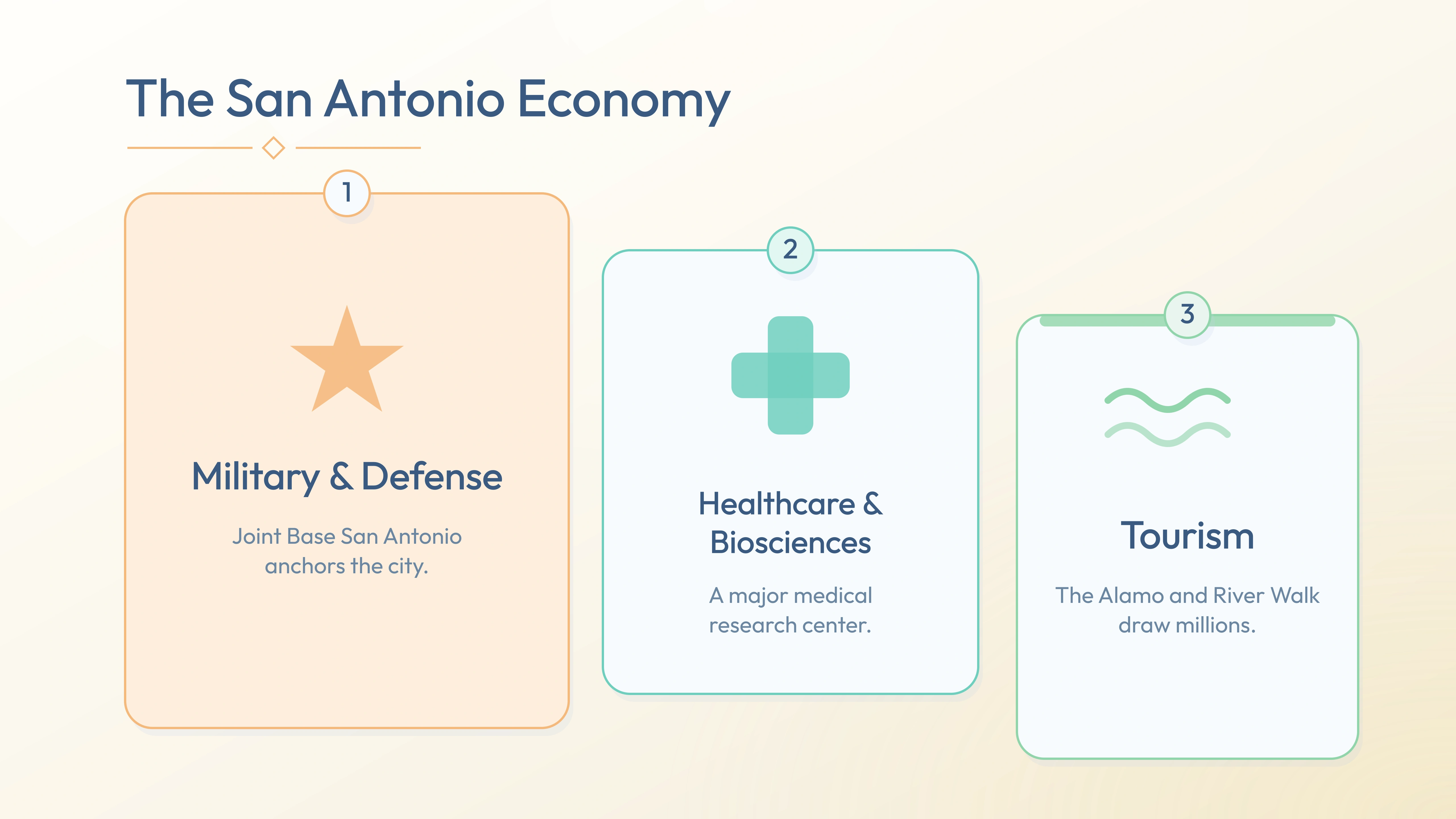
San Antonio pairs one of the country's most storied tourist economies with serious institutional weight — military commands, research hospitals, and a growing cybersecurity workforce. A local number places a business inside a market where community ties and local recognition carry real commercial value.
Military & Defense
Joint Base San Antonio anchors the city, uniting several historic installations into one of the largest military communities in the nation. The base ecosystem supports training, medical, and cybersecurity missions, and a deep bench of defense contractors and service firms has grown up around it — earning the city its 'Military City USA' nickname.
Healthcare & Biosciences
The city is a major medical research center, with the South Texas Medical Center campus concentrating hospitals, research institutes, and medical schools on the northwest side. Biosciences firms, clinical trials, and health-focused startups radiate outward from that core, making healthcare one of the region's largest sources of employment.
Tourism
The Alamo and River Walk draw millions of visitors, feeding a hospitality economy of hotels, restaurants, tour operators, and event venues that stretches from downtown to the theme parks on the city's edge. Austin's tech boom next door — the territory of the 512 area code — sends a steady stream of weekend visitors down I-35 as well, tightening the commercial link between the two metros.
The pattern mirrors the 915 area code, where the El Paso economy shapes number demand in much the same way.
How to Get a 210 Phone Number
A business does not need a San Antonio address to answer calls with a San Antonio number. Cloud phone providers activate local numbers in minutes through three simple steps:
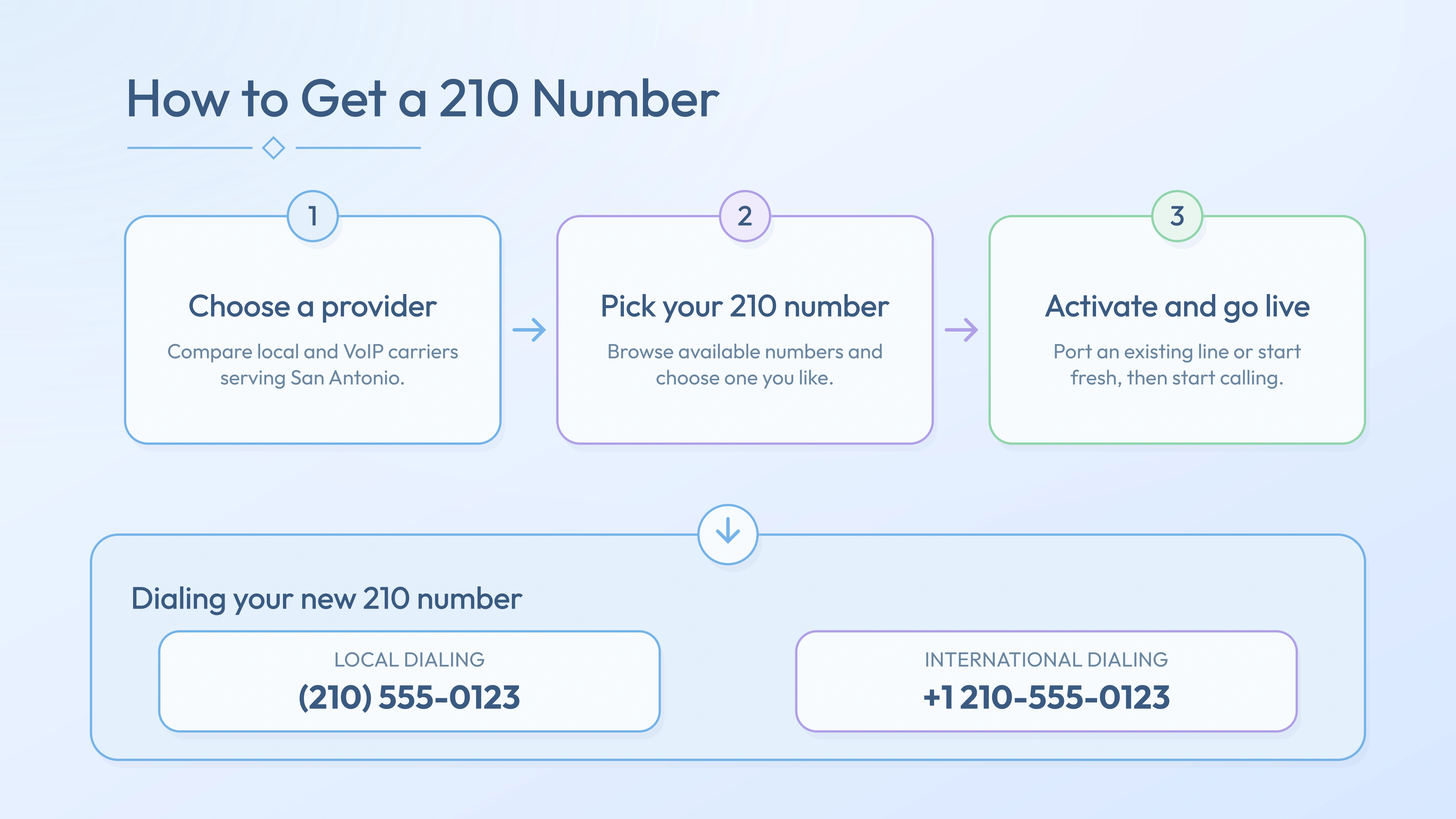
- 1Choose a provider — select a cloud phone service that stocks San Antonio numbers and includes the features the business needs, such as auto-attendant, call recording, and CRM integration.
- 2Pick a number — browse available combinations in the city prefix and reserve one, presented as (210) 555-0123 for local callers and +1 210-555-0123 in international format.
- 3Activate and route — verify the account and point the number anywhere. Calls ring on any device — a desk phone at headquarters, a laptop at home, or a mobile app on the road.
Local digits suit companies expanding into South Texas, remote teams serving Bexar County customers, and hometown businesses that want their number to match their roots. Because everything is hosted in the cloud, the number follows the business wherever it operates.
Common Phone Scams to Watch For
San Antonio's large military and retiree communities make the city a frequent target for phone fraud, and scammers routinely spoof local prefixes so their calls appear to come from a neighbor rather than a call center. Schemes reported around Bexar County follow familiar national patterns — impostor calls claiming to be a utility about to cut power, a delivery service holding a package, a bank flagging suspicious charges, or an official demanding payment to avoid arrest.
- No legitimate agency or utility demands payment by gift card, wire transfer, or cryptocurrency.
- Callers targeting military families sometimes pose as benefits or finance offices — verify through official installation channels, never through a number the caller provides.
- Banks do not ask customers to read out one-time passcodes over the phone.
- Let unfamiliar local-looking calls roll to voicemail; genuine callers leave messages.
A spoofed caller ID imitates local digits without touching the real line behind them. Reporting suspect calls to the FCC helps carriers sharpen their blocking tools. For more, see ten-digit dialing.
Landlines, Mobiles and San Antonio Numbers
The three digits at the front of a San Antonio number reveal nothing about the device on the other end. Landlines, mobile phones, and cloud-hosted business lines all draw from the same local pools, so a downtown law office, a contractor's cell phone, and a virtual reception line can look identical on caller ID.
That neutrality works in a business's favor. A cloud number carrying the city prefix can ring a desk phone during office hours, fail over to a mobile after close, and route to a laptop softphone on the road — all behind the same local identity. Callers simply see a familiar San Antonio number; the technology answering it, and the place it physically rings, can change as often as the business needs without the number ever changing.
Conclusion
Since 1992, San Antonio's prefix has grown from a practical fix for a booming phone network into a genuine piece of civic identity — the code of the River Walk, the Alamo, Military City USA, and one of the fastest-growing big cities in the country. The 726 overlay expanded the number supply, but the original three digits still carry the local pride.
For any business that wants to sound like part of the city, a cloud-based San Antonio number gets there in minutes — no local office, no hardware, and full call features from the first ring.
Ready to get started with 210 area code?
Join thousands of businesses using MeraTalk for Wholesale Voice, VoIP, and phone number services.
Contact MeraTalk Today