Introduction
The 281 area code is the prefix that grew up with the Houston suburbs. When the metro's original 713 code ran short of numbers in the mid-1990s, 281 arrived on November 2, 1996 as a geographic split — Beltway 8 became the dividing line, with addresses inside the loop keeping 713 and everything outside it assigned the new 281 code. It quickly became the digits people associate with the fast-growing ring of communities around the city, from The Woodlands in the north to Sugar Land in the southwest and the Clear Lake space corridor in the southeast, before the 713/281 boundary was erased in 1999 and both became part of a single overlay complex.
This guide covers what 281 actually is, which suburban cities and master-planned communities it reaches, how it relates to the 713, 832, 346 and 621 codes that share the same ground, the Central Time business-hours picture, and exactly how to activate a 281 virtual number for your business in minutes — with no Texas office required.
Key Takeaways
Covers where is the 281 area code in depth
Covers 281 area code Houston in depth
Covers 281 area code cities in depth
Covers 281 area code overlay in depth
Need a business phone number? Get a MeraTalk number in minutes, no contract required.
Get started free281 Area Code at a Glance
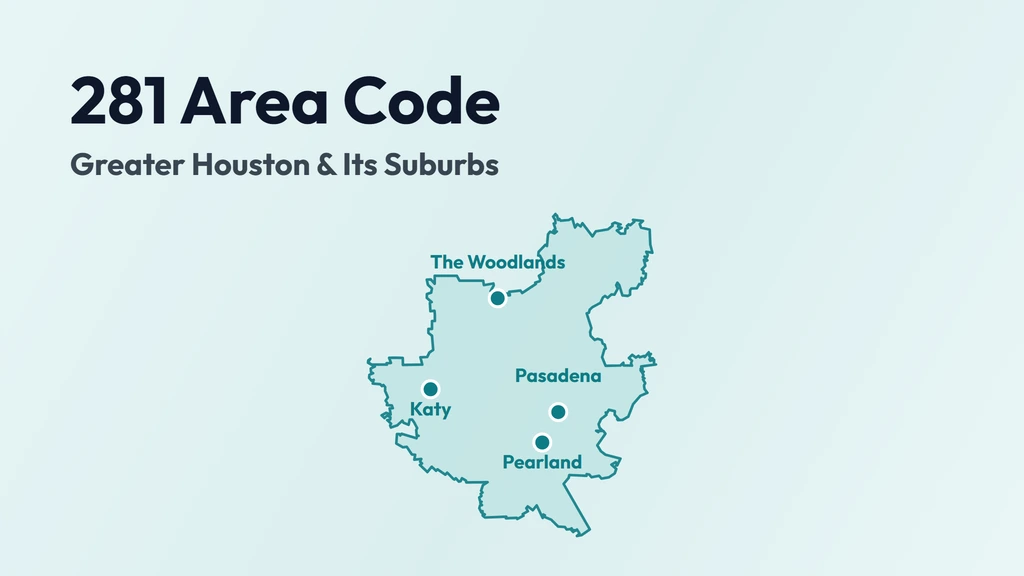
The 281 area code is in Texas. It serves greater Houston, and is most closely tied to the suburbs around the city such as The Woodlands, Katy, Sugar Land and Clear Lake.
- Location: greater Houston and its suburban ring in southeastern Texas
- State: Texas
- Main cities: The Woodlands, Katy, Sugar Land, Pearland, League City, Baytown, Conroe
- Time zone: Central Time (CT)
- Overlay: shares ground with 713, 832, 346 and 621
- In service since: November 2, 1996, as a split from 713 along Beltway 8
- Dialing: 10 digits required for all local calls
What Is the 281 Area Code?
The 281 area code is a telephone prefix for the greater Houston metropolitan area in southeastern Texas. It was introduced on November 2, 1996 not as an overlay but as a geographic split of the older 713 area code — Beltway 8 divided the two, with the urban core inside the loop keeping 713 and the suburbs outside it moving to 281. Because Houston had outgrown a single code, 281 gave the metro a fresh pool of numbers while keeping every existing 713 line untouched.
That geographic boundary didn't last: on January 16, 1999, regulators erased the 713/281 line and added a third code, 832, as a full overlay across the combined territory. From that point on, all three codes shared the same footprint, and providers could assign any of them anywhere in the metro. Even so, 281 kept its suburban identity in practice — most residents and businesses in the outer counties still carry a 281 number, a legacy of the original 1996 boundary even though it no longer determines what a new line receives.
Dialing Format and Time Zone
- Dialing format: (281) 555-0182
- International: +1 281-555-0182
- Time zone: Central Time (CT) — UTC−6 Standard, UTC−5 Daylight Saving (March–November)
- 10-digit dialing required for all local calls
Where Is the 281 Area Code? Cities & Suburbs
The 281 area code covers Harris County and the surrounding suburban counties that make up greater Houston — Fort Bend, Montgomery, Brazoria, Galveston, Liberty, Chambers and Waller. While it overlaps the City of Houston itself, 281 is most strongly tied to the metro's outer communities, where much of the region's population growth has happened. Key suburbs and communities include the following.
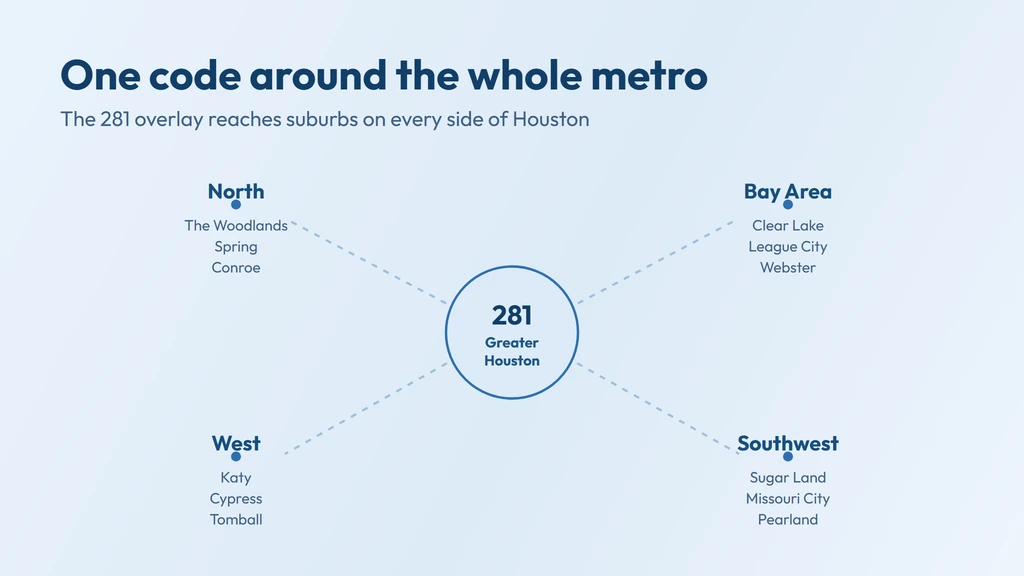
- The Woodlands — a large master-planned community north of the city, home to corporate campuses and headquarters
- Spring & Kingwood — established residential suburbs on the metro's north and northeast edges
- Katy & Cypress — booming west-side communities along the Energy Corridor and the Grand Parkway
- Sugar Land & Missouri City — affluent, fast-growing suburban cities in Fort Bend County to the southwest
- Pearland & Friendswood — rapidly expanding residential cities on the southern edge of the metro
- League City, Clear Lake & Webster — the Bay Area corridor near NASA's Johnson Space Center
- Pasadena & Baytown — industrial port-side cities along the Houston Ship Channel to the east
- Conroe & Tomball — outer-ring cities extending the metro northward into Montgomery County
- Stafford & Humble — smaller suburban hubs woven through the region's commercial corridors
Together these communities form one continuous suburban economy that wraps around the 713 urban core. A business with a 281 number signals that it belongs to this wider metro — the neighbourhoods where Houston families increasingly live, shop and work.
Get a local number in this area code for your business — set up in minutes.
281 Time Zone
The 281 area code observes Central Time (CT) — UTC−6 during Standard Time and UTC−5 during Daylight Saving Time, which runs from mid-March to early November. The Houston suburbs keep the same clock as Dallas, San Antonio, Chicago and most of the central United States.
Central Time is a practical base for national operations: it sits one hour ahead of the Pacific coast and one hour behind the East coast. A 281 number lets a business comfortably reach contacts on both coasts within a single working day, which is one reason so many suburban Houston companies run sales and support lines from the metro.
281 Overlay and Nearby Area Codes
Houston needed more numbers than one prefix could supply, so the region stacked several overlay codes on the same geography over the years. Because they all cover the identical territory, 10-digit dialing is mandatory for every local call across the metro — even to a neighbour on the next street. The 713 area code remains the original Houston prefix; 281 arrived first as a geographic split, then joined 713 in a true overlay once 832 was added.

- 713 — the original Houston code, introduced in 1947, carrying the deepest local history
- 281 — added November 2, 1996 as a geographic split along Beltway 8, folded into the overlay complex in 1999
- 832 — added January 16, 1999, the code that erased the 713/281 boundary and turned all three into a true overlay
- 346 — added July 1, 2014 as a further overlay for the growing metro
- 621 — went into service January 23, 2025 as the newest relief code for Houston number demand
Beyond the Houston overlays, the outlying region uses adjacent codes: 936 to the north around Conroe and Huntsville, 979 to the west toward College Station, and 409 to the east and southeast toward Galveston and Beaumont. For a business targeting the Houston suburbs specifically, 281 remains one of the most recognisable local signals in the metro.
The Greater Houston Suburban Economy and 281
The communities on the 281 code anchor one of the most dynamic suburban economies in the country. Growth in greater Houston has pushed jobs, corporate campuses and retail well beyond the old city limits, and a 281 number connects a business to that expanding base of customers and employers.

Energy, Aerospace and the Space Corridor
The suburbs carry two of Houston's signature industries. The Energy Corridor on the west side concentrates oil, gas and energy-services companies near Katy and west Houston, while the Clear Lake area to the southeast is home to NASA's Johnson Space Center — Mission Control for human spaceflight — and the aerospace suppliers that cluster around it. Both sit squarely in 281 territory.
Master-Planned Communities and Corporate Campuses
Places such as The Woodlands and Sugar Land pair large master-planned neighbourhoods with major corporate campuses, drawing employers in energy, healthcare, technology and professional services out to the suburbs. The result is a decentralised metro where a great deal of business happens far from downtown — and where a suburban area code carries real weight.
Ports, Petrochemicals and Logistics
To the east, Pasadena, Baytown and the communities along the Houston Ship Channel form one of the largest petrochemical and logistics complexes in the United States. The trade, manufacturing and distribution firms tied to the port round out an economy that spans energy, space, healthcare and heavy industry across the 281 footprint.
How to Get a 281 Area Code Phone Number
Modern VoIP and cloud phone providers let you activate a 281 Houston-area number in minutes — no Texas office, no hardware and no long-term contract. Search the available 281 inventory, choose a number, complete a quick verification, and set up call routing, voicemail and an auto-attendant. The line is live and callable almost immediately.
A 281 number is a strong fit for any company selling into the Houston suburbs — energy and oilfield-services vendors near the Energy Corridor, contractors and clinics serving The Woodlands, Katy, Sugar Land and Pearland, aerospace suppliers around Clear Lake, and national firms opening a Houston presence.
MeraTalk provides 281 virtual phone numbers as part of its cloud telephony platform, so it is a quick way to add a local business phone number: route calls to any device, record conversations, and connect your CRM from one dashboard. Numbers activate in minutes — search the available 281 inventory at meratalk.com.
Common 281 Area Code Scams
Because 281 looks reassuringly local to millions of Houston-area residents, scammers spoof it to make fraudulent calls appear to come from a neighbour, a local utility or a nearby government office. A familiar 281 caller ID is easy to fake and proves nothing about who is really on the line.

Watch for a few recurring patterns. Callers may impersonate a utility such as CenterPoint Energy and threaten to cut power over an unpaid bill, pose as the Social Security Administration or a county office claiming a warrant, or promise a prize or refund that requires a gift card or a small upfront fee.
In every case the pressure is the tell — a demand to act immediately before you can check. Never share personal or financial details with an unsolicited caller.
If a call feels off, hang up and dial the organisation back on a number you look up yourself. Federal rules make it illegal to transmit misleading or inaccurate caller-ID information with intent to defraud, and reporting suspicious calls helps regulators act on the worst offenders. For more, see the FCC's Truth in Caller ID rules.
Conclusion
The 281 area code has been part of greater Houston since November 1996, born as a geographic split along Beltway 8 before becoming part of a full overlay in 1999, spreading across the metro's booming suburbs — The Woodlands, Katy, Sugar Land, Pearland and the Clear Lake space corridor. It shares its ground with 713, 832, 346 and 621, but it carries a distinct suburban identity that many Houston-area businesses value.
Activating a 281 virtual number takes minutes with MeraTalk. Go live with a Houston-area code, route calls to any device, and pair it with call recording, an auto-attendant and CRM integration from day one — no physical Texas office required. Explore MeraTalk's virtual number options at meratalk.com.
Ready to get started with 281 area code?
Join thousands of businesses using MeraTalk for Wholesale Voice, VoIP, and phone number services.
Contact MeraTalk Today