Introduction
The 415 area code is San Francisco's original telephone prefix — assigned in 1947 and still one of the most recognizable area codes in the country. San Francisco is the financial and cultural anchor of the Bay Area, home to a dense cluster of technology companies, venture capital firms, and global brands. A 415 number places your business at the center of all of it.
This guide covers the full picture: which San Francisco neighborhoods and Marin County towns 415 serves, how it relates to the 628 overlay, the way 415 connects to the surrounding Bay Area codes, the prefix's history since 1947, and exactly how to activate a 415 virtual number for your business in minutes.
Key Takeaways
Covers where is the 415 area code in depth
Covers 415 area code location in depth
Covers San Francisco area code in depth
Covers 415 vs 628 area code in depth
Need a business phone number? Get a MeraTalk number in minutes, no contract required.
Get started freeWhat Is the 415 Area Code?
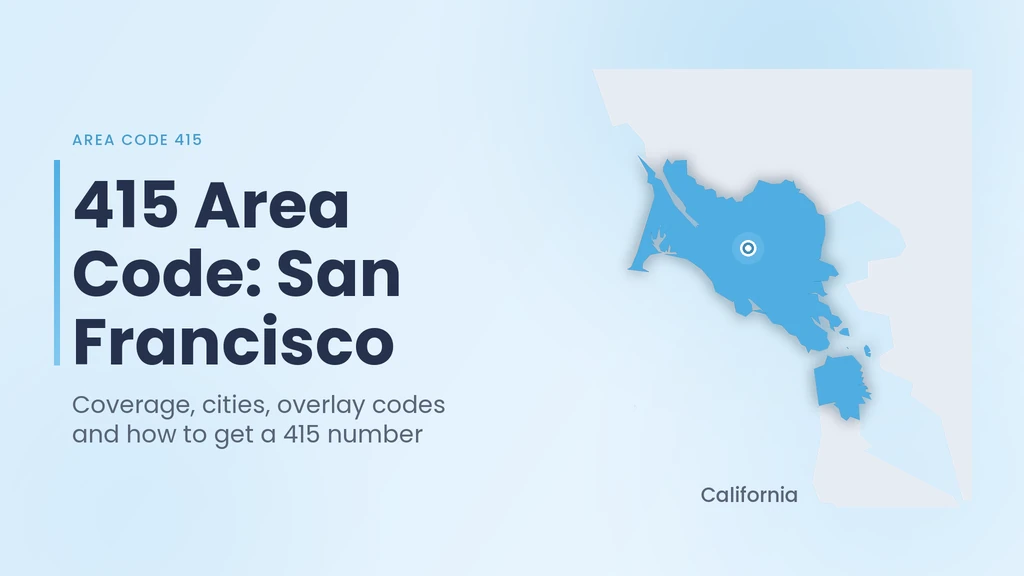
The 415 area code is assigned to the City and County of San Francisco, most of Marin County, and a small portion of northeastern San Mateo County in California. It was one of the original area codes established under the North American Numbering Plan (NANP) in 1947, when it covered a sweeping region of central and northern California.
A series of splits over the following decades — most notably a 1959 three-way division that created both 408 and 707 — plus a 2015 overlay, narrowed 415 to the San Francisco and Marin footprint it serves today.
Dialing Format and Time Zone
- Dialing format: (415) 555-0182
- International: +1 415-555-0182
- Time zone: Pacific Time (PT) — UTC−8 Standard, UTC−7 Daylight Saving (March–November)
- 10-digit dialing required for all local calls within the 415/628 overlay
The History of the 415 Area Code
When AT&T published the first nationwide numbering plan in 1947, California was large enough to need three area codes from the outset. 213 took the south, 916 took the north, and 415 was assigned to the centre of the state — a territory that stretched from Sacramento in the north all the way down to Bakersfield. Almost nothing of that original footprint remains.
In 1950 the boundaries between California's numbering plan areas were redrawn along a north–south line. 415 was reassigned to the coastal strip, running from the Bay Area up the North Coast to the Oregon border, while 916 took the north-eastern corner of the state. Sacramento moved out of 415 and into 916 in that realignment, and Bakersfield moved to 213.
There was also a brief detour. During the early trials of direct distance dialing, area code 318 was used temporarily to reach the San Francisco area — first by customers in Englewood, New Jersey, and by some communities north of the Golden Gate. In 1953 the whole Bay Area was enumerated again under 415.
Every Change to the 415 Boundary
| Date | Change | What moved |
|---|---|---|
| 1947 | 415 assigned | Central California, from Sacramento in the north to Bakersfield in the south |
| 1950 | Boundaries redrawn | Sacramento moved to 916 and Bakersfield to 213; 415 took the coast up to the Oregon border |
| 1959 | 707 and 408 split off | A three-way split — the North Coast and wine country to 707; San Jose, the South Bay, Monterey Bay and the Salinas Valley to 408 |
| 2 September 1991 | 510 split off | The East Bay — Oakland, Berkeley and the Alameda County shoreline |
| 2 August 1997 | 650 split off | Most of San Mateo County; portions of Brisbane and Daly City stayed in 415 |
| 21 March 2015 | 628 overlay added | Nothing moved — a second code was laid over the same territory |
Each split peeled off a region that went on to build an identity around its own code: the wine country, Silicon Valley, Oakland, the Peninsula. What was left after all of it is the compact footprint 415 holds today — the City and County of San Francisco, Marin County, and the two San Mateo County communities that stayed behind.
Where Is the 415 Area Code? Cities & Neighborhoods
The 415 area code covers the City and County of San Francisco in its entirety, most of Marin County to the north across the Golden Gate Bridge, and a small slice of northeastern San Mateo County to the south. It is one of the most geographically compact and economically concentrated area codes in the United States, spanning the city's hills and waterfront as well as the leafy communities of Marin.
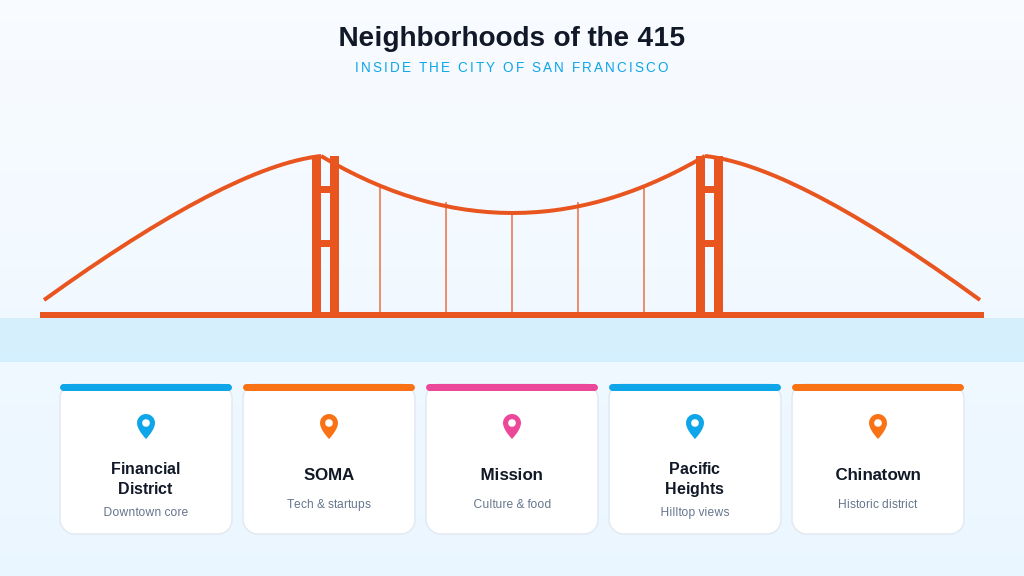
- San Francisco — the financial, cultural, and tech core of the region; from the Financial District and SoMa to the Mission, the Marina, and the Sunset
- Daly City — a populous city on the San Francisco–San Mateo border, just south of the city limits
- Brisbane — a small bayside community at the northern edge of San Mateo County
- Sausalito — a waterfront town in southern Marin known for its harbor and views back toward the city
- Mill Valley — an affluent Marin community at the base of Mount Tamalpais
- Tiburon and Belvedere — peninsula towns on Richardson Bay with sweeping bay views
- Larkspur and Corte Madera — central Marin towns along the Highway 101 corridor
- San Rafael — the Marin County seat and its largest city
- Novato — a city in northern Marin near the Sonoma County line
- San Anselmo, Ross, and Fairfax — historic small towns in the Ross Valley
- Point Reyes, Inverness, and Stinson Beach — coastal Marin communities along the Pacific shoreline
While the East Bay, the Peninsula, and Silicon Valley fall under their own area codes, they form part of the same contiguous Bay Area economy as 415. Many businesses maintain presence across several of these codes at once.
San Francisco Neighborhoods Inside the 415 Footprint
415 covers the whole city, but the business districts that matter most to a phone number are concentrated in a few square miles on the north-eastern side of the peninsula.
| Neighborhood | What is there |
|---|---|
| Financial District | Banks, investment firms, and the law and accounting practices that serve them |
| SoMa (South of Market) | The enterprise software and startup corridor; Salesforce Tower, the tallest building in the city, stands at 415 Mission Street |
| Mission Bay | The UCSF Mission Bay campus, biotechnology and life sciences, and Chase Center |
| Embarcadero and the Ferry Building | Waterfront offices, food retail and hospitality along the bay |
| Civic Center | City Hall, state and federal courts, and government offices |
| Union Square | Retail, hotels and corporate offices |
| Mid-Market and the Tenderloin | Mixed use, with technology offices along the Market Street spine |
| Nob Hill and Russian Hill | Residential, hotels and professional services |
| The Mission, Castro, Noe Valley and Bernal Heights | Residential neighborhoods south and west of downtown |
| Sunset and Richmond | The outer districts on either side of Golden Gate Park |
| Chinatown | The oldest Chinatown in North America; restaurants, retail and community services |
| North Beach and Fisherman’s Wharf | Hospitality, restaurants and the visitor trade |
| Dogpatch and Potrero Hill | Design studios and smaller technology offices on the central waterfront |
What Is Not in the 415 Zone
The Bay Area is often treated as one market, but it is divided across eight area codes. A number in any of the following is not a 415 number, and will not read as San Francisco to anyone who knows the region.
| Area | Area codes |
|---|---|
| East Bay — Oakland, Berkeley, Alameda, Fremont, Richmond | 510, 341 |
| Inland East Bay — Walnut Creek, Concord, Livermore, Pleasanton | 925 |
| The Peninsula — San Mateo, Redwood City, Menlo Park, Palo Alto, Mountain View | 650 |
| South Bay and Silicon Valley — San Jose, Sunnyvale, Santa Clara | 408, 669 |
| North Bay and wine country — Napa, Santa Rosa, Petaluma, Vallejo | 707, 369 |
| Central Coast — Santa Cruz, Monterey, Salinas | 831 |
One boundary is worth stating plainly, because it is often reported wrongly: Marin County is entirely within 415. Novato sits at the Sonoma County line and is still 415, so the 707 boundary follows the county line rather than cutting through Marin. At the southern edge the line is less tidy — portions of Brisbane and Daly City are 415 while the rest of San Mateo County is 650, so an address near that border should be checked against its rate centre rather than assumed.
Get a local number in this area code for your business — set up in minutes.
415 Time Zone
The 415 area code observes Pacific Time (PT). That means UTC−8 during Standard Time (early November through mid-March) and UTC−7 during Daylight Saving Time (mid-March through early November). All of San Francisco and Marin County keep the same clock, so there is never an internal time difference within the 415 footprint.
Pacific Time has direct implications for business hours. A 9 a.m. start in San Francisco is already noon on the East Coast, so teams serving national clients often begin the day early to overlap with Eastern Time partners. For companies working with Europe or Asia, the late-Pacific offset shapes when calls and handoffs are scheduled — a factor any business using a 415 number should plan around.
Calling 415 from Other Time Zones
The windows below assume a 9 a.m. to 6 p.m. Pacific business day, on Standard Time.
| Your time zone | Call between |
|---|---|
| Eastern Time (ET) | 12:00 p.m. – 9:00 p.m. |
| Central Time (CT) | 11:00 a.m. – 8:00 p.m. |
| Mountain Time (MT) | 10:00 a.m. – 7:00 p.m. |
| United Kingdom (GMT) | 5:00 p.m. – 2:00 a.m. |
| Central Europe (CET) | 6:00 p.m. – 3:00 a.m. |
| India (IST) | 10:30 p.m. – 7:30 a.m. |
| Dubai (GST) | 9:00 p.m. – 6:00 a.m. |
| Singapore and Hong Kong | 1:00 a.m. – 10:00 a.m., next day |
Two caveats. The United States and Europe do not change their clocks on the same dates, so for a couple of weeks in March and again at the end of October the windows above shift by an hour. And because San Francisco runs the latest business day in the continental United States, a 415 number aimed at European customers needs cover in the early Pacific morning, while one aimed at Asia-Pacific customers needs it late in the Pacific afternoon.
415 Overlay and Nearby Area Codes
On March 21, 2015, the 628 area code was introduced as an overlay covering the exact same territory as 415. Mandatory ten-digit dialing had already taken effect a month earlier, on February 21, 2015, to prepare the region. An overlay adds a second area code to a region rather than splitting it geographically, which means existing 415 customers kept their numbers while new lines in the same area began receiving 628 numbers.
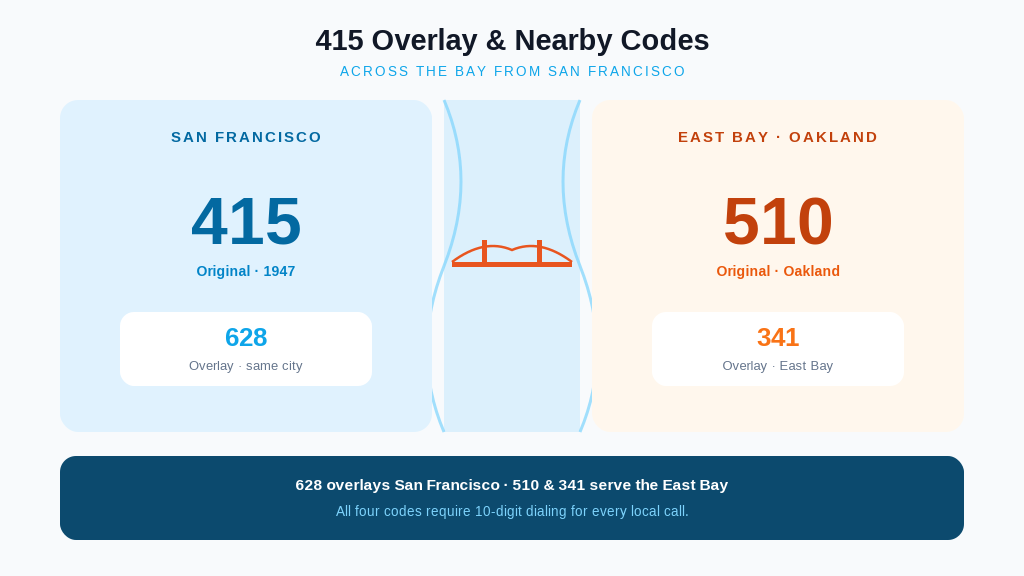
Because two codes now share one footprint, 10-digit dialing is required for every local call — you must dial the full area code plus the seven-digit number every time.
415 sits at the heart of a cluster of Bay Area codes, each anchoring a distinct part of the region. Understanding how they fit together helps you choose the right local presence.
- 628 — the overlay code sharing the same San Francisco and Marin territory as 415, added March 21, 2015; new numbers in the area are increasingly assigned 628
- 510 — the East Bay, including Oakland, Berkeley, and the Alameda County waterfront, split from 415 on September 2, 1991
- 650 — the Peninsula and most of San Mateo County, from Daly City south toward Palo Alto, split from 415 on August 2, 1997
- 408 — San Jose and Silicon Valley, the southern hub of the regional tech economy, split from 415 in 1959
- 707 — the North Bay and wine country to the north, including Sonoma and Napa counties, created in the same 1959 three-way split that produced 408
All of these codes share Pacific Time and the same 10-digit dialing requirement. For businesses targeting San Francisco specifically, a 415 number carries the strongest local signal — it is the prefix the rest of the world associates with the city itself. If your focus is the southern tech corridor, the 408 Silicon Valley area code is the natural counterpart.
415 Against Its Neighbours
| Code | In service | Coverage | What it signals |
|---|---|---|---|
| 415 | 1947 | San Francisco and Marin County | The original; the code the rest of the world associates with the city |
| 628 | 2015 | The same territory, as an overlay | Newer, with no legacy association, and functionally identical |
| 510 / 341 | 1991 / 2019 | East Bay — Oakland, Berkeley, Fremont | Oakland and the East Bay, an identity distinct from the city |
| 925 | 1998 | Inland East Bay — Walnut Creek, Concord, Livermore | The suburban East Bay beyond the Berkeley Hills |
| 650 | 1997 | The Peninsula — San Mateo County, Menlo Park, Palo Alto | Sand Hill Road and the Peninsula campuses |
| 408 / 669 | 1959 / 2012 | South Bay — San Jose, Sunnyvale, Santa Clara | Silicon Valley hardware and infrastructure |
| 707 / 369 | 1959 / 2023 | North Bay and wine country — Napa, Santa Rosa | North of the Golden Gate, beyond the Marin county line |
Note that 650 is still a single code with no overlay of its own, which makes it the exception among 415's neighbours — every other code in the table has been split or overlaid since it was created. For a business choosing between them the practical question is not capacity but recognition: each of these codes reads as a specific part of the Bay Area to anyone local, and 415 is the only one that reads as the city itself.
The San Francisco Economy and the 415 Area Code
San Francisco is one of the most economically influential cities in the world relative to its size. Packed onto a compact peninsula, it concentrates technology, finance, biotechnology, and tourism into a few square miles — and a 415 number ties your business directly to that identity.
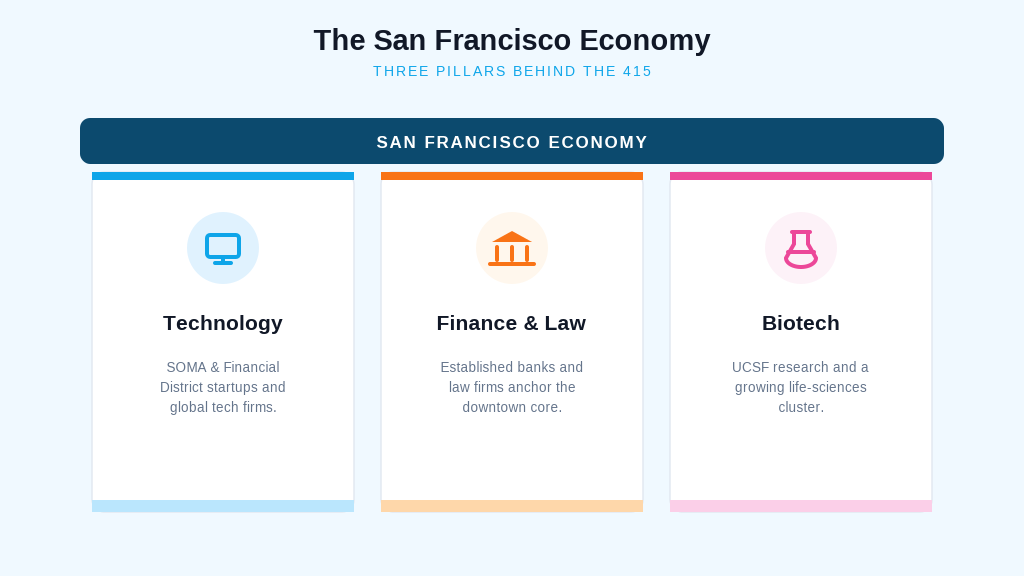
Key Industries
Technology and venture capital dominate the San Francisco economy, from established software and cloud companies to a continuous wave of startups clustered in SoMa and the Financial District. Finance and professional services have deep roots in the city, alongside a strong biotechnology and life-sciences presence in Mission Bay. Tourism and hospitality remain major employers as well, drawing visitors to the waterfront, Golden Gate Bridge, and the city's distinctive neighborhoods.
Notable Companies and Landmarks
Some of the most recognizable names in technology and finance maintain headquarters or major offices within the 415 footprint, and the city's venture capital community helps fund startups far beyond California. Landmarks like the Golden Gate Bridge, the Transamerica Pyramid, Alcatraz, Fisherman's Wharf, and the cable cars make San Francisco instantly identifiable — and that recognition rubs off on the 415 prefix itself.
Marin County's Role
North of the Golden Gate, the 415 footprint extends into Marin County — an affluent area combining residential communities, small-business districts, and easy access to the city. Towns like Mill Valley, Sausalito, and San Rafael give 415 a reach that blends urban density with the open space of the Marin headlands and coast.
The Sectors Behind the 415 Prefix
| Sector | Where it sits | Why the code matters |
|---|---|---|
| Technology | SoMa and Mid-Market | Enterprise software, consumer internet and cloud services; Salesforce Tower at 415 Mission Street anchors the corridor |
| Venture capital and finance | The Financial District | The Federal Reserve Bank of San Francisco sits on Market Street, and a growing share of the venture industry has moved into the city from Sand Hill Road in 650 |
| Legal services | Civic Center and the Financial District | The Ninth Circuit Court of Appeals and a Northern District of California courthouse are both in the city, which makes it a centre for intellectual property and securities work |
| Biotechnology and life sciences | Mission Bay | The UCSF Mission Bay campus and the research companies clustered around it |
| Media, design and advertising | SoMa, the Financial District and Dogpatch | Agencies, design studios and architecture practices — a trade in the city long before the technology industry arrived |
| Healthcare | Across the city | UCSF Medical Center, Zuckerberg San Francisco General, California Pacific Medical Center and Saint Francis Memorial |
| Hospitality and conventions | Union Square, the Wharf and SoMa | Moscone Center, one of the largest convention venues on the West Coast, plus the hotel and visitor trade around it |
What these sectors share is a client base that reads area codes. In a region where 650 means the Peninsula, 408 means Silicon Valley and 510 means Oakland, a 415 number is the one that places a business in the city — which is why it is the code technology and finance firms ask for by name.
How to Get a 415 Area Code Phone Number
Modern VoIP and cloud phone providers let you activate a 415 San Francisco number in minutes — no California office, no hardware, and no long-term contract required. You search available 415 numbers, pick the combination you want, complete a short verification, and route incoming calls to any device anywhere in the world.
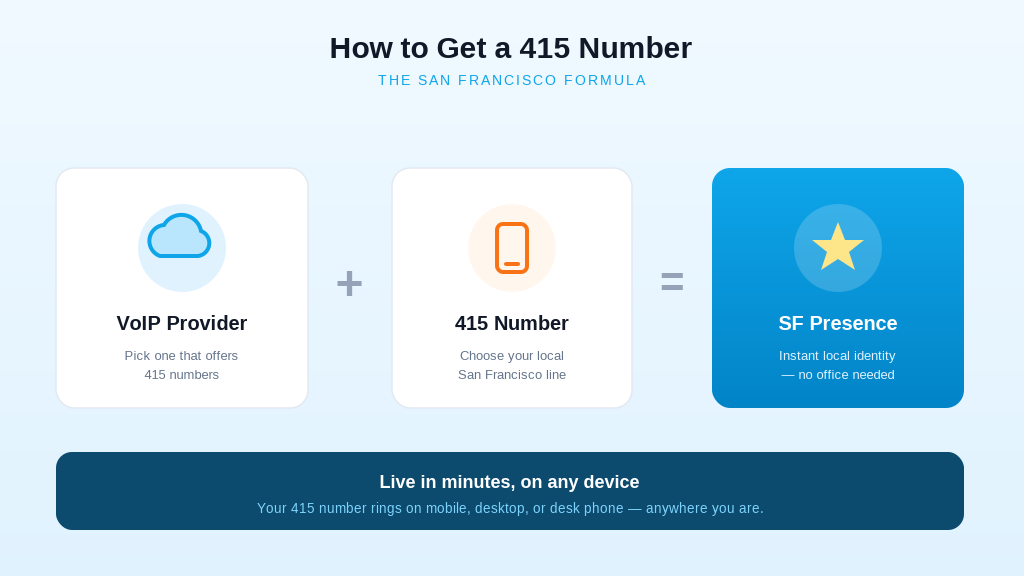
A 415 number benefits remote teams, startups expanding into the Bay Area, agencies serving West Coast clients, and any business that wants instant San Francisco credibility on outbound calls. A local presence tends to lift answer rates and signals that you are part of the regional market.
MeraTalk provides 415 virtual phone numbers as part of its cloud telephony platform — numbers activate in minutes, route to any device, and pair with voicemail, call routing, and CRM integration from a single dashboard. Search available 415 numbers at meratalk.com. A virtual phone number for business gives you that local footprint without a physical office.
Dialing a San Francisco Number from Abroad
San Francisco does business with the world, so its numbers are dialed from more countries than almost any other American prefix. The pattern is always the same: the caller's international exit code, then the North American country code 1, then the full ten digits. From most of Europe that looks like 00 1 415 555 0182, while mobile users everywhere can rely on the plus-sign shortcut — +1 415-555-0182 connects from any modern network.
A few details make cross-border calling smoother: For more, see 415 area code.
- Store contacts in full international format with the leading +1 so numbers dial correctly from any country without editing.
- Plan around Pacific Time — morning in San Francisco is evening in much of Europe and the start of the next day in East Asia.
- Businesses expecting overseas callers should publish the +1 format on websites and signatures so international customers never have to guess.
Call Recording on a 415 Number: California Requires All-Party Consent
This is the compliance point that most often catches businesses out when they put a California number into service. California is an all-party consent state. Under Penal Code section 632 it is unlawful to record a confidential communication, including a telephone call, without the consent of every party to it. One party agreeing is not enough.
The exposure is real rather than theoretical. Penal Code section 637.2 gives anyone injured by a violation a civil action for the greater of $5,000 per violation or three times their actual damages, and section 632 carries criminal penalties on top of that. Because the obligation attaches to the call rather than to where your company is registered, it applies whenever a California party is on the line — a business in London or Mumbai recording calls on a 415 number is squarely within scope.
In practice that means a recording notice plays before capture begins, on inbound and outbound calls alike, and that consent is logged alongside the recording. The safer configuration on a 415 number is to apply the all-party standard to every call rather than branch on where the caller appears to be: caller ID is a poor guide to location, and a mobile number tells you nothing about which state its owner is sitting in today.
None of the above is legal advice. Call-recording law varies by state and several jurisdictions apply a stricter test than California does to calls that cross their borders, so take advice from counsel before enabling recording on any number.
Common Phone Scams Spoofing Bay Area Numbers
Because the prefix signals San Francisco money and tech, scammers spoof it constantly. Residents report fake fraud-alert calls impersonating banks and payment apps, bogus tech-support callbacks, cryptocurrency and investment pitches, and toll or delivery texts that lead to phishing pages. The caller ID looks local, but the call may originate anywhere in the world.
A few habits defeat nearly all of these schemes. Let unfamiliar local-looking calls roll to voicemail — genuine banks, employers, and agencies leave messages with verifiable callback paths. Never read out a one-time passcode, approve a login prompt, or move money at an inbound caller's request, no matter how convincing the caller ID appears. When a call claims urgency, hang up and dial the organization's published number directly.
Suspicious calls and texts can be reported to the carrier and the FCC, which helps trace repeat spoofing operations and protects the prefix's reputation for everyone who legitimately uses it.
Conclusion
The 415 area code has represented San Francisco since 1947 — through the city's rise as a financial center, the growth of Silicon Valley to the south, and its emergence as one of the world's leading technology hubs. Spanning the city and the towns of Marin County, it remains the most recognized telephone prefix in the Bay Area, even as the 628 overlay adds new capacity alongside it.
Activating a 415 virtual number takes minutes with MeraTalk. Go live with a San Francisco area code, route calls to any device, and pair it with voicemail, auto-attendant, and CRM integration from day one — no physical Bay Area office required. Explore MeraTalk's virtual number options at meratalk.com.
Ready to get started with 415 area code?
Join thousands of businesses using MeraTalk for Wholesale Voice, VoIP, and phone number services.
Contact MeraTalk Today