Introduction
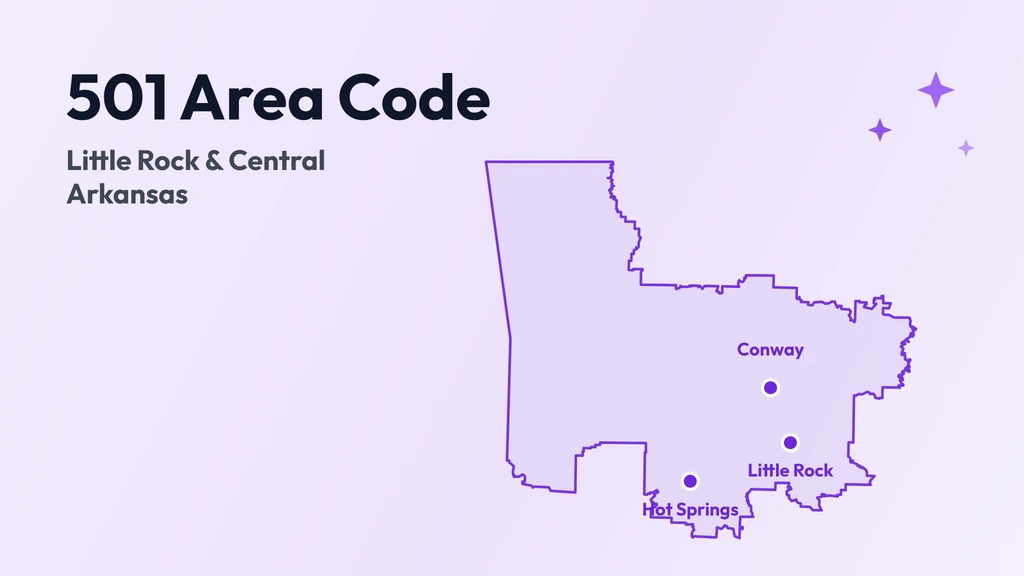
The 501 area code is the telephone code of central Arkansas — a compact, fast-growing region built around the state capital of Little Rock. It rings across Little Rock and North Little Rock on either bank of the Arkansas River, reaches north through Conway's college towns, west into the resort city of Hot Springs and the Ouachita Mountains, and south and east through Benton, Jacksonville and Little Rock Air Force Base.
A phone number that begins with 501 signals this corner of the state specifically: the seat of state government, a growing college and data-industry corridor, and one of the South's best-known spa and tourism towns.
Because 501 covers the state capital and its surrounding metro, it turns up in two very different searches: people who just received a 501 number and want to know where it comes from, and people asking whether an unfamiliar 501 call is safe to answer.
This guide covers both — the cities and communities that make up the 501 region, how it started as Arkansas's only area code in 1947 before two later splits, the Central-Time detail that keeps it simple, what to watch for with spoofed calls, and how to activate a 501 virtual number for a business in minutes.
Key Takeaways
Covers where is the 501 area code in depth
Covers 501 area code location in depth
Covers is 501 a scam in depth
Covers get a 501 phone number in depth
Need a business phone number? Get a MeraTalk number in minutes, no contract required.
Get started freeWhat Is the 501 Area Code?
| Area code 501 | |
|---|---|
| State | Arkansas — central |
| Main city | Little Rock |
| In service since | 1947, one of the original North American area codes |
| First split | 870, on April 14, 1997 |
| Second split | 479, on January 19, 2002 |
| Overlay | None |
| Ten-digit dialling | Required since October 24, 2021 |
| Time zone | Central (UTC-6, UTC-5 in summer) |
| Counties | Pulaski, Faulkner, Saline, Garland, White, Lonoke, Conway, Cleburne, Hot Spring, Perry, Van Buren |
The 501 area code is a telephone area code serving central Arkansas, anchored by Little Rock and covering the counties immediately around it. It began life in 1947 as one of the original North American area codes, assigned to the entire state of Arkansas from the very start of the nationwide numbering plan.
As the state's population and number demand grew, 501 was split on April 14, 1997, handing the eastern, southern and rural portions of the state to the new 870 code while 501 kept the central region around Little Rock. A second split followed on January 19, 2002, when the fast-growing northwest corner around Fayetteville and Fort Smith was carved off into area code 479.
Since that second split, 501 has never been overlaid — it remains a single, straightforward code for central Arkansas. Many companies opening a location in the Little Rock metro request a dedicated business phone number on 501 specifically so the line reads as local from the first ring.
Dialing Format and Time Zone
- Dialing format: (501) 555-0142
- International: +1 501-555-0142
- Time zone: Central Time (CT) — UTC−6 standard, UTC−5 during Daylight Saving Time
- 501 has never been overlaid, so seven-digit local dialing generally remains available within the region
Where Is the 501 Area Code? Cities & Communities
Geographically, 501 covers central Arkansas — the state capital and the ring of counties around it, roughly bounded by the Ouachita Mountains to the west and the flatter delta country to the east. This is the state's political, financial and higher-education center, built along the Arkansas River and stretching from mountain resort towns to a modern data and insurance corridor.
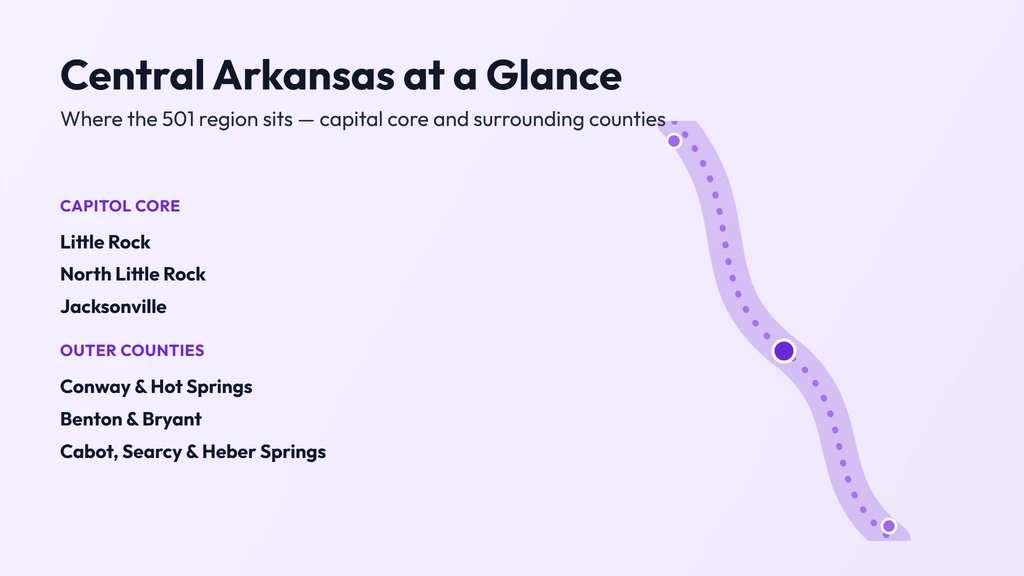
Companies expanding into any of these communities often start with a virtual phone number tied to the region before opening a physical office.
Major Cities and Communities
- Little Rock — the state capital and largest city, home to the Arkansas State Capitol, the Clinton Presidential Center and the state's largest concentration of banking, insurance and government employers
- North Little Rock — Little Rock's sister city across the Arkansas River, home to the Argenta Arts District and a major rail and logistics hub
- Conway — the college-town anchor of Faulkner County, home to the University of Central Arkansas, Hendrix College and Central Baptist College, and headquarters to the data and marketing firm Acxiom
- Hot Springs — the historic spa city and gateway to Hot Springs National Park, long known for its bathhouses and thoroughbred racing at Oaklawn
- Benton & Bryant — the fast-growing Saline County suburbs southwest of Little Rock
- Jacksonville — home to Little Rock Air Force Base and the 19th Airlift Wing
- Cabot & Searcy — growing Lonoke and White County communities northeast of the capital
- Heber Springs — the Cleburne County lake town on Greers Ferry Lake, popular for fishing and boating
Beyond the 501 region, the neighboring codes take over toward the rest of the state: 870 covers eastern, southern and most rural Arkansas to the east and south, and 479 serves Fayetteville and Fort Smith to the northwest.
Across state lines, Missouri's 417 and 573 sit to the north, Tennessee's 731 and 901 reach in from the east, Mississippi's 662 and Louisiana's 318 border the state to the southeast and south, and Oklahoma's 918 and 479's own western neighbor lie to the west.
501 and Nearby Area Codes
| Code | Covers | Since |
|---|---|---|
| 501 | Central Arkansas — Little Rock, Conway, Hot Springs | 1947 |
| 870 | North, south and east Arkansas — Jonesboro, Pine Bluff, El Dorado | April 14, 1997 |
| 479 | Northwest Arkansas — Fort Smith, Fayetteville, Bentonville | January 19, 2002 |
| 327 | The same area as 870 — an overlay added in 2024 | 2024 |
501 itself has no overlay. Arkansas ran on clean geographic splits for its whole history, and only 870 has since been overlaid — which is unusual now, when most states have two codes sharing every city.
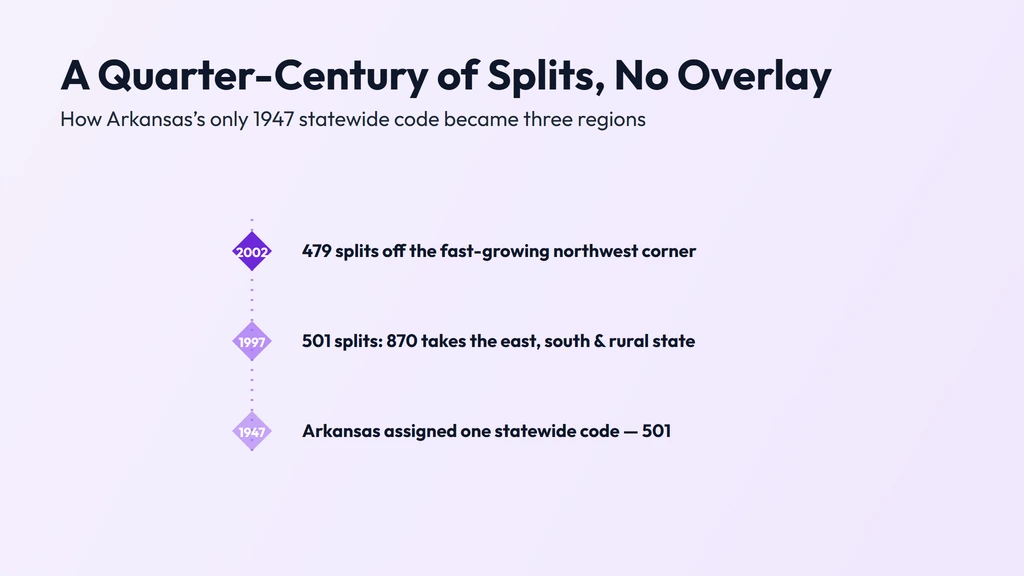
501's story is one of two geographic splits rather than an overlay. When the North American Numbering Plan launched in 1947, Arkansas was assigned a single area code — 501 — covering the entire state, one of the original 86 area codes created that year. That single-code arrangement held for exactly half a century.
- 501 — Arkansas's original 1947 statewide code, later narrowed to the central region around Little Rock
- 870 — split off on April 14, 1997, taking the eastern, southern and rural portions of the state and leaving 501 with the Little Rock metro and surrounding counties
- 479 — split off on January 19, 2002, taking the fast-growing northwest corner around Fayetteville and Fort Smith
The 1997 split was driven by Little Rock's growth and rising demand across the rest of the state straining the original code's supply of numbers, and regulators chose a geographic division rather than an overlay, giving the new 870 code the state's larger but less populous footprint.
The second split in 2002 responded to similar growth in the Fayetteville-Fort Smith corridor, leaving 501 with the smallest but most densely populated of Arkansas's three regions. A quarter century after that second split, 501 has never needed an overlay of its own, which sets it apart from many other state-capital codes that have since added a second layer.
Get a local number in this area code for your business — set up in minutes.
Why Arkansas Went to Ten-Digit Dialling in 2021
Local calls in the 501 area used to work on seven digits. Since October 24, 2021 they have needed all ten, and the reason is 988.
When 988 was designated nationally as the three-digit number for the Suicide and Crisis Lifeline, every area code that still allowed seven-digit dialling and had local numbers beginning 988 had a conflict: dial those seven digits and the network could not tell whether you wanted the crisis line or your neighbour. 501 was one of those area codes — it had numbers assigned on the 988 exchange — so Arkansas moved to mandatory ten-digit dialling instead.
Not every state solved it the same way. Maine's 207 faced the identical constraint and chose the opposite route: it withheld 988 as a local prefix and kept seven-digit dialling, which still works there today. Two states, one rule, opposite outcomes.
Nothing about the numbers themselves changed in 2021. A 501 number issued before the switch is still valid — only the way you dial it locally did.
How to Get a 501 Area Code Phone Number
Modern cloud phone providers let a business activate a 501 number in minutes — no Little Rock office, no hardware, and no long-term contract. Search available 501 numbers, complete a short verification, and route the line to any device anywhere in the world.
Because the code is instantly recognizable across the Little Rock metro, the number reads as authentically local across the whole region, even for a team working remotely from elsewhere.
A 501 number suits anyone who wants to feel rooted in the region: government-facing consultancies and law firms near the Capitol, higher-education and edtech services around Conway's college corridor, hospitality and event businesses in Hot Springs, defense contractors near Little Rock Air Force Base, and remote teams targeting central Arkansas from out of state.
Setting up a dedicated business phone number on 501 takes only a few steps. MeraTalk provides 501 numbers as part of its cloud telephony platform — lines activate in minutes, route to any device, and pair with voicemail, call recording, an auto-attendant and CRM integration from one dashboard. To get started, search available numbers at meratalk.com.
Common 501 Phone Scams to Watch For
501 is a legitimate, long-established Arkansas code, but like any area code its numbers can be spoofed. Caller-ID spoofing lets a fraudster make any number — including a 501 prefix — appear on a screen, so a resident sees what looks like a nearby Little Rock business, bank or state agency calling.
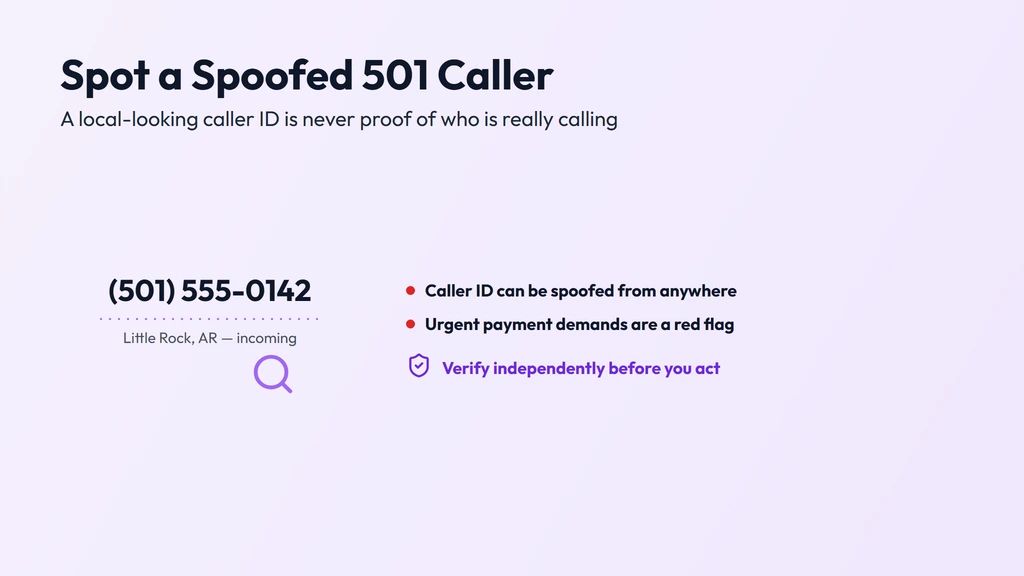
The prefix itself proves nothing: a genuine 501 call and a spoofed one look identical, and within the region, Little Rock and Conway are frequently reported by consumers for unwanted spam and scam calls, so extra caution is warranted for numbers from those cities specifically.
Arkansas residents who encounter a suspicious call can review current warning signs and file a report through USAGov's consumer complaint resources, which route reports to the right federal or state agency.
- Fake bank or payment alerts — a voicemail or text about a 'suspicious transaction' pushing you to call back or tap a link
- State agency and utility threats — callers claiming to be from a state office or utility, warning of an unpaid balance or service cutoff unless you pay immediately
- Prize and refund lures — claims you have won something or are owed a refund, requesting card details to 'process' it
The reliable defense is to hang up and call back through a number you find independently — on a bill, an official website or a saved contact. No genuine bank, utility or government agency demands gift cards or wire transfers over the phone, and a local-looking 501 caller ID is never proof of who is really on the line.
Any pressure to act immediately should be treated as a warning sign in itself. For more, see consumer complaint resources.
Conclusion
The 501 area code is the number of central Arkansas — Little Rock and North Little Rock at its heart, Conway's college corridor and Hot Springs' resort economy to the west, and Benton, Jacksonville and the surrounding river-valley counties completing the region.
Arkansas's original 1947 statewide code, narrowed by two later splits and never overlaid since, 501 remains the state's political and financial center, distilled into a single, unmistakable area code. A 501 line remains a clear signal of the Little Rock metro, rooted in a government, finance, education and tourism economy found nowhere else in the state.
Activating a 501 virtual number takes minutes with MeraTalk. Go live with an authentic Little Rock presence, route calls to any device, and add call recording, an auto-attendant and CRM integration from day one — no physical central-Arkansas office required. Explore the options at meratalk.com.
Ready to get started with 501 area code?
Join thousands of businesses using MeraTalk for Wholesale Voice, VoIP, and phone number services.
Contact MeraTalk Today