Introduction
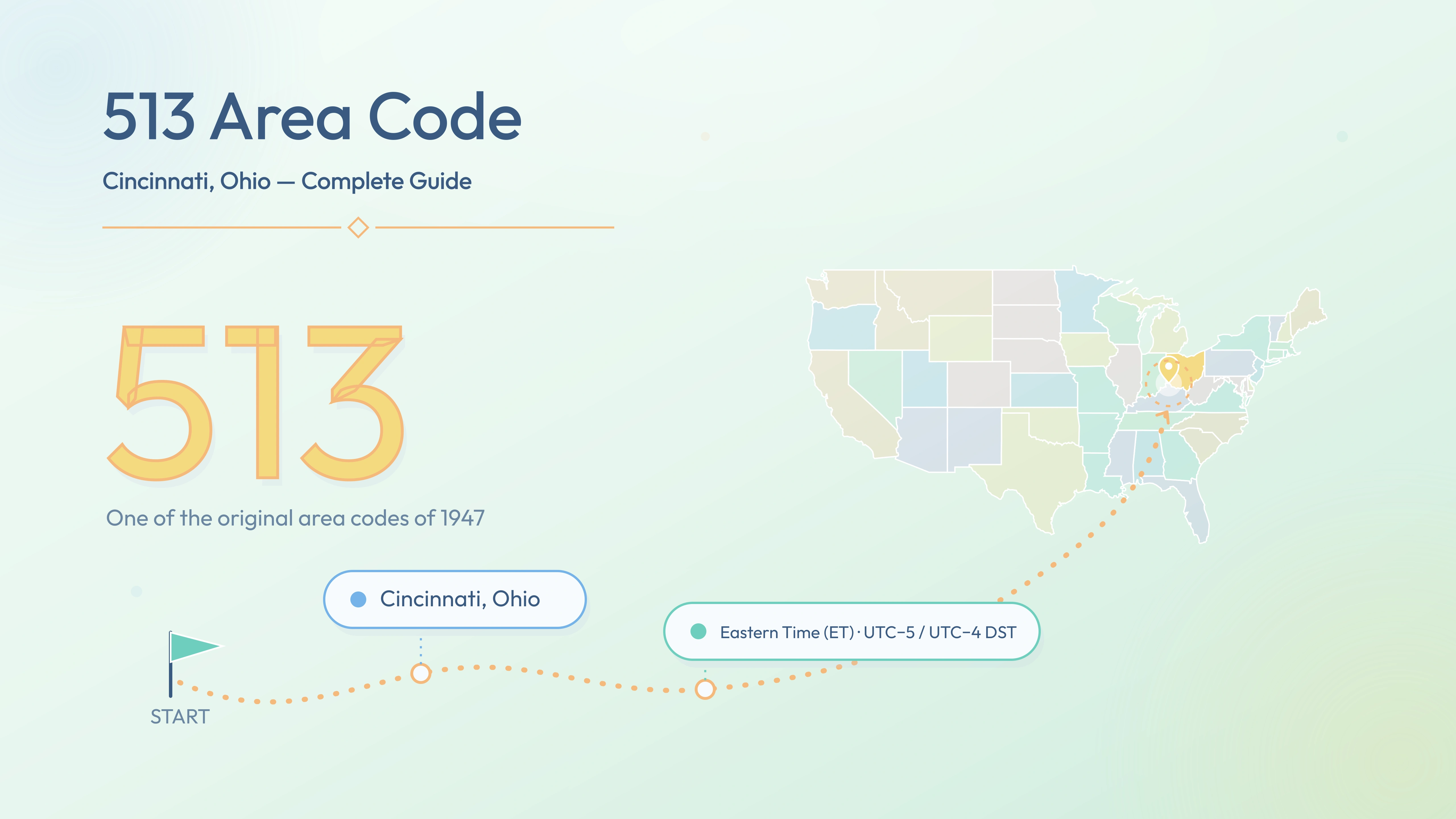
The 513 area code is the telephone code for Cincinnati, Ohio. It covers Hamilton County and the surrounding southwestern Ohio counties of Butler, Warren, and Clermont on Eastern Time. It has identified Cincinnati since 1947, when Ohio was first divided under the North American Numbering Plan, hosting some of the best-known consumer brands in the world alongside one of America's most celebrated historic districts.
For businesses on either side of the Ohio River, the code reads as the authentic Cincinnati signature.
This guide walks through the full picture: the territory the code covers, the neighborhoods and suburbs that define it, how the 283 overlay changed local dialing, the codes bordering the region in Kentucky and around Dayton, the corporate economy that drives number demand, and a simple three-step way to activate a local line.
Key Takeaways
Covers where is the 513 area code in depth
Covers 513 area code location in depth
Covers 513 area code time zone in depth
Covers 513 vs 283 overlay in depth
Need a business phone number? Get a MeraTalk number in minutes, no contract required.
Get started freeWhat Is the 513 Area Code?
The code serves Cincinnati and the surrounding counties of southwestern Ohio. It arrived in the original 1947 numbering of the continent, when a handful of codes divided the whole state, and its territory has narrowed over the decades as other Ohio regions received prefixes of their own. Today it covers the Cincinnati metro's Ohio side — from the riverfront through the northern suburbs — while Northern Kentucky, though part of the same metropolitan area, dials under its own code.
- Dialing format: (513) 555-0123
- International format: +1 513-555-0123
- Time zone: Eastern Time (ET) — UTC−5 Standard, UTC−4 Daylight Saving
- Introduced: 1947 — one of the original 1947 codes
Since the 283 overlay was added across the same footprint, every local call is dialed with ten digits. Existing numbers kept their original code, which is why the classic prefix still dominates the signage, advertising, and established business lines of the metro — and still carries the stronger local recognition of the two.
Where Is the 513 Area Code? Cities & Communities
The coverage area runs from the Ohio riverfront north through Cincinnati's historic neighborhoods and out to the fast-growing suburbs along the interstate corridors. Four communities give a good sense of the territory.
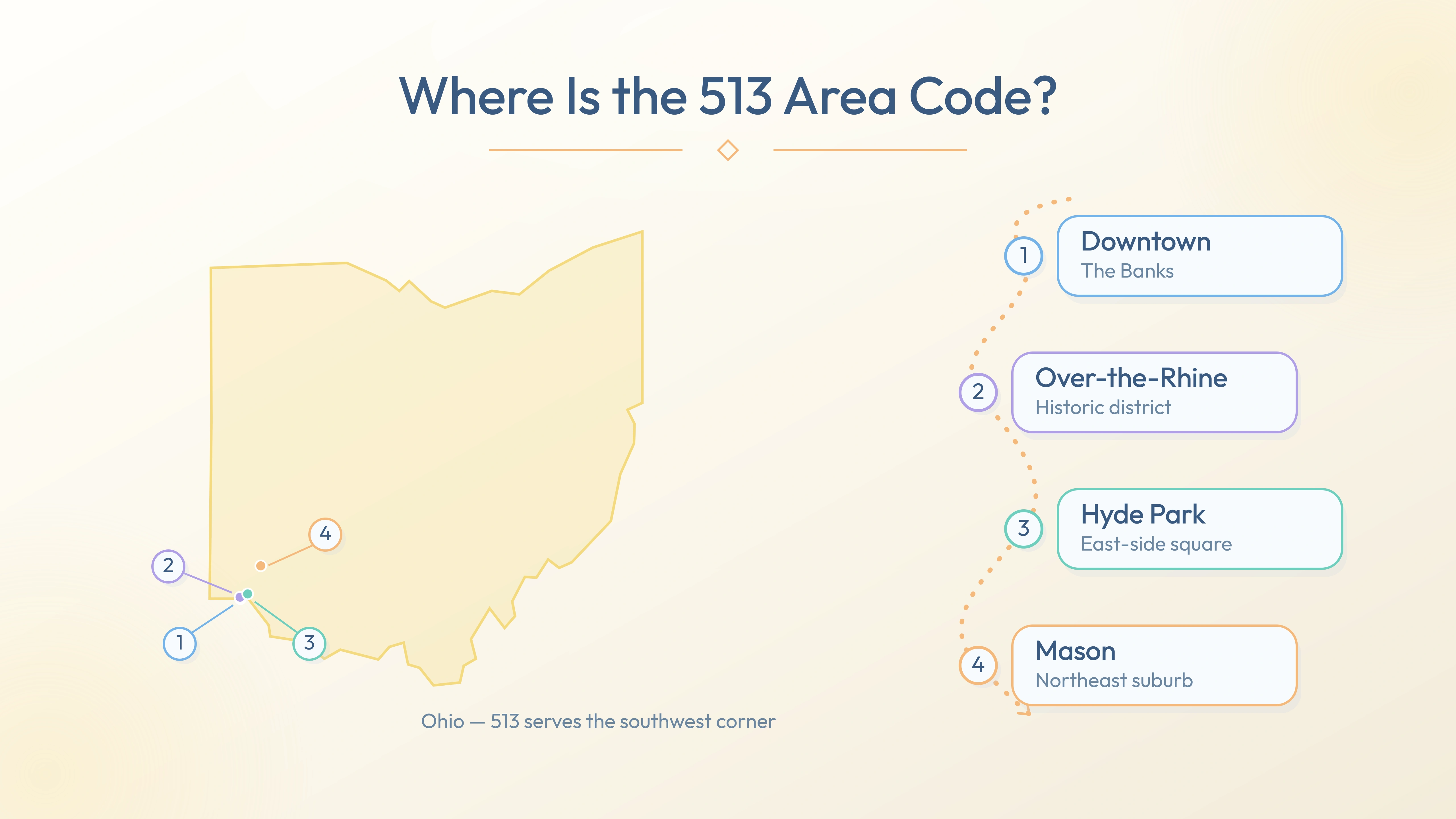
Downtown
Downtown Cincinnati is anchored by The Banks, the riverfront district that stretches between the city's two stadiums and connects the business core to the water. Corporate headquarters, hotels, and restaurants concentrate here, and their main lines carry the local prefix that customers across the region recognize on sight.
Over-the-Rhine
Over-the-Rhine is the city's famed historic district, holding one of the largest collections of nineteenth-century Italianate architecture in the country. Its revival has filled Vine Street and the blocks around Findlay Market with restaurants, breweries, boutiques, and startups — nearly all of them answering on local numbers that match the neighborhood's proudly Cincinnati character.
Hyde Park
Hyde Park is the east side's signature neighborhood, arranged around a classic square of shops, cafes, and professional offices. Its medical practices, realtors, and boutiques serve some of the city's most established residential streets, and the local prefix has been part of the neighborhood's fabric for generations.
Mason
Mason, the northeast suburb, has grown into one of the metro's strongest business addresses, with corporate campuses, a famous amusement park, and a top-tier tennis tournament on its calendar. Its employers and family businesses dial under the same code as the urban core, extending the metro's shared identity well beyond the city limits.
Counties and Communities the 513 Code Serves
The prefix covers Cincinnati's Ohio-side metro across four southwestern Ohio counties. Anyone checking whether a local number will land in the right market can use the list below as a quick reference for the cities the code covers.
- Hamilton County — Cincinnati, Norwood, Forest Park, and Harrison
- Butler County — Hamilton, Middletown, West Chester, and Oxford
- Warren County — Mason and Lebanon
- Clermont County — Milford, all sharing the 283 overlay on the identical footprint
513 Overlay and Nearby Area Codes
Southwestern Ohio now dials under two codes covering identical ground. The 283 overlay was introduced so new numbers could keep being issued without changing any existing line, and its arrival made ten-digit dialing mandatory for every local call in the region.
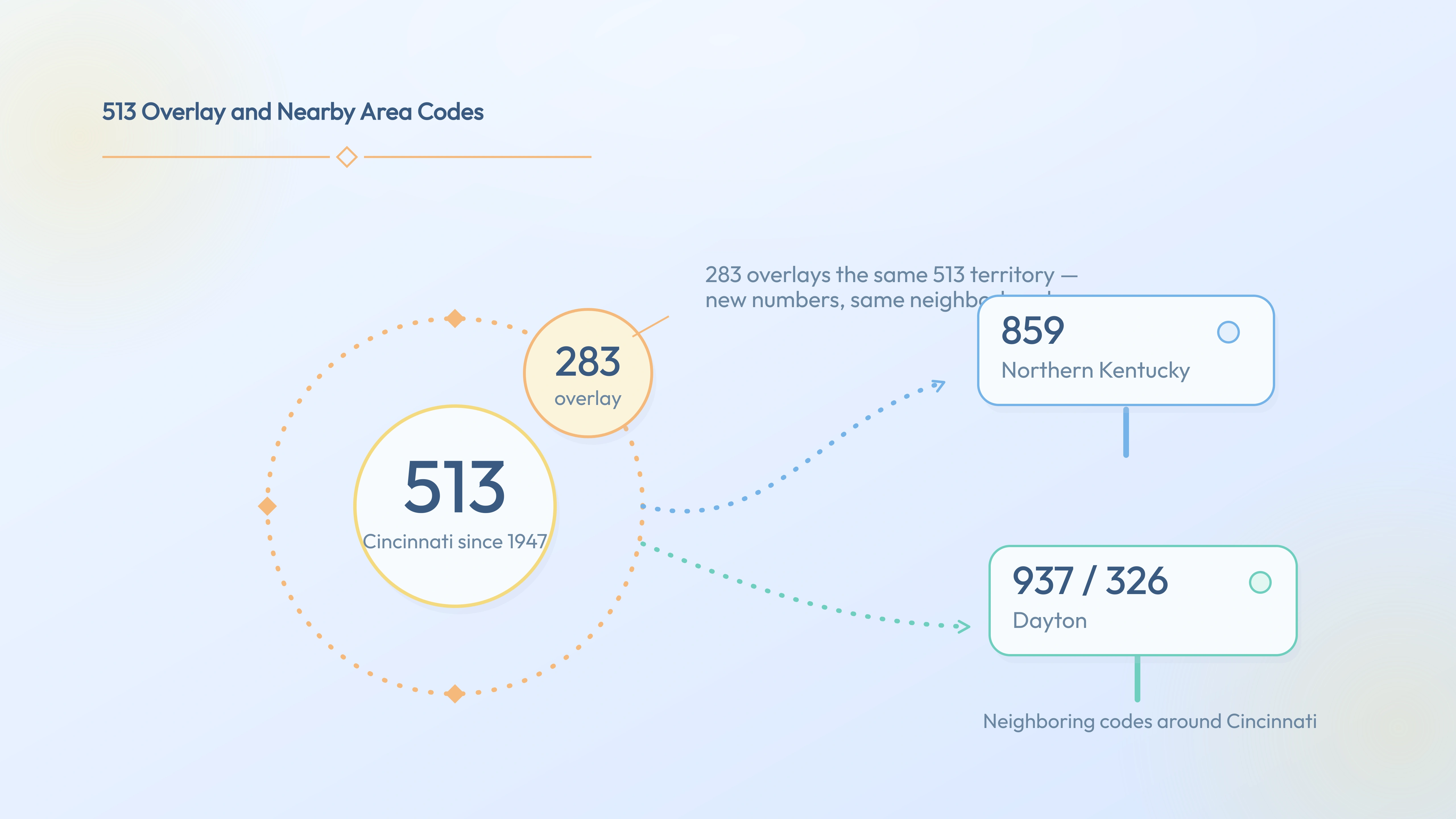
- 513 — the original 1947 code for Cincinnati and southwestern Ohio
- 283 — the overlay sharing the exact same footprint, common on newer lines
- 859 — Northern Kentucky, directly across the Ohio River
- 937 / 326 — Dayton and west-central Ohio to the north
The metro's geography makes the neighboring codes unusually relevant: Covington and Newport sit just across the river in 859 territory, and Dayton's 937 and 326 begin less than an hour north. Further west, the 765 area code covers the central Indiana ring, rounding out the cluster of prefixes a Cincinnati business is likely to dial in a normal week. Within that cluster, the original Cincinnati code remains the strongest hometown marker.
Get a local number in this area code for your business — set up in minutes.
513 Time Zone
The region observes Eastern Time (ET) — UTC−5 during Standard Time and UTC−4 during Daylight Saving Time, which runs from mid-March to early November. Cincinnati keeps the same clock as New York, Atlanta, and the entire East Coast corridor.
For business, Eastern Time is the country's default rhythm: markets, headquarters, and media all key off it. A Cincinnati-numbered line therefore matches the schedule most national customers already assume, and a team answering that line from another region simply follows Eastern hours to appear seamlessly local.
The Cincinnati Economy and Business Scene
Cincinnati's economy is remarkably headquarters-heavy for its size, pairing global consumer companies with advanced manufacturing. That corporate density trickles down to a busy ecosystem of agencies, suppliers, and startups — many of which now run their sales lines on cloud phone numbers so a local presence can follow them wherever their teams work. Three sectors define the metro.
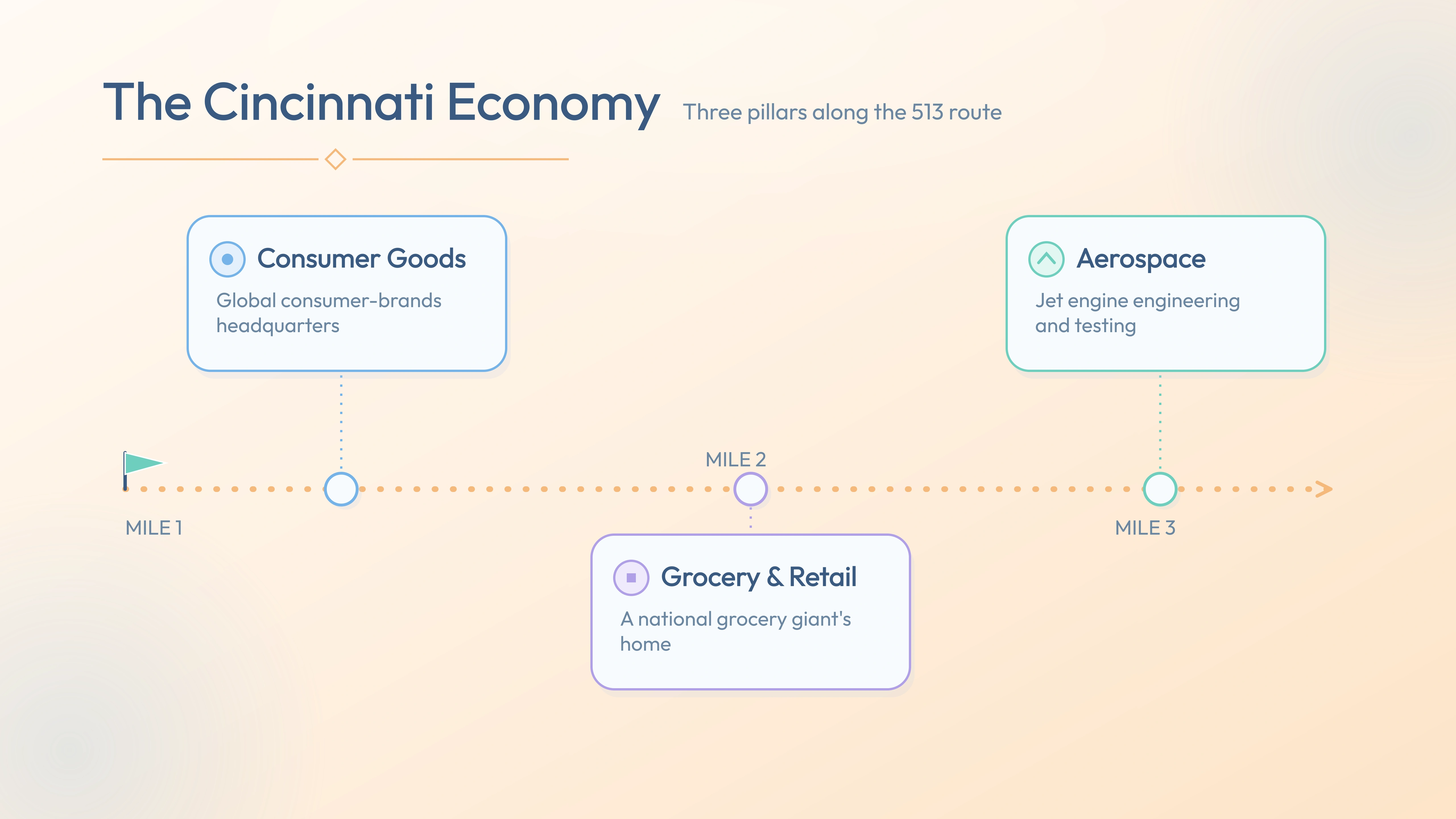
Consumer Goods
Cincinnati is a global consumer-brands headquarters city. Household-name products are conceived, tested, and marketed from offices here, and the industry sustains a deep local bench of brand agencies, market researchers, and packaging designers who serve it — an unusually complete consumer-goods ecosystem for a midwestern metro.
Grocery & Retail
The city is home to a national grocery giant, and the retail expertise concentrated around it shapes the local job market from data science to logistics. Retail technology firms and food brands gravitate to the metro to be close to that decision-making, reinforcing Cincinnati's standing in how America shops.
Aerospace
Jet engine engineering and testing happens on the metro's north side, where one of the world's major engine makers runs its operations. The plants and labs anchor a network of precision suppliers and engineering contractors across the region, tying southwestern Ohio directly into global aviation.
A similar dynamic plays out in the 614 area code, where Columbus companies weigh the same trade-offs.
How to Get a 513 Phone Number
Claiming a Cincinnati number is now a same-day, fully online task. No Ohio address is needed — the number lives in the cloud and rings wherever it is pointed. Three steps cover it.
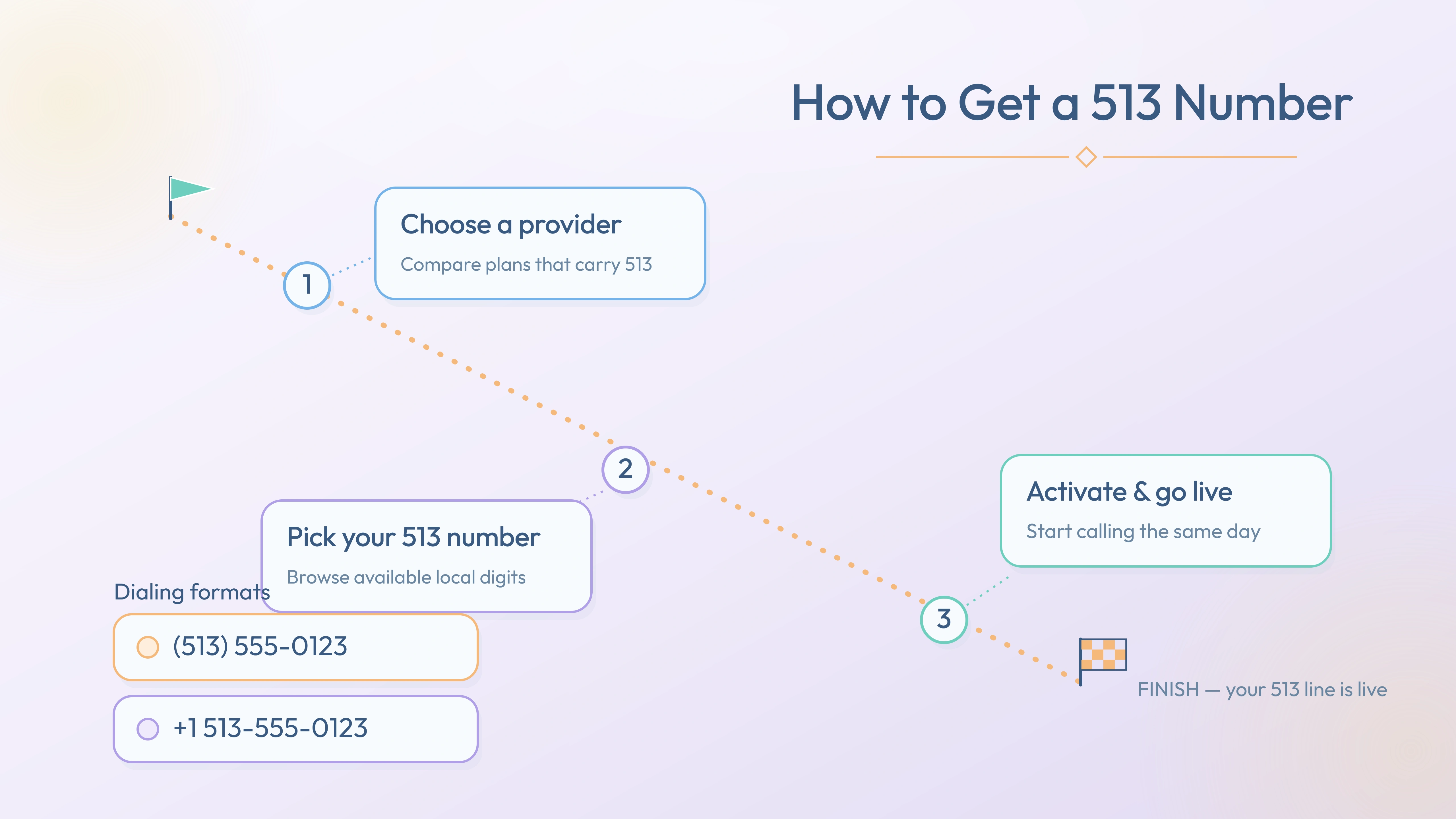
- 1Choose a provider. Pick a cloud phone service with Cincinnati inventory and the business features — routing rules, voicemail, hours-based handling — the operation requires.
- 2Pick a number. Search available local options and select digits that read well in marketing — the line will display as (513) 555-0123 locally and as +1 513-555-0123 in international format.
- 3Activate and route. Finish verification, then send calls anywhere. The number rings on any device — a desk phone in Mason, a laptop in Over-the-Rhine, or a mobile on the road.
The result behaves exactly like a line installed downtown: customers in Hyde Park see a familiar prefix on caller ID, while the business answers from wherever its people actually sit.
Why Local Numbers Still Matter in Cincinnati
Even as messaging apps and email absorb more of daily communication, the humble local phone number keeps its commercial pull in the Queen City. Residents screening unknown calls are far more willing to answer a familiar hometown prefix than an out-of-state or anonymous one, and that single behavioral fact shapes how smart businesses present themselves.
For companies competing in southwest Ohio, a local line does quiet work on every outbound call: it tells the customer the business is nearby, reachable, and invested in the market. Service trades, medical and dental offices, insurance agents, and local retailers all see the benefit most directly, because their customers actively prefer dealing with neighbors.
Cloud telephony extends the same advantage to remote and expanding companies — a firm headquartered elsewhere can answer on a Cincinnati line and compete on level footing with businesses down the street. For more, see 1947 numbering.
Common Phone Scams to Watch For
Scam callers routinely spoof local prefixes because a hometown caller ID earns more answered calls, and the Cincinnati region is no exception. Frequent schemes include fake fraud alerts pretending to be a bank, utility shut-off threats demanding immediate payment, and robocalls about expiring vehicle warranties.
- Legitimate banks, utilities, and agencies never demand payment by gift card, cryptocurrency, or wire transfer.
- Pressure to act immediately is the clearest red flag — real organizations allow time to verify.
- When in doubt, hang up and call back using the number printed on an official bill or card.
Businesses should also protect their own outbound reputation. Registering numbers with the caller authentication tools modern providers offer helps genuine calls display as verified, so customers can tell a real local business from a spoofed imitation.
Conclusion
Cincinnati's prefix has connected the metro since 1947 — through the rise of its consumer-brands empire, the restoration of Over-the-Rhine, and the growth of suburbs like Mason into corporate addresses of their own. The 283 overlay changed how locals dial, but not which digits they trust.
For a business, those digits are an inexpensive credibility asset in a market that notices hometown signals. A local Cincinnati number can be live within minutes on a modern cloud platform, ringing any device anywhere — no riverfront office required.
Ready to get started with 513 area code?
Join thousands of businesses using MeraTalk for Wholesale Voice, VoIP, and phone number services.
Contact MeraTalk Today