Introduction
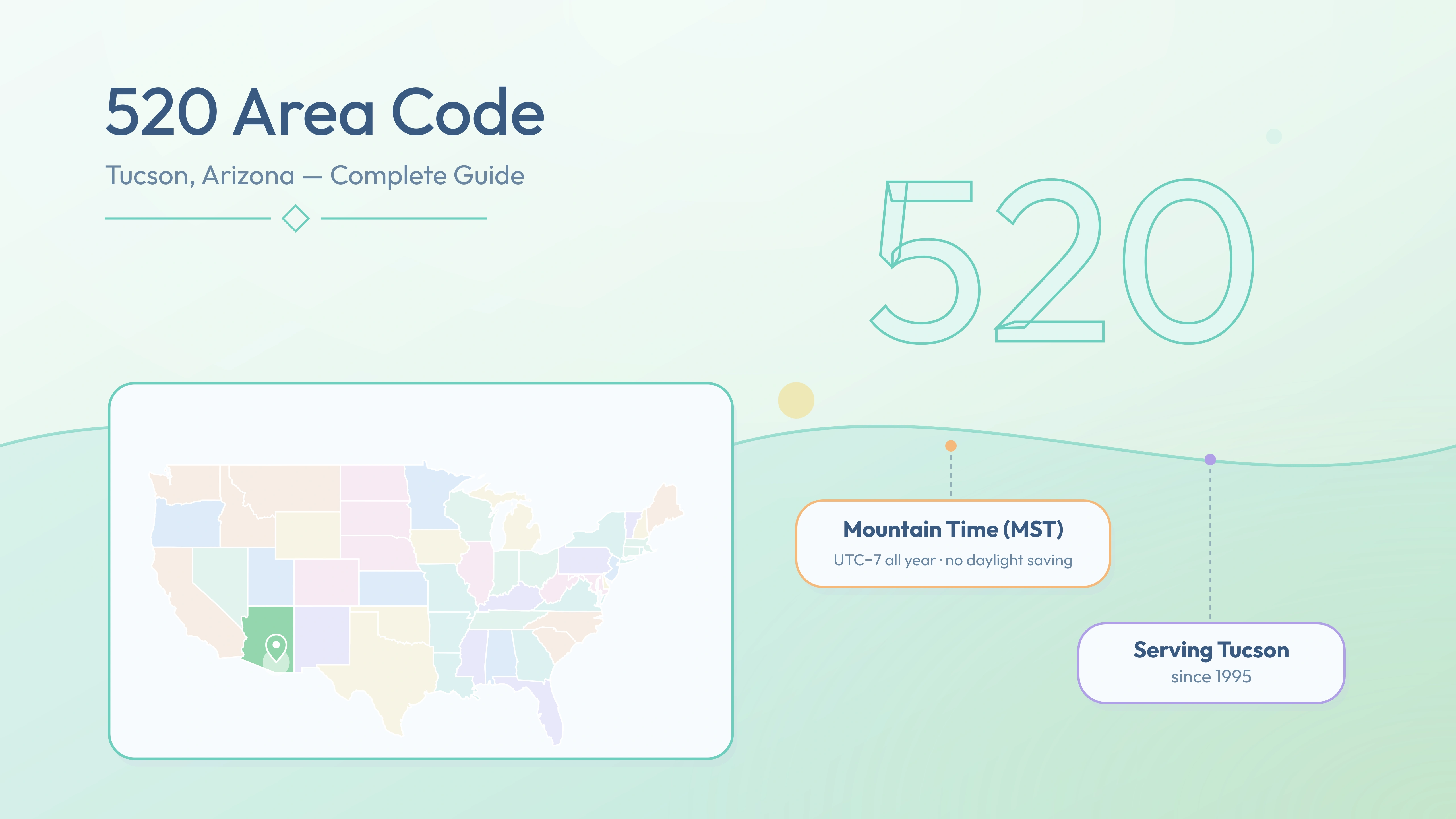
The 520 area code is the telephone code for Tucson, Arizona, and the southeastern corner of the state — Pima, Cochise, and Santa Cruz counties plus part of Pinal — on Mountain Standard Time year-round, as Arizona does not observe daylight saving.
While Phoenix commands the center of the state, Tucson has carved out its own identity: a university city ringed by saguaro-covered mountains, where missile systems, telescope mirrors, and mining technology are designed within a few miles of one another.
This guide lays out the essentials: the code's history and coverage, the neighborhoods and suburbs it serves, the nearby Arizona codes, the state's unusual year-round clock, the industries that define the Tucson business scene, and the quick online process for activating a local 520 line from anywhere.
Key Takeaways
Covers where is the 520 area code in depth
Covers 520 area code location in depth
Covers 520 area code time zone in depth
Covers get a 520 phone number in depth
Need a business phone number? Get a MeraTalk number in minutes, no contract required.
Get started freeWhat Is the 520 Area Code?
The code was created in 1995, when it was split from Arizona's original 602 code to serve everything outside the Phoenix metropolitan area. In 2001 a further split assigned 928 to northern and western Arizona, leaving the prefix focused on the state's southeastern corner — Tucson and Pima County at its heart, along with Sierra Vista, Nogales, and the borderland communities stretching toward New Mexico.
The two splits tell the story of Arizona's growth in miniature. For nearly half a century a single code served the entire state; then the Phoenix boom of the 1990s forced the first division, and continued growth statewide forced the second only six years later. Through both changes, Tucson and its neighbors kept the digits assigned in 1995, and the code has settled into a stable identity for the southeastern quarter of the state.
- Dialing format: (520) 555-0123
- International format: +1 520-555-0123
- Time zone: Mountain Time (MST) — UTC−7 year-round — Arizona does not observe daylight saving
- Year introduced: 1995
Where Is the 520 Area Code? Cities & Communities
The code covers southeastern Arizona, anchored by the Tucson metropolitan area in Pima County. Four communities give the metro its shape.
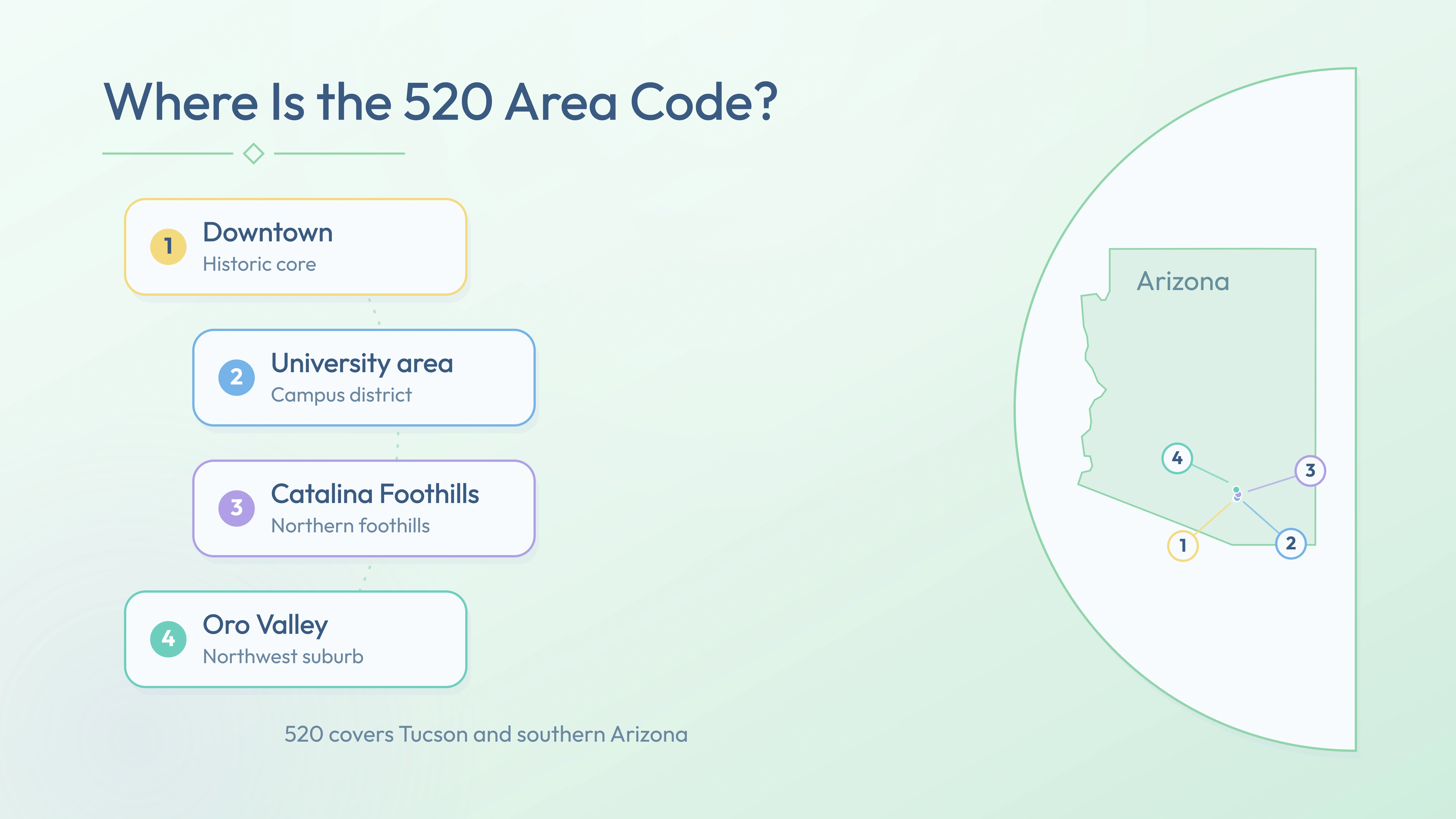
Downtown
Downtown is Tucson's historic core, where adobe-era barrios meet a revived arts and dining scene along Congress Street. The modern streetcar links the district to the university, and restored theaters, galleries, and restaurants have made it the metro's gathering place once again. City and county government offices keep the district busy on weekdays, while festivals and gem shows fill its calendar through the cooler months.
University area
The University area is the campus district surrounding the University of Arizona, one of the state's flagship research institutions. Student life fills the surrounding blocks, while the university's laboratories — particularly in optics and astronomy — feed talent directly into the region's technology employers.
Catalina Foothills
Catalina Foothills climbs the northern foothills of the Santa Catalina Mountains, where desert ridgelines carry some of the metro's most sought-after addresses. Resorts, trailheads, and hillside homes share sweeping views over the city and the valley below.
Oro Valley
Oro Valley is the metro's northwest suburb, a planned community that has grown into a substantial town in its own right. Technology and bioscience employers have settled here alongside golf communities and retail centers at the base of the Catalinas.
The wider footprint stretches far past the metro. Marana and Sahuarita bracket Tucson to the northwest and south, Sierra Vista serves the Army's intelligence post at Fort Huachuca, Nogales anchors the busy border crossing into Sonora, and the historic towns of Bisbee and Tombstone sit among the mountains to the southeast. One local number carries recognition across the entire borderland region.
Counties and Communities the 520 Code Serves
The prefix covers the southeastern quarter of Arizona, from the Tucson metro to the Mexican border. Anyone checking whether a local number will land in the right market can use the list below as a quick reference for the cities the code covers.
- Pima County (Tucson metro) — Tucson, Oro Valley, Marana, and Sahuarita
- Santa Cruz and Cochise counties — Nogales, Sierra Vista, Douglas, and Bisbee
- Green Valley and the southern desert communities
- Neighboring codes — Phoenix uses 602, 480, and 623, while 928 covers northern and western Arizona
520 Overlay and Nearby Area Codes
The code has no overlay. Every line in southeastern Arizona shares the same prefix, which keeps dialing simple and gives the region a clean single-code identity. An overlay would only arrive if local number supply neared exhaustion, and no such overlay is in effect today.
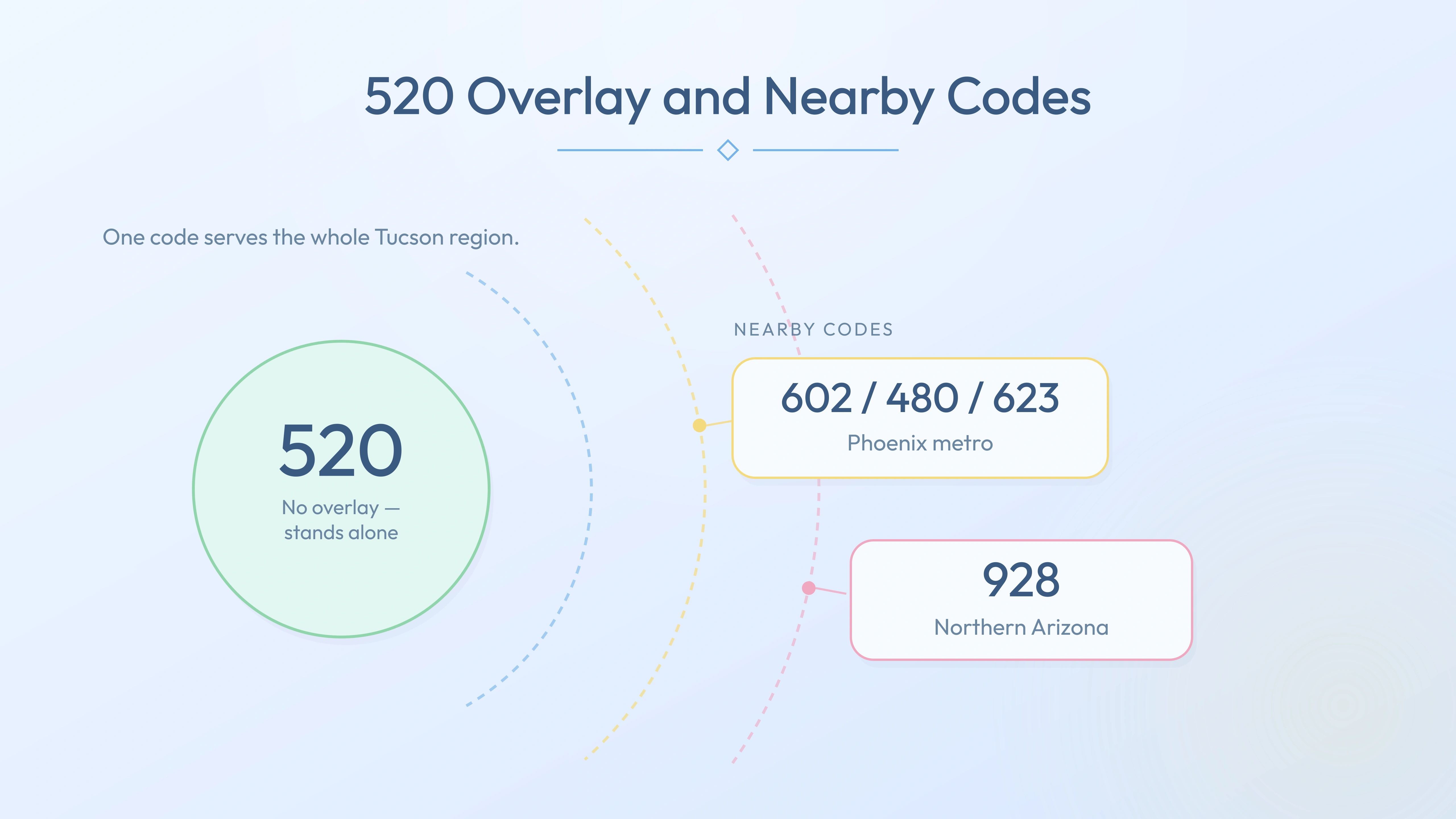
Two neighboring code groups border the territory. To the north and west, the Phoenix metro uses 602, 480, and 623 — three codes dividing the Valley of the Sun among central Phoenix, the East Valley, and the West Valley. Beyond the metros, 928 wraps around northern Arizona, from Flagstaff and the Grand Canyon down to Yuma.
Border-region economies often share more with distant coastal metros than with their own state capitals — Tucson's trade and defense ties run west toward the 619 area code territory of San Diego, another desert-adjacent city whose economy leans on the military and cross-border commerce.
Get a local number in this area code for your business — set up in minutes.
520 Time Zone
Southern Arizona keeps Mountain Standard Time (MST) — UTC−7 year-round — because Arizona does not observe daylight saving. Clocks in Tucson never change: in winter the city matches Denver, and in summer, while the rest of the Mountain zone springs forward, Tucson effectively aligns with Pacific Time cities like Los Angeles instead.
For businesses this quirk is worth planning around. A local number answers on a fixed offset all year, so teams elsewhere should remember that the gap to East Coast callers stretches from two hours in winter to three in summer. Many Tucson firms simply publish hours in local time and let the steady clock work in their favor — no twice-yearly adjustment ever applies.
The fixed clock also simplifies cross-border scheduling. Sonora, the Mexican state directly to the south, likewise skips daylight saving in most of its territory, so Tucson firms trading through Nogales coordinate with partners across the line on a matching schedule for much of the year — a small but genuine convenience for the borderland economy.
The Tucson Economy and Business Scene
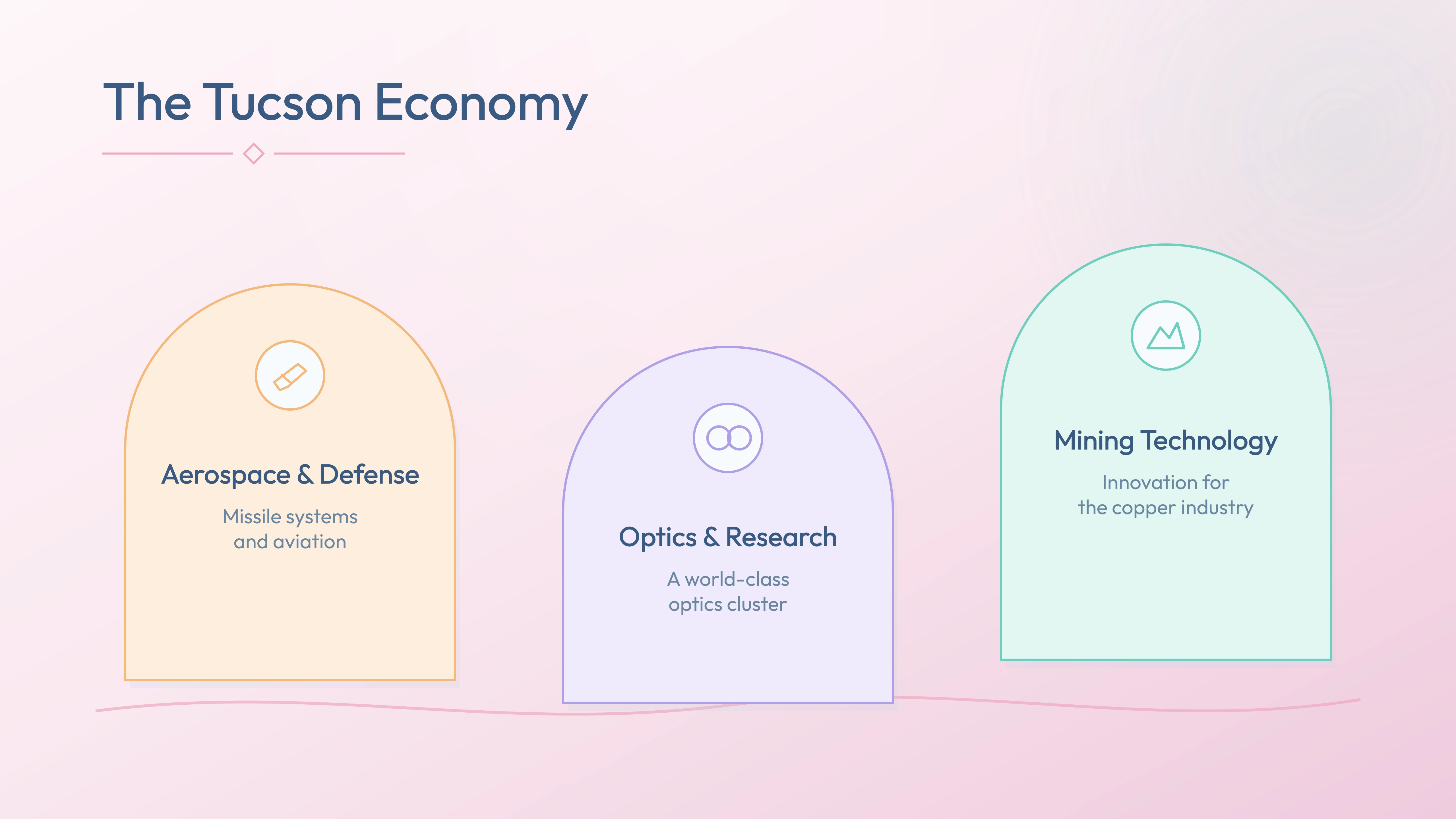
Tucson's economy pairs deep federal and university roots with a surprising concentration of specialized engineering. The metro has deliberately grown around knowledge industries rather than sheer scale, and the result is a business scene where a relatively small city fields globally significant capabilities. Three pillars define the region's identity.
Aerospace & Defense
Missile systems and aviation anchor the metro's industrial base. One of the world's major missile builders operates a large campus beside the airport, Davis-Monthan Air Force Base sustains a substantial military community, and a network of precision suppliers and maintenance operations has grown around both. Engineering talent circulates among these employers and the university's programs.
The sector's long production timelines and security requirements make it an unusually stable employment base, insulating the metro from the boom-and-bust cycles that affect many Sunbelt economies.
Optics & Research
Tucson hosts a world-class optics cluster, sometimes called Optics Valley. The University of Arizona's renowned optical-sciences programs and mirror laboratories — which polish segments for some of the largest telescopes ever built — have spun out generations of lens makers, imaging firms, and photonics startups that sell into medicine, astronomy, and industry worldwide.
Mining Technology
Innovation for the copper industry rounds out the picture. Southern Arizona sits amid some of the continent's most productive copper districts, and Tucson has become the place where mining companies develop automation, remote-operations, and environmental technology. The university's mining programs and a cluster of engineering firms serve operations across the Americas, a specialization as regionally distinctive as the innovation corridors covered in the 925 area code guide to California's East Bay.
Firms expanding across the region often add a second local presence in the 714 area code to reach Anaheim customers.
How to Get a 520 Phone Number
A Tucson number is available to any business through cloud telephony — no southern Arizona address, hardware, or long-term contract required. Three steps complete the process.
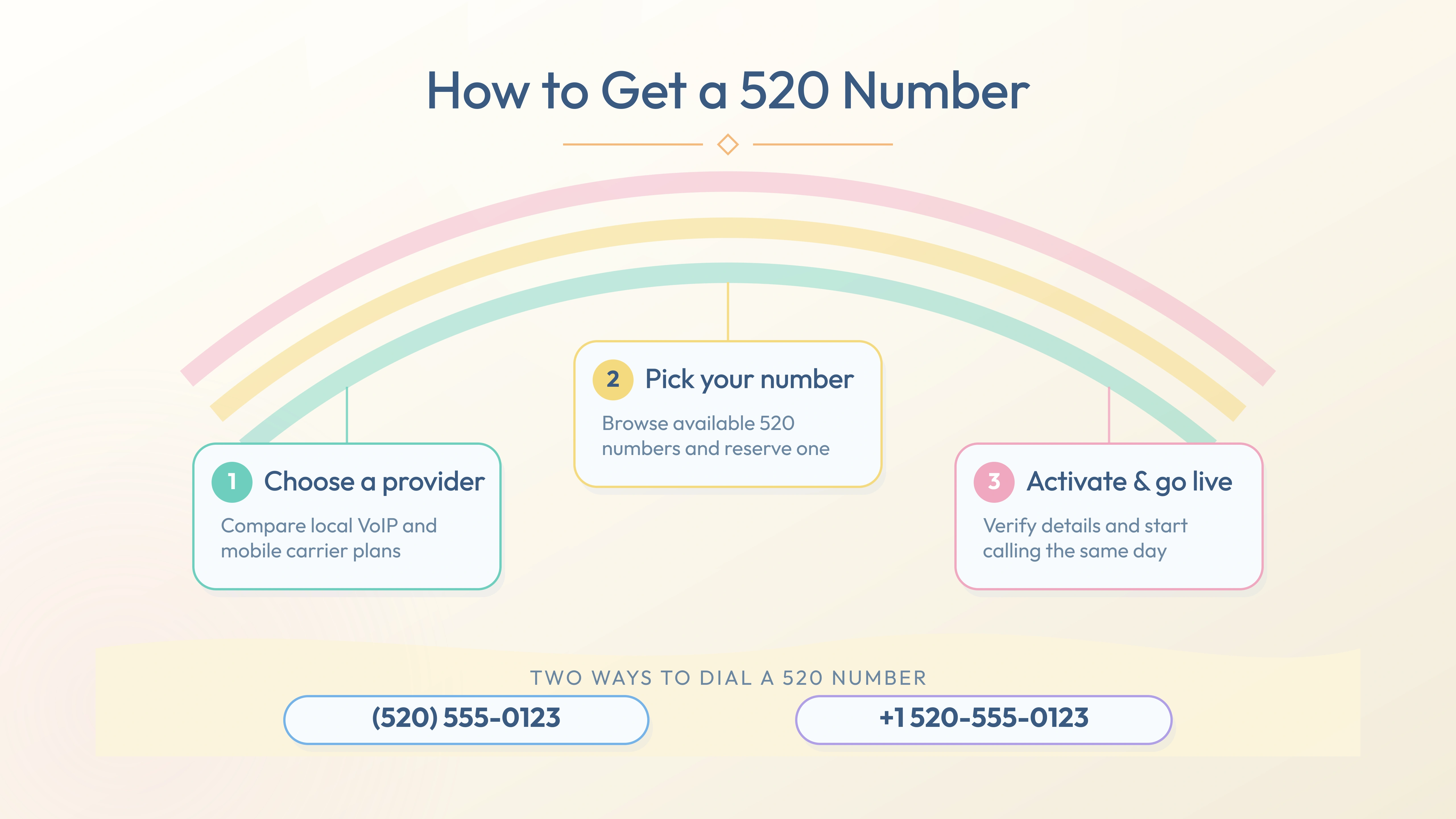
- 1Choose a provider. Select a cloud phone service that carries Arizona inventory, with listings in the Tucson, Oro Valley, and surrounding Pima County rate centers.
- 2Pick a number. Search available numbers and reserve a combination that fits the business — memorable digits, or a pattern that matches existing company lines.
- 3Activate and route. Complete verification, then send the line wherever work happens. Calls ring on any device — an office phone downtown, a mobile in the foothills, or a laptop out of state.
Once live, the number is dialed locally as (520) 555-0123 and internationally as +1 520-555-0123. Auto-attendant, business-hours routing, and voicemail-to-email complete the setup, giving the local line the capabilities of a full office phone system. Businesses that already hold a Tucson number can port it to a cloud provider and keep the digits customers recognize while upgrading the features behind them.
Landlines, Mobiles, and 520 Numbers
The prefix on a southern Arizona number reveals where it was assigned, but nothing about the device answering it. The same 520 inventory feeds traditional landlines in Tucson storefronts, mobile handsets across Pima County, and cloud-based lines that ring on laptops and apps anywhere. The numbering plan is organized by geography, not by technology, so all three coexist under one code.
This device-neutrality is what lets numbers outlive the hardware they started on. A family number installed on a kitchen wall phone decades ago can now live on a smartphone, and a business line that once terminated at a desk can follow employees between office, home, and the road. For companies serving the Tucson market, it means choosing a local number is a branding decision, not a technology commitment — the line can move to whatever equipment the business uses next. For more, see overlay.
Choosing Between a Local Tucson Number and a Toll-Free Line
Businesses serving southern Arizona often ask whether a local line or a national toll-free number serves them better. The honest answer depends on the customer base each number is meant to reach.
- A local prefix wins with Tucson-area residents: familiar caller ID, better answer rates, and an unmistakable community signal for restaurants, clinics, trades, and local services.
- Toll-free numbers suit companies fielding calls from across the country, where geographic identity matters less than a consistent national brand.
- Vanity toll-free combinations add memorability for advertising-heavy businesses.
Many organizations simply run both — the local line for in-market advertising and the toll-free line for national campaigns — since cloud platforms let the two numbers ring the same team and share one set of routing rules.
Conclusion
Since 1995 this prefix has stood for southern Arizona — a region that builds missile guidance and telescope mirrors in the same desert valley, keeps its own steady clock, and grows around a historic downtown and a flagship university. It is one of the Southwest's most distinctive regional identities.
For a business that wants to be local to Tucson, a 520 line is the simplest signal available. It activates in minutes, rings any device anywhere, and places a company inside one of the country's most specialized desert economies.
Ready to get started with 520 area code?
Join thousands of businesses using MeraTalk for Wholesale Voice, VoIP, and phone number services.
Contact MeraTalk Today