Introduction
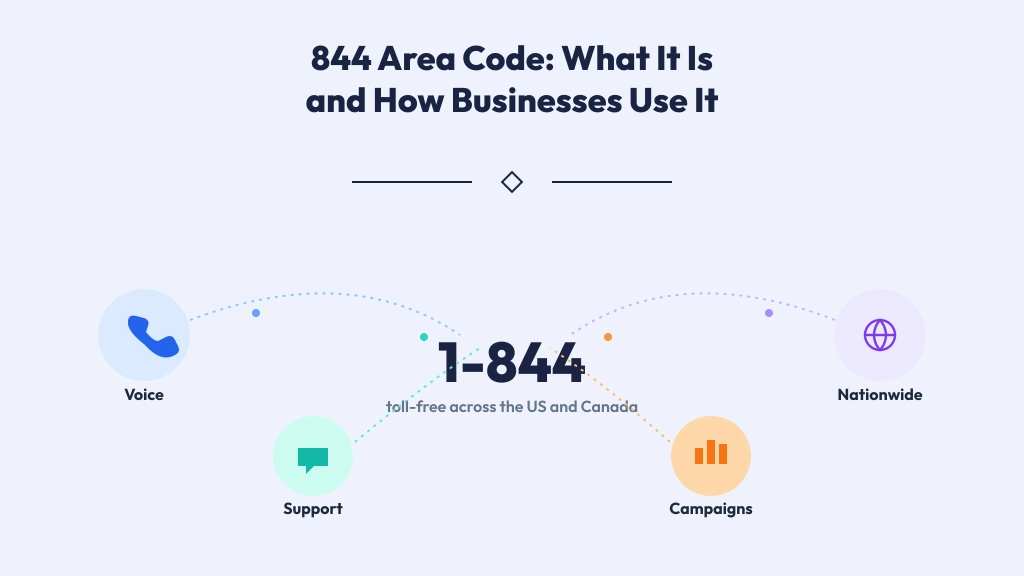
The 844 area code is a toll-free prefix in the North American Numbering Plan (NANP). When customers dial an 844 number, they pay nothing for the call — the business on the receiving end covers the cost. The prefix went live on December 7, 2013, after older toll-free codes such as 800 and 888 began running short of available combinations.
Because the prefix is non-geographic, a company in Texas, Toronto, or Tallahassee can answer the same 844 number without callers ever knowing where the phones ring. This guide explains how the code works, how to tell legitimate calls from scams, and how a business can claim its own number.
Key Takeaways
- 844 is a genuine toll-free code, activated in December 2013 as part of the NANP toll-free family.
- Calls to an 844 number are free for the caller; the subscribing business pays for the call.
- The prefix is not tied to any city, state, or province — it works across the US, Canada, and other NANP countries.
- Scammers sometimes spoof toll-free digits, so treat unexpected 844 calls with caution.
- Businesses obtain 844 numbers through Responsible Organizations (RespOrgs) and providers on a first-come, first-served basis.
Key Takeaways
844 is a genuine toll-free code, activated in December 2013 as part of the NANP toll-free family.
Calls to an 844 number are free for the caller; the subscribing business pays for the call.
The prefix is not tied to any city, state, or province — it works across the US, Canada, and other NANP countries.
Scammers sometimes spoof toll-free digits, so treat unexpected 844 calls with caution.
Need a business phone number? Get a MeraTalk number in minutes, no contract required.
Get started freeWhat Is the 844 Area Code?
The 844 area code belongs to the group of toll-free prefixes that also includes 800, 888, 877, 866, 855, and 833. It was the sixth toll-free code placed into service, created to relieve pressure on earlier prefixes as demand kept climbing. Functionally, an 844 number behaves exactly like an 800 number: the caller is never billed, and the subscriber pays for the airtime.
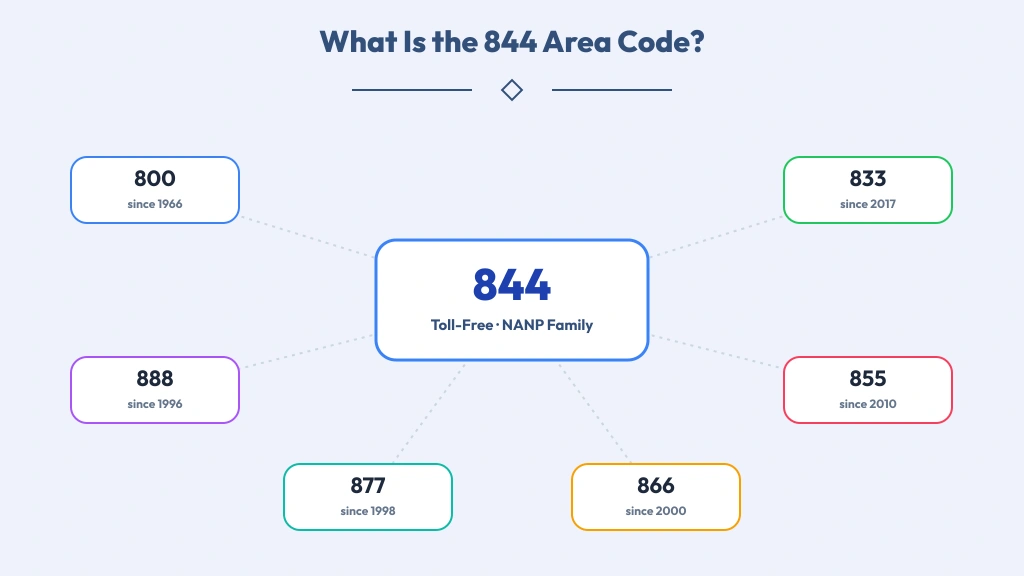
Toll-free numbering in the United States is overseen by the Federal Communications Commission and administered day to day through a central database managed by Somos. Entities called Responsible Organizations, or RespOrgs, reserve and manage numbers on behalf of subscribers. The FCC toll-free guide explains the caller-pays-nothing model and confirms that these numbers are portable between providers.
The Standard Number Format
Every number on this prefix follows the familiar ten-digit NANP pattern:
- Prefix: 844 — identifies the call as toll-free
- Exchange code: three digits assigned within the toll-free database
- Line number: four digits unique to the subscriber
Is the 844 Area Code Legitimate or a Scam?
The prefix itself is completely legitimate. The FCC authorized it, and banks, hospitals, airlines, insurers, and government help lines answer calls on it every day. The confusion arises because fraudsters know that toll-free digits look official, so they borrow that credibility. A spoofed 844 caller ID costs a scammer nothing and instantly makes a robocall look like a customer-service line.
Commonly reported schemes include fake debt collectors demanding payment for years-old obligations, phony fraud-alert calls pretending to be a bank's security team, and one-ring calls designed to bait a callback. The pattern mirrors what has been reported on every toll-free prefix — the 833 prefix guide covers the same tactics on the newest code, and the advice carries over directly.
How to Tell a Real Call from a Fake One
- 1Legitimate organizations rarely demand immediate payment, gift cards, or wire transfers over the phone.
- 2A real company will not object if the caller hangs up and dials back using the number printed on a statement or official website.
- 3Pressure, threats, and countdown deadlines are classic manipulation signals — genuine support teams do not use them.
- 4Requests for full Social Security numbers, one-time passcodes, or online banking credentials are red flags every time.
Consumers who receive suspicious calls can report them to the Federal Trade Commission, register with the National Do Not Call Registry, and enable call-screening tools on their smartphones and carrier apps.
844 vs Other Toll-Free Prefixes
All seven toll-free codes work identically — the differences come down to age, availability, and perception. The original 800 code dates back decades and carries the strongest instant recognition, but nearly every memorable combination on it was claimed long ago. Each newer code opened as its predecessors filled up: 888, then 877, 866, 855, 844 on December 7, 2013, and finally 833 on June 3, 2017.
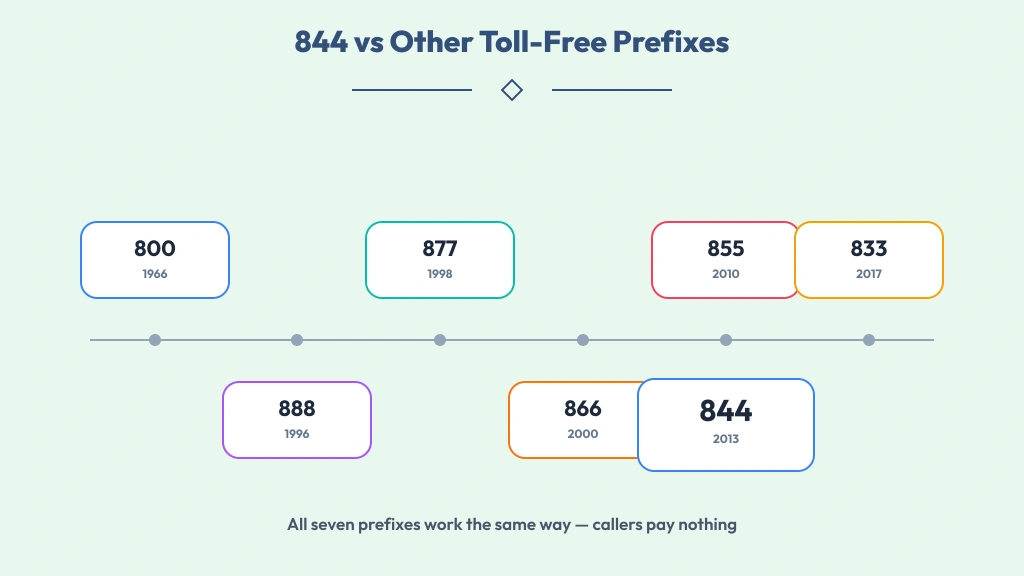
Where 844 Fits in the Family
- 800, 888, 877 — the oldest codes; supply of attractive numbers is thin
- 866 and 855 — mid-generation codes with moderate availability
- 844 — a strong balance of recognition and remaining inventory, in service since late 2013
- 833 — the newest code, with the widest selection of vanity patterns
One point worth stressing: dialing an 844 number costs the caller exactly the same as dialing an 800 number — nothing. Callers recognize all seven codes as toll-free, so the practical question for a business is simply which code still has the word or digit pattern it wants.
Vanity Numbers on the 844 Prefix
Because the prefix is younger than 800 or 888, many spellable combinations remain open. A vanity pattern that maps to a brand name is often still available on 844 when the same digits are long gone on older codes.
Get a local number in this area code for your business — set up in minutes.
Coverage and Location Flexibility
Geographic area codes anchor a number to a rate center in one city. Toll-free codes do the opposite: they float above the map. An 844 number reaches subscribers in all 50 US states, every Canadian province and territory, and the Caribbean nations that participate in the NANP. The company answering the call can sit anywhere.
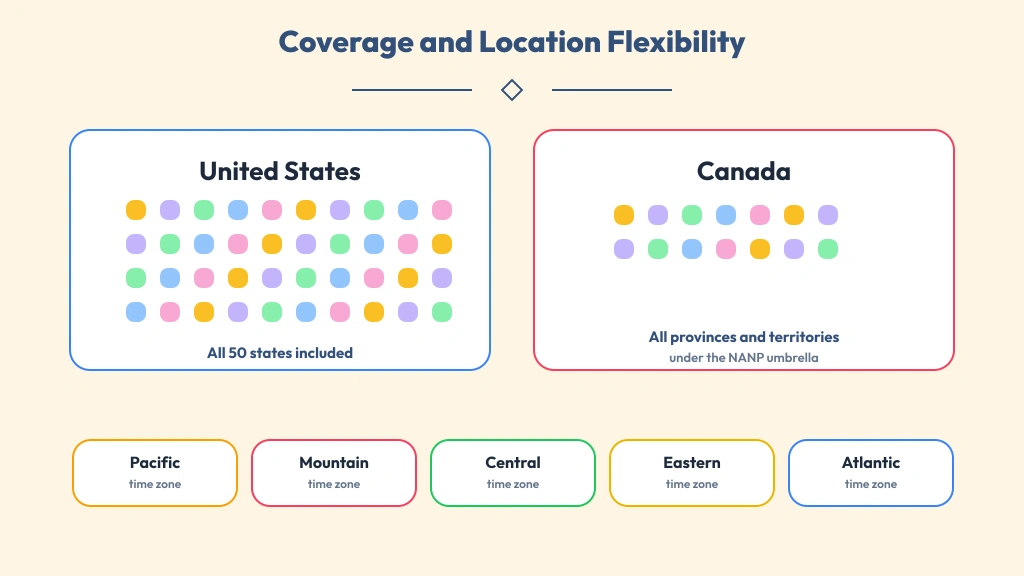
This location independence pairs naturally with toll-free call forwarding, which lets a business route its 844 line to an office phone during the day, a mobile after hours, and a voicemail-to-email box overnight. Teams spread across time zones can share one public number while calls quietly follow the sun behind the scenes.
What Location Independence Delivers
- One number for every market — no need to advertise separate local lines per city
- Continuity during moves — relocate the office and the number follows
- Distributed answering — route by time of day, agent skill, or caller menu choice
- Consistent branding — the same digits on packaging, ads, and invoices nationwide
Setup is simpler than most owners expect. Providers such as MeraTalk activate toll-free numbers with routing rules, IVR menus, and call analytics included, so a small team can present a national front door without new hardware.
Benefits of an 844 Number for Business
Lower Barriers for Customers
When the call is free, hesitation drops. Prospects comparing vendors, patients confirming appointments, and customers chasing an order all reach out more readily when no charge is attached.
A National, Professional Image
A toll-free line signals an established operation. A two-person startup with an 844 number presents the same polished contact point as a firm with offices in ten cities.
Marketing Measurement
Toll-free numbers can be assigned per campaign — one for the radio spot, another for the direct-mail piece — so response tracking becomes straightforward. Call analytics then show which channel actually makes phones ring.
Portability and Ownership Protections
FCC rules make toll-free numbers portable, meaning the subscriber can switch providers and keep the digits. The same rules prohibit warehousing and hoarding, so numbers are assigned to actual subscribers rather than stockpiled for resale.
Scales with Growth
The number that serves a solo founder can later feed a full contact center. Routing trees, queues, and extra users attach to the same number, so growth never forces a change to familiar digits.
Businesses comparing prefixes often shortlist the 866 area code alongside this one before deciding.
How to Get an 844 Number
Toll-free numbers are assigned on a first-come, first-served basis through RespOrgs and the providers that work with them. FCC rules forbid brokering — selling a toll-free number as a standalone asset — so numbers always come through an authorized provider, never a secondary marketplace.
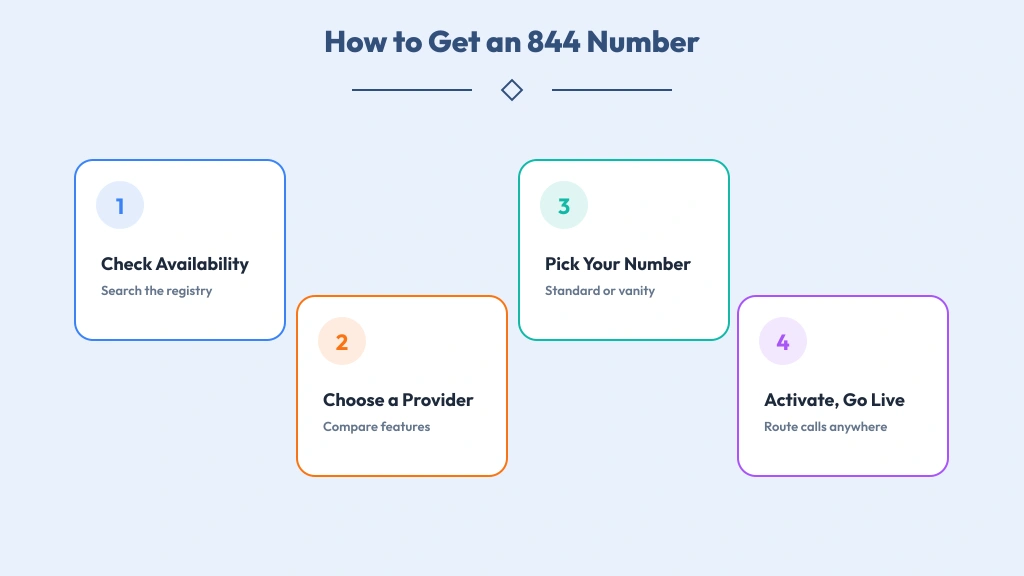
Six Steps from Search to First Call
- 1Search available inventory for the 844 combinations that suit the brand, including vanity patterns.
- 2Choose a provider based on routing features, support quality, and how easily the service scales.
- 3Reserve the number — the provider's RespOrg records the assignment in the toll-free database.
- 4Configure routing: destination phones, business-hours rules, greetings, and menu options.
- 5Test from multiple carriers and regions to confirm calls connect cleanly everywhere.
- 6Publish the number on the website, ads, invoices, and packaging once testing checks out.
Most cloud providers complete activation quickly, and porting an existing number in from another carrier is routine. Businesses ready to claim a number can compare available 844 options at meratalk.com and have a national line answering calls the same week.
Texting on an 844 Number
Voice is no longer the only channel a toll-free line can carry. Once a number on this prefix is text-enabled and passes the toll-free messaging verification process, it can send and receive SMS on the same digits customers already dial. That gives a business one recognizable contact point for calls, support texts, appointment reminders, and delivery updates alike.
- Two-way texting lets agents resolve quick questions without pulling customers into a phone queue
- Verified toll-free messaging routes carry strong deliverability and lower spam-filtering risk
- Order confirmations, reminders, and short surveys are natural fits for toll-free SMS
- Outbound programs require documented opt-in consent and an easy opt-out keyword such as STOP
Enabling messaging is usually a short verification submission through the provider, making it one of the simplest upgrades available for an existing toll-free line.
Handling Call Volume Spikes on a Toll-Free Line
Free-to-call lines invite volume, and volume rarely arrives evenly. A promotion, a press mention, or a service disruption can multiply inbound calls within the hour. The difference between a smooth surge and a wall of busy signals is routing that was configured before the spike, not during it.
- 1Build an IVR menu so callers sort themselves by need instead of stacking in one queue
- 2Add overflow rules that send excess calls to backup agents, mobile devices, or voicemail with callback
- 3Use schedule-based routing so after-hours callers hear accurate hours rather than unanswered ringing
- 4Review post-campaign analytics to match staffing to the call patterns each channel actually produces
Because cloud platforms manage routing in software, these safeguards can be adjusted from a dashboard in minutes — no carrier tickets, no new hardware, and no missed customers when the next campaign lands.
Conclusion
The 844 prefix earned its place in the toll-free family by removing the cost barrier between a business and its callers while still offering a healthy supply of memorable combinations. It is legitimate, regulated, portable, and recognized across North America.
For consumers, the sensible posture is simple: the code is trustworthy, individual callers may not be, so verify before sharing anything sensitive. For businesses, the opportunity is one free-to-call number that follows the company anywhere and scales from a single desk to a full support floor.
Ready to get started with 844 area code?
Join thousands of businesses using MeraTalk for Wholesale Voice, VoIP, and phone number services.
Contact MeraTalk Today