Introduction
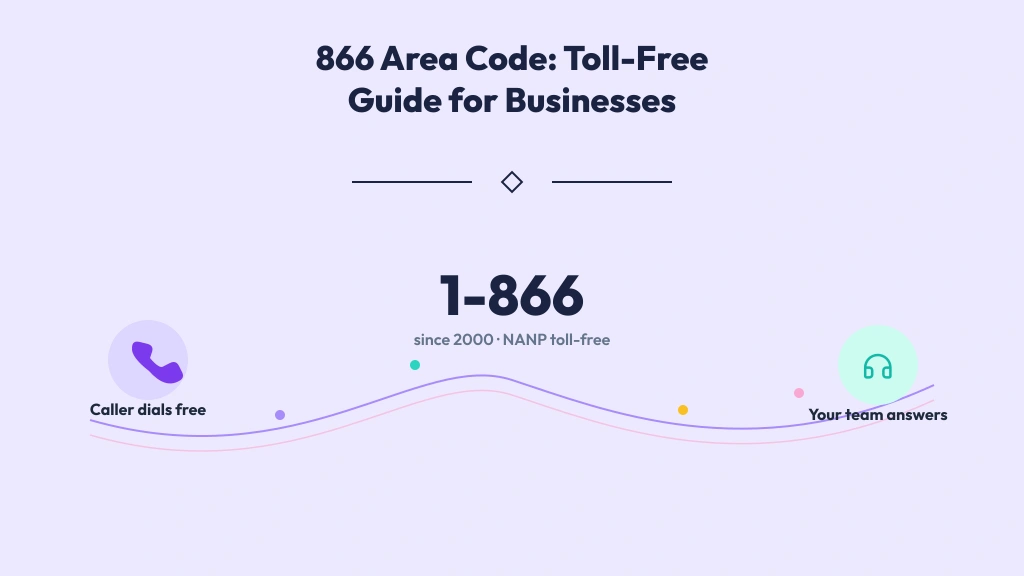
The 866 area code is one of the toll-free prefixes in the North American Numbering Plan (NANP), alongside 800, 888, 877, 855, 844, and 833. Opened on July 29, 2000, when demand for earlier codes outpaced supply, it has been in continuous service for more than two decades. Calls to an 866 number are free for the caller, with the receiving business covering the cost.
That arrangement makes the prefix a workhorse for support lines, sales desks, and appointment hotlines. Because it is non-geographic, a company in Denver or Toronto can answer the same 866 number without customers knowing where the office sits. This guide covers how the prefix works, how it compares with the rest of the family, and how to activate a number.
Key Takeaways
- The 866 prefix is a genuine toll-free code that entered service in July 2000.
- Callers pay nothing; the business that owns the number pays for the call.
- The code is non-geographic and works across the US, Canada, and other NANP countries.
- Legitimate numbers are assigned through Responsible Organizations on a first-come, first-served basis.
- Scammers can spoof any toll-free code, so caller identity should always be verified independently.
Key Takeaways
The 866 prefix is a genuine toll-free code that entered service in July 2000.
Callers pay nothing; the business that owns the number pays for the call.
The code is non-geographic and works across the US, Canada, and other NANP countries.
Legitimate numbers are assigned through Responsible Organizations on a first-come, first-served basis.
Need a business phone number? Get a MeraTalk number in minutes, no contract required.
Get started freeWhat Is the 866 Area Code?
The 866 prefix is a toll-free service access code, not a regional dialing code. When someone dials a number that begins with 866, the network routes the call according to instructions stored in the central toll-free database rather than by geography. Every active toll-free number in North America is recorded in the Somos toll-free registry, the FCC-designated database that tracks which numbers are assigned, reserved, or available.
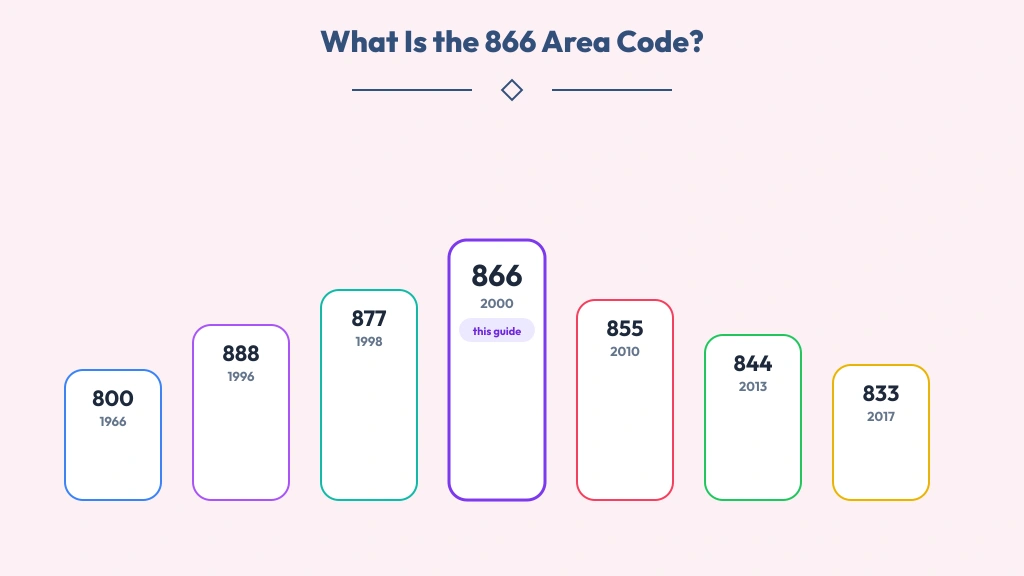
Assignments run through entities called Responsible Organizations, or RespOrgs. These are carriers and service providers certified to reserve numbers in the registry on behalf of subscribers. When a business orders a toll-free line, its provider acts as the RespOrg, reserves the specific digits, and points them at the company's phone system.
How 866 Numbers Are Formatted
Numbers with this prefix follow the standard NANP ten-digit pattern:
- Prefix: 866 — identifies the call as toll-free
- Exchange code: three digits assigned within the toll-free database
- Line number: four digits unique to the subscriber
Who Typically Uses the 866 Prefix
- Customer service and technical support desks
- Banks, insurers, and healthcare providers running secure hotlines
- E-commerce brands handling order and returns inquiries
- Government agencies, nonprofits, and helplines
- Sales teams tracking inbound response to national campaigns
Is the 866 Area Code Legitimate or a Scam?
The 866 area code itself is completely legitimate. It was activated through the official NANP expansion process and is used daily by banks, hospitals, airlines, utilities, and government offices. A call from an 866 number is not automatically suspicious — usually it is a business the recipient already deals with.
The caution people associate with the code comes from spoofing. Fraudsters can fake any caller ID, including toll-free prefixes, because a familiar-looking business number makes victims more likely to answer. The same pattern affects every code in the family; the 855 prefix guide covers how identical schemes target that code. The prefix on the screen says nothing about who is actually calling — the behavior on the call does.
Common Scam Tactics on Toll-Free Numbers
- 1Fake fraud alerts pretending to be a bank's security department
- 2Tech support impostors claiming a device or account is compromised
- 3Robocalls about expiring warranties, prizes, or account suspensions
- 4Callback bait, where a missed call lures the target into dialing a premium line
- 5Charity and government impostors demanding urgent payment or gift cards
How to Stay Safe
- Hang up and call back using the number printed on a statement or official website
- Never share passwords, one-time codes, or full card details with an inbound caller
- Register on the National Do Not Call Registry and report abuse to the FCC or FTC
- Use carrier-level call blocking or a screening app for repeat offenders
866 vs Other Toll-Free Prefixes
Functionally, every toll-free code behaves the same way: the caller pays nothing, routing is controlled in the central registry, and the number can point anywhere. The differences are age, inventory, and public recognition.
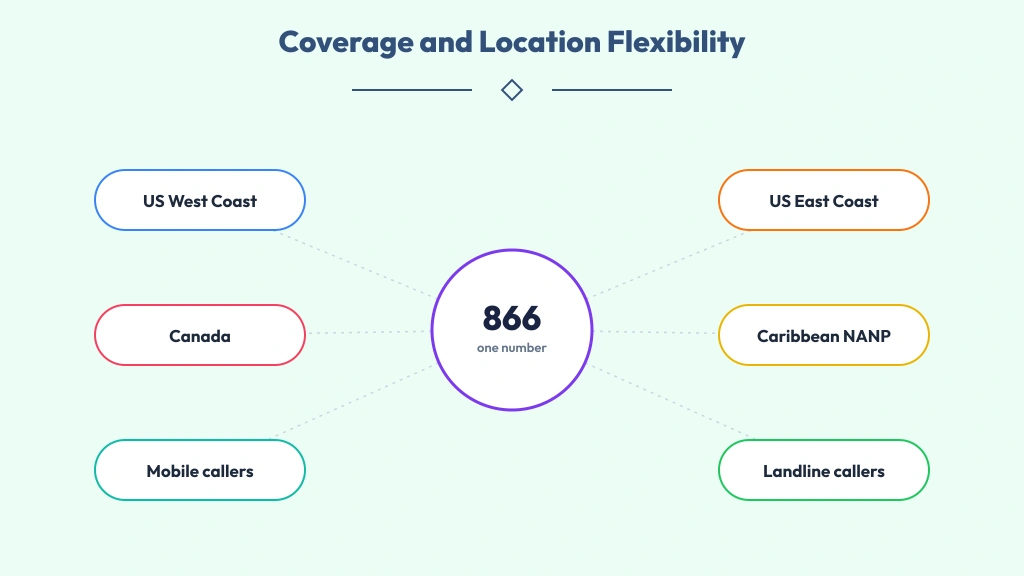
The Toll-Free Family Timeline
- 800 — the original code, in service since the 1960s and the most recognized
- 888 — added in 1996 as 800 inventory ran low
- 877 — added in 1998
- 866 — opened July 29, 2000
- 855 — released in 2010
- 844 — released in 2013
- 833 — the newest code, released in 2017
After more than twenty-five years in circulation, 866 enjoys stronger recognition than the newer 855, 844, and 833 codes while offering better availability than 800, where memorable combinations were claimed long ago — a practical sweet spot for many businesses.
One caution: 866 is not interchangeable with the other codes. Dialing the same seven digits behind 800 instead of 866 reaches a completely different subscriber, so marketing materials should always print the full ten-digit number.
Get a local number in this area code for your business — set up in minutes.
Coverage and Location Flexibility
Toll-free codes are non-geographic by design. A number with this prefix carries no city, state, or province information, which is precisely what makes it valuable to organizations serving customers across borders and time zones.
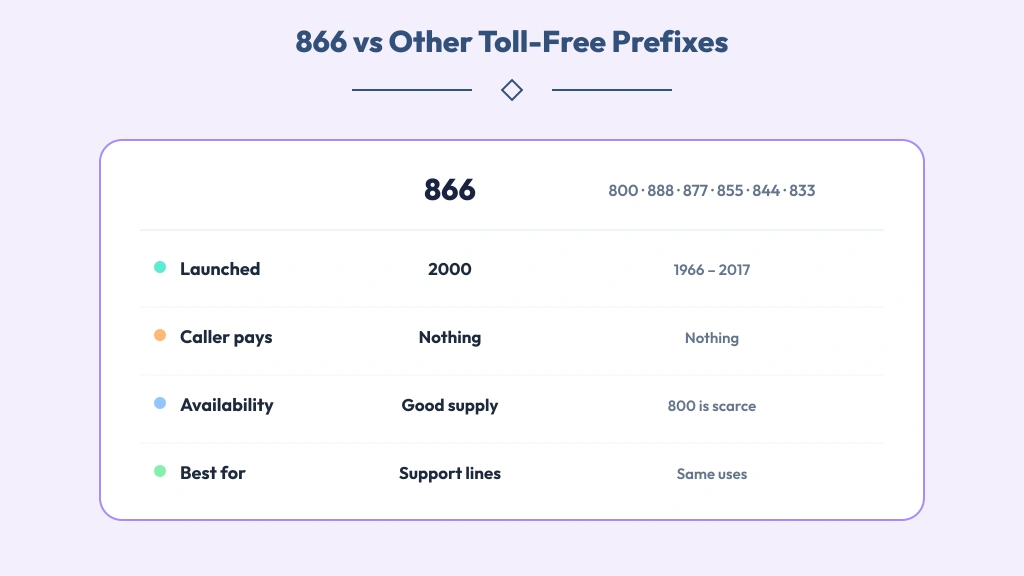
Where the Prefix Works
- All 50 US states, plus US territories in the NANP
- Every Canadian province and territory
- Other NANP participants, including many Caribbean nations
What Location Independence Enables
- One national number across every ad, invoice, and storefront
- Routing by time of day, so calls follow the sun between offices
- Instant redirection to remote agents or an overflow answering service
- Continuity when a business relocates — the number never changes
Cloud platforms extend that flexibility further: because routing lives in software, an 866 line can ring a desk phone, a mobile app, and a contact-center queue simultaneously, wherever each happens to be.
Benefits of an 866 Number for Business
Credibility and National Presence
A toll-free line signals that a company is established and reachable. For small teams competing against larger brands, it removes the local-shop impression a geographic number can create and presents a single national identity.
Lower Barriers for Customers
When calling costs nothing, customers reach out sooner — before a billing issue becomes a cancellation or a product question becomes an abandoned cart. Free inbound contact consistently supports satisfaction and retention.
Branding and Memorability
Toll-free inventory makes it possible to select digit patterns that spell a word or repeat a sequence. These vanity phone numbers turn a phone line into a marketing asset that customers can recall from a radio spot or a billboard without writing anything down.
Marketing Measurement and Scale
Assigning different toll-free lines to different campaigns shows exactly which channel drives calls, and cloud routing, IVR menus, and analytics scale without new hardware. Providers such as MeraTalk activate toll-free numbers with call routing and analytics included, making the 866 line part of a complete phone system rather than a standalone contact point.
Businesses comparing prefixes often shortlist the 877 area code alongside this one before deciding.
How to Get an 866 Number
The FCC does not sell toll-free numbers directly. Numbers are obtained through a provider acting as a RespOrg, and a few rules shape the process: assignment is strictly first-come, first-served, and FCC regulations prohibit hoarding numbers or brokering them for resale. Toll-free numbers are also fully portable, so a business keeps its digits when switching providers.
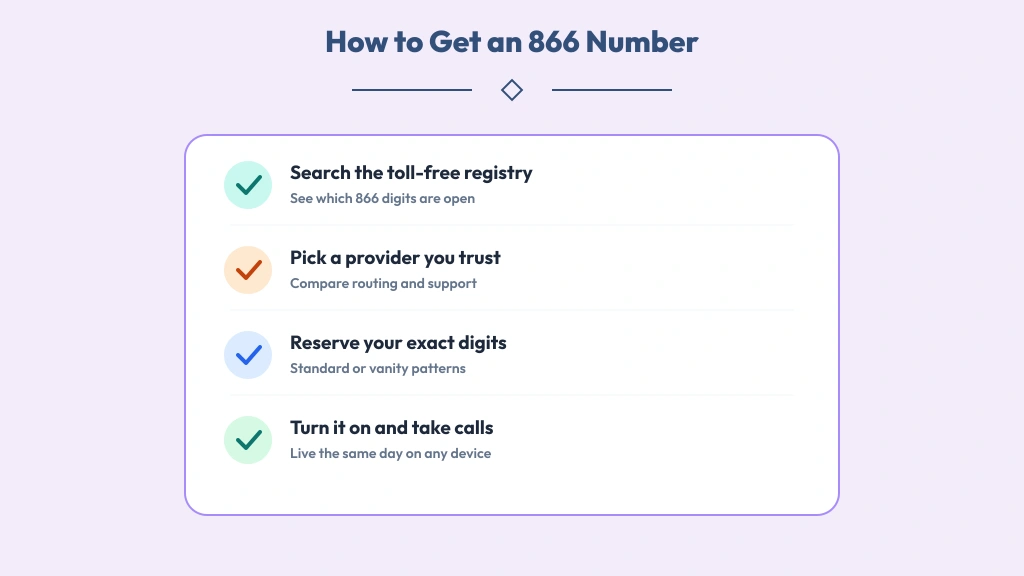
Steps to Activate a Number
- 1Choose a provider that offers toll-free service with the routing features the business needs
- 2Search available inventory for a memorable 866 combination, or a vanity pattern
- 3Reserve the number — the provider registers it in the toll-free database
- 4Configure routing: destination lines, business-hours rules, IVR, and voicemail
- 5Test the number from mobile and landline networks before publishing it
- 6Add the full ten-digit number to the website, invoices, and campaigns
What to Look For in a Provider
- Transparent activation timelines and porting support
- Call forwarding, analytics, and CRM integrations
- Capacity to add more numbers or seats as the team grows
Setup is usually fast — often live the same day. Businesses ready to launch a toll-free presence can compare available numbers and routing options at meratalk.com and go live without new hardware.
Toll-Free Numbers and Customer Trust
A phone number is often the first trust signal a customer evaluates. A toll-free line communicates two things at once: the company is established enough to maintain a national contact point, and it cares enough to absorb the cost of the conversation. For first-time buyers weighing an unfamiliar brand, that signal can be the difference between calling and clicking away.
- Consistency builds recognition — printing the same digits on the website, invoices, and packaging reinforces legitimacy
- Answering behavior matters as much as the number — a clear greeting and short hold times confirm the impression the prefix creates
- A published toll-free line reassures customers that support will still be reachable after the sale
- Pairing the line with a professional voicemail and callback option preserves trust even outside business hours
Trust compounds over time: a number that stays the same for years becomes part of the brand itself, which is exactly why portability rules protect the subscriber's right to keep it. For more, see toll-free number rules.
Compliance Basics for Toll-Free Outreach
Businesses that use a toll-free line for outbound calls or texts take on regulatory duties that inbound-only lines never face. In the United States, the Telephone Consumer Protection Act governs automated dialing and marketing texts, while the National Do Not Call Registry restricts unsolicited sales calls to registered consumers.
- Collect and store proof of consent before sending marketing calls or texts to any consumer
- Honor opt-out requests promptly and maintain an internal do-not-contact list alongside the national registry
- Identify the business clearly at the start of every outbound call — no misleading caller ID
- Complete toll-free messaging verification before launching any SMS program on the line
Good compliance is also good deliverability. Carriers monitor toll-free traffic for spam patterns, and documented consent practices keep a legitimate number from being flagged, filtered, or blocked mid-campaign.
Conclusion
The 866 prefix has spent more than two decades proving itself as a dependable, recognizable toll-free code. It costs callers nothing, works across the entire NANP footprint, and carries enough history that customers treat it as a mark of an established operation. The scam concerns attached to it are really spoofing concerns, which affect every prefix and are managed with sensible verification habits.
For a business weighing its options: better availability than 800, more recognition than the newest codes, and full compatibility with cloud calling. With a reputable provider handling registration and routing, an 866 number becomes a permanent, portable front door for customer conversations.
Ready to get started with 866 area code?
Join thousands of businesses using MeraTalk for Wholesale Voice, VoIP, and phone number services.
Contact MeraTalk Today