Introduction
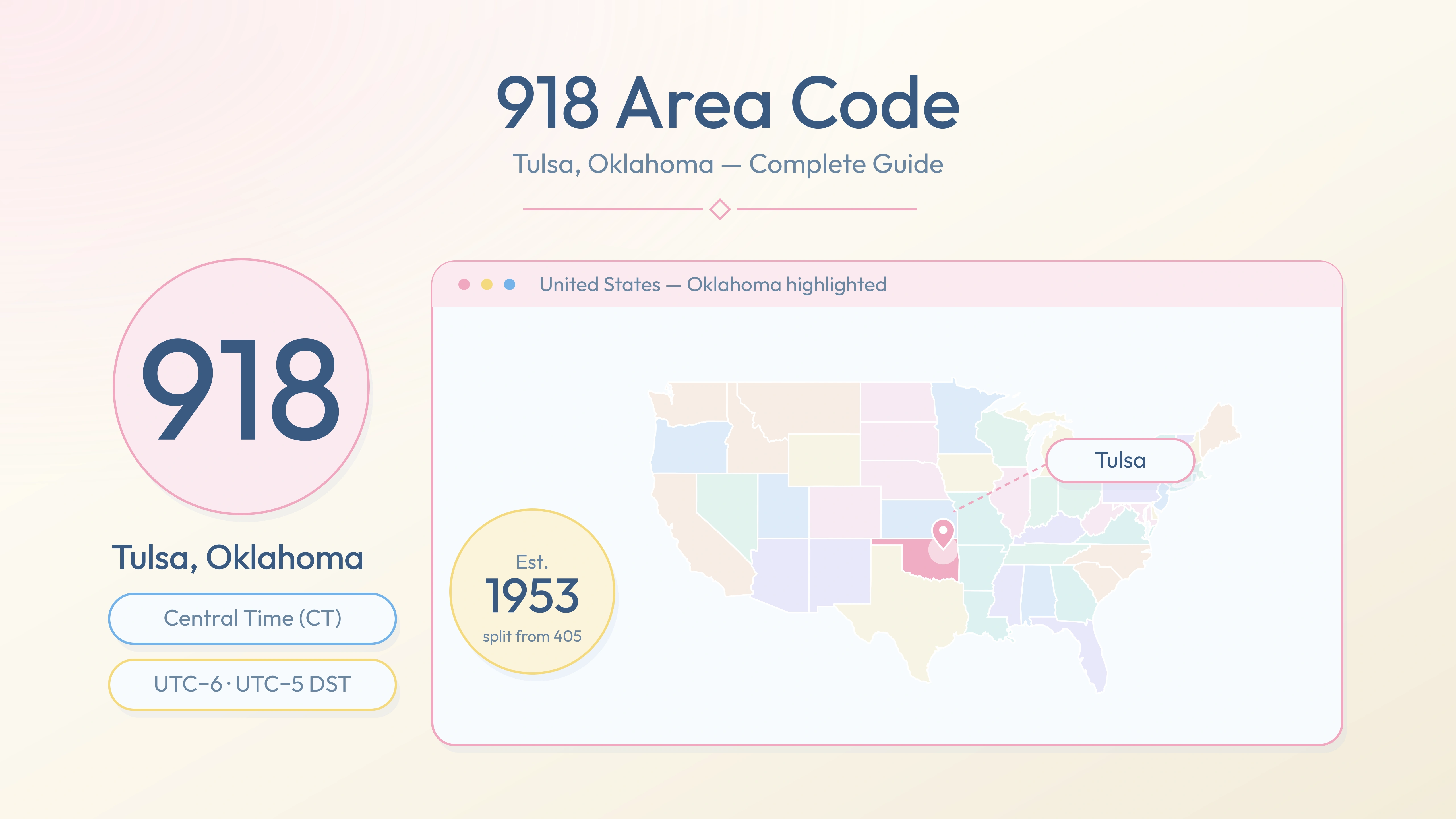
The 918 area code is the telephone code for Tulsa, Oklahoma. It covers Tulsa and roughly three dozen counties across northeastern Oklahoma — from Tulsa County out to Muskogee, Bartlesville, and Tahlequah — all on Central Time. The 918 code has been Tulsa's telephone signature since 1953, when northeastern Oklahoma received its own prefix.
It arrived while the city was still trading on its reputation as an oil capital, and it has stayed put through every reinvention since — the art deco building boom's legacy downtown, the growth of aerospace maintenance, and Tulsa's recent emergence as a magnet for remote workers. For local customers, the prefix reads as unmistakably Tulsan.
This guide lays out the essentials: what the code covers, which districts and suburbs dial under it, how the 539 overlay reshaped local calling, which codes sit next door, and how Tulsa's economy drives demand for local numbers. It ends with a practical three-step route to getting a Tulsa number, no local office required.
Key Takeaways
Covers where is the 918 area code in depth
Covers 918 area code location in depth
Covers 918 area code time zone in depth
Covers 918 vs 539 overlay in depth
Need a business phone number? Get a MeraTalk number in minutes, no contract required.
Get started freeWhat Is the 918 Area Code?
The code serves Tulsa and the surrounding communities of northeastern Oklahoma. It was carved out in 1953, when demand for numbers outgrew a single statewide code and the eastern part of the state received a prefix of its own. Since then the territory has stayed remarkably stable, covering the Tulsa metro along with the towns spread across the region's green hills — a corner of the state that looks and feels distinct from the plains to the west.
- Dialing format: (918) 555-0123
- International format: +1 918-555-0123
- Time zone: Central Time (CT) — UTC−6 Standard, UTC−5 Daylight Saving
- Introduced: 1953
Since the 539 overlay was layered over the same footprint, all local calls are dialed with ten digits. Existing numbers never changed, so the original prefix still dominates signage, advertising, and long-standing business lines throughout the metro, and it remains the code most closely tied to Tulsa's identity.
Where Is the 918 Area Code? Cities & Communities
The coverage area radiates from Tulsa across northeastern Oklahoma, taking in the city's historic core, its beloved shopping and dining districts, and the fast-growing suburbs to the southeast. Four places give a clear picture of the territory.
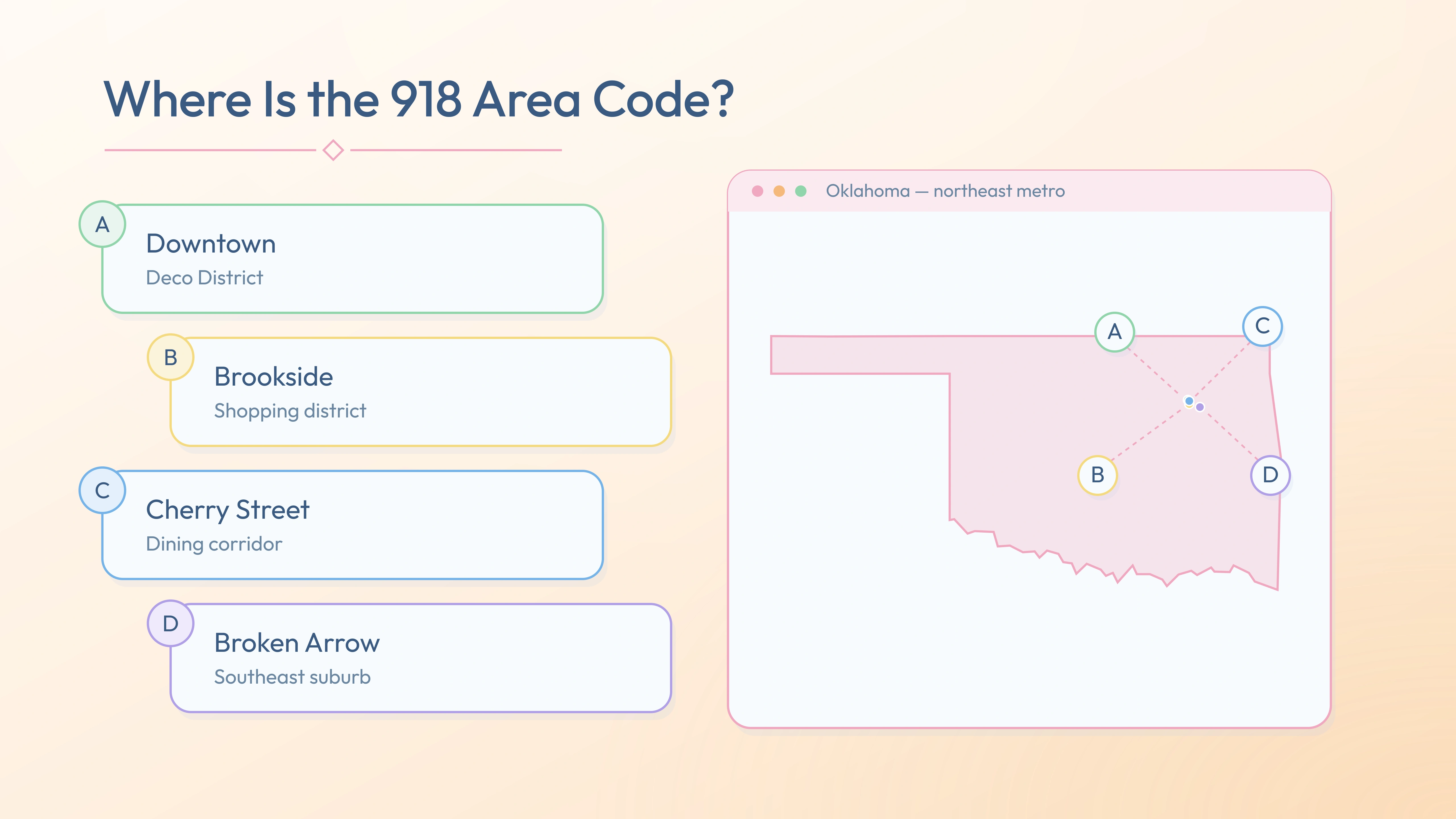
Downtown
Downtown Tulsa is anchored by the Deco District, one of the finest collections of art deco architecture in the country — a legacy of the oil wealth that built the city in the early twentieth century. Today those landmark buildings house energy firms, startups, hotels, and arts venues, and a local number remains the default for every business among them.
Brookside
Brookside is Tulsa's signature shopping district, a walkable stretch along Peoria Avenue lined with boutiques, salons, cafes, and neighborhood restaurants. Its merchants rely heavily on local phone lines, since shoppers calling ahead expect to see a familiar Tulsa prefix rather than an anonymous out-of-town number.
Cherry Street
Cherry Street is the city's dining corridor, where chef-driven restaurants, coffee roasters, and a popular farmers market share a compact historic strip. Reservations, takeout orders, and catering inquiries flow through local numbers every day, making the district a small but telling snapshot of how the code lives in daily Tulsa life.
Broken Arrow
Broken Arrow, the metro's large southeast suburb, has grown from a farm town into one of Oklahoma's biggest cities in its own right, with a revitalized downtown known as the Rose District. Its manufacturers, family businesses, and service companies dial under the same code and the same ten-digit habit as Tulsa proper.
Counties and Communities the 918 Code Serves
The prefix spreads well beyond the Tulsa metro across the northeastern quarter of Oklahoma. Anyone checking whether a local number will land in the right market can use the list below as a quick reference for the cities the code covers.
- Tulsa County core — Tulsa, Broken Arrow, Owasso, Bixby, Jenks, and Sand Springs
- Surrounding metro counties — Claremore, Sapulpa, and Wagoner
- Wider northeastern Oklahoma — Muskogee, Bartlesville, Tahlequah, and McAlester
- Shared 539 overlay territory — every community above can also receive a 539 number on the identical footprint
918 Overlay and Nearby Area Codes
Northeastern Oklahoma now dials under two codes. The 539 overlay was introduced across the exact same territory so new numbers could keep flowing without forcing existing lines to change. Because two codes share one geography, every local call requires all ten digits — the area code plus the seven-digit number.
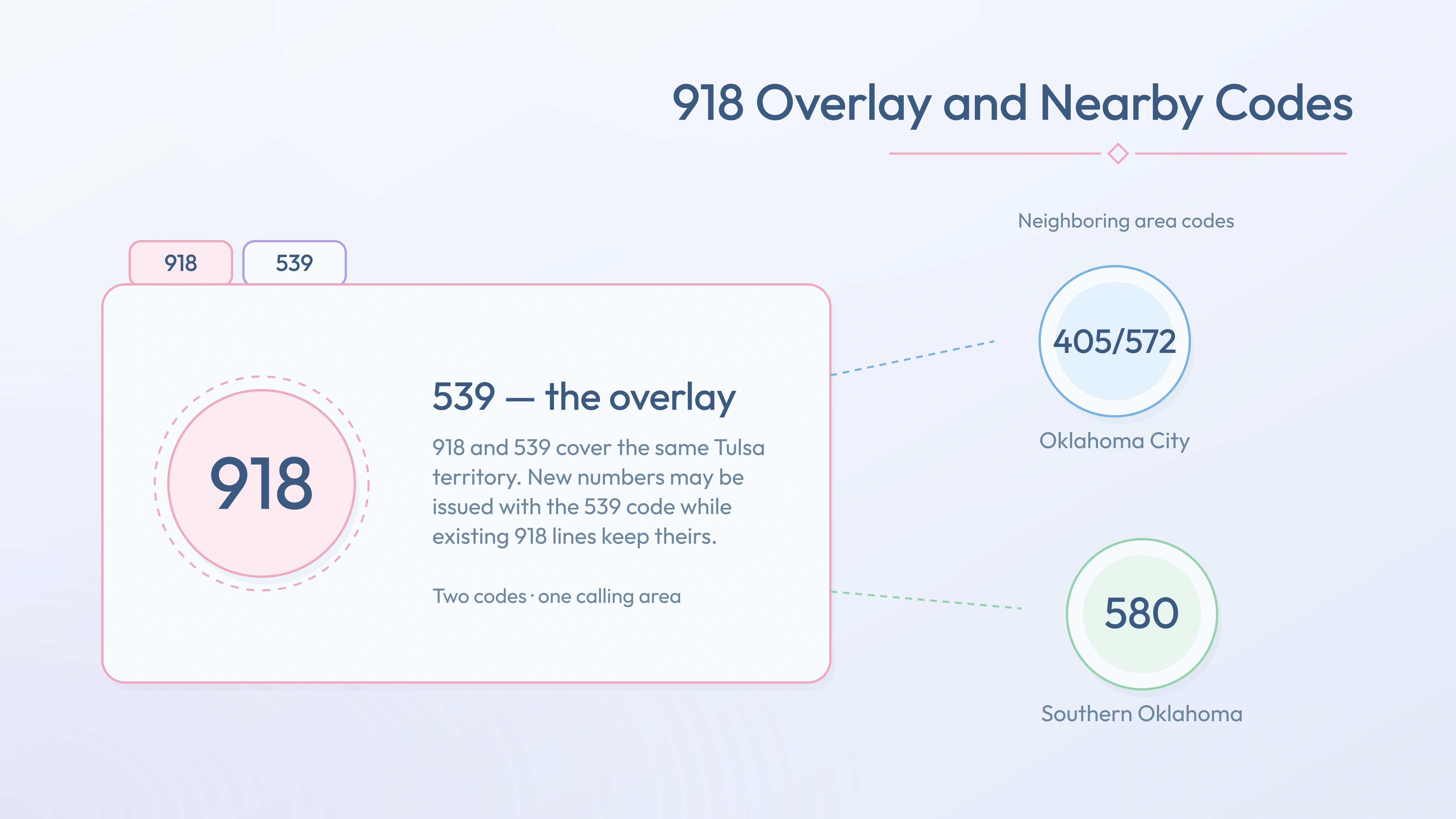
- 918 — the original 1953 code for Tulsa and northeastern Oklahoma
- 539 — the overlay covering the identical footprint, common on newer lines
- 405 / 572 — Oklahoma City and central Oklahoma
- 580 — southern Oklahoma
Down the turnpike, Oklahoma City dials under 405 and its 572 overlay, while 580 covers the southern half of the state. Tulsa businesses that court customers in North Texas often note how strongly the 214 area code signals Dallas identity — the Tulsa prefix works exactly the same way at home, marking a company as genuinely local in a market where that still matters.
Get a local number in this area code for your business — set up in minutes.
918 Time Zone
The region observes Central Time (CT) — UTC−6 during Standard Time and UTC−5 during Daylight Saving Time, which runs from mid-March to early November. Tulsa keeps the same clock as Dallas, Kansas City, and Chicago, so business scheduling across the middle of the country is seamless.
Central Time gives a Tulsa-numbered line a practical national reach. Calls placed in the morning catch East Coast offices mid-morning, while late-afternoon calls still land inside West Coast business hours. A remote team answering a Tulsa number from anywhere simply works to the Central clock and callers experience an ordinary local business.
The Tulsa Economy and Business Scene
Tulsa's economy blends a century of energy heritage with newer strengths in aviation and technology, and its business community has a strong local-first streak that makes a recognizable prefix valuable. Some firms even pair a standard local line with memorable vanity numbers to make their brand easier to recall in a crowded market. Three sectors define the city today.
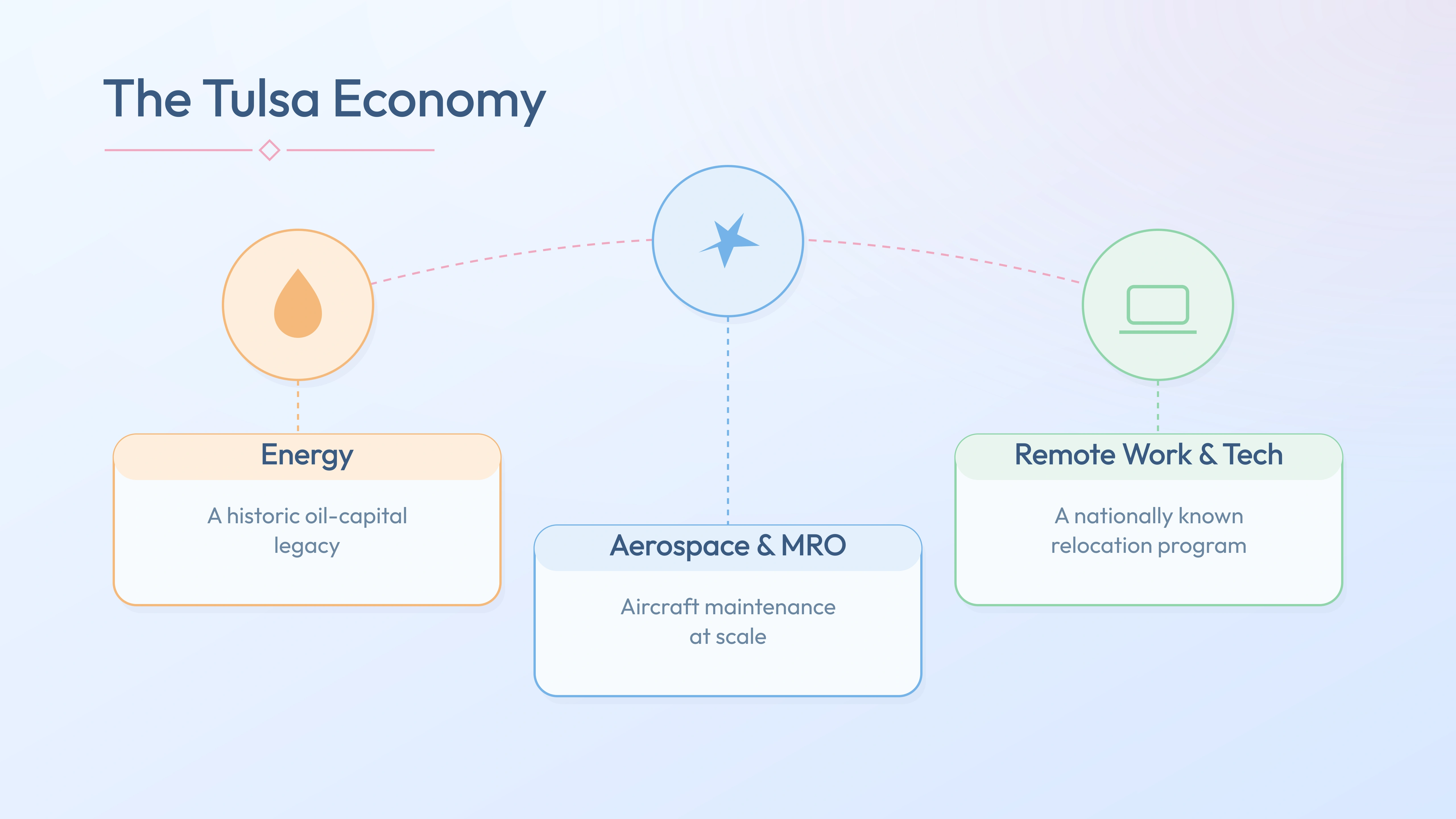
Energy
Tulsa carries a historic oil-capital legacy. The petroleum boom of the early twentieth century built the downtown skyline and endowed the city's museums, parks, and universities, and energy companies — from pipeline operators to engineering firms — remain woven into the local economy long after the derricks moved elsewhere.
Aerospace & MRO
The metro handles aircraft maintenance at scale. Major maintenance, repair, and overhaul operations, together with parts suppliers and engineering contractors, make aviation one of the region's largest employment bases, and the cluster keeps attracting supporting businesses that set up local lines to serve it.
Remote Work & Tech
Tulsa runs a nationally known relocation program that pays remote workers to move to the city, and the influx has energized coworking spaces, startups, and the downtown housing market. Many of the newcomers adopt local numbers soon after arriving — a small switch that signals they intend to stay.
Firms expanding across the region often add a second local presence in the 817 area code to reach Fort Worth customers.
How to Get a 918 Phone Number
Getting a Tulsa number no longer involves a phone company truck or a local address. Cloud phone providers issue numbers in minutes, and the line rings wherever its owner wants it to. Three steps cover the whole process.
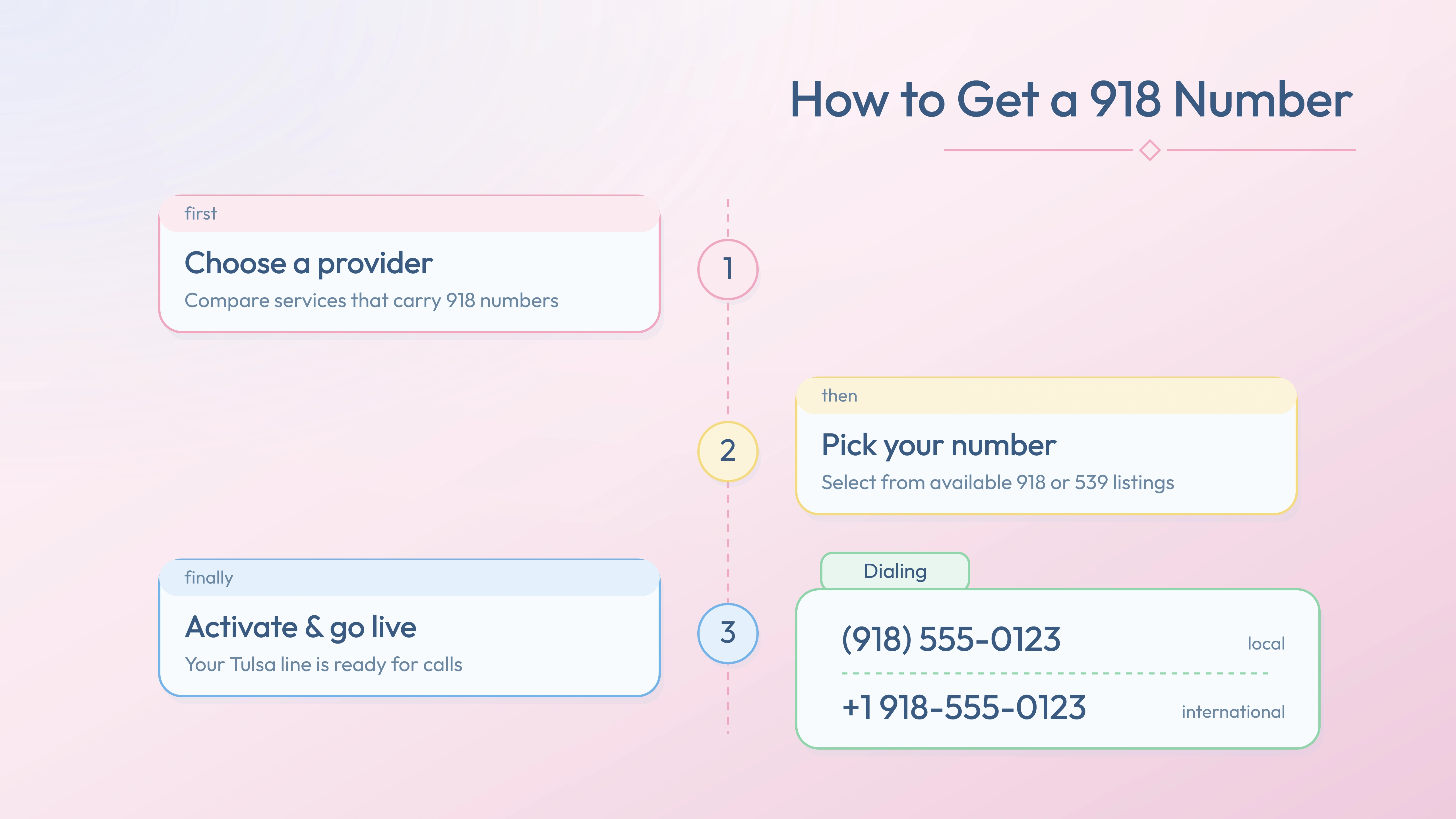
- 1Choose a provider. Select a cloud phone service that stocks Tulsa numbers and offers the call routing, voicemail, and business features the situation calls for.
- 2Pick a number. Search the available inventory in the local prefix and choose a combination that reads well on a storefront or website — it will display as (918) 555-0123 locally and as +1 918-555-0123 internationally.
- 3Activate and route. Verify the account, then direct the number anywhere. Calls ring on any device — a desk phone in Broken Arrow, a laptop in a coworking space, or a mobile on the road.
From the caller's side, nothing about the number reveals where it is answered. A customer on Cherry Street sees a familiar Tulsa prefix, whether the business picks up from Brookside or from a home office three states away.
Common Phone Scams to Watch For
Because a familiar Tulsa prefix earns trust at a glance, scammers spoof it to make fraudulent calls appear local. Residents report the usual repertoire: callers impersonating utility companies and threatening same-day disconnection, recorded messages about fake vehicle warranties, and impersonations of government offices demanding immediate payment. The local-looking caller ID is the whole trick — the call may originate anywhere in the world.
- Legitimate utilities and agencies never demand payment by gift card, wire transfer, or cryptocurrency.
- Pressure to act immediately is the clearest warning sign — real organizations allow time to verify.
- Hang up and call back on a number from a bill or official website, never one the caller supplies.
- Never read out one-time codes, account numbers, or passwords to an unsolicited caller.
Letting unknown callers roll to voicemail is a simple, effective filter: genuine contacts leave messages, and most scam operations move on to the next number instead. For more, see overlay.
Choosing Between Local and Toll-Free Numbers
Tulsa's local-first business culture makes the choice between a local and a toll-free line a genuine strategic question. A local number tells a Brookside shopper or a Broken Arrow homeowner that the company is part of the community — the strongest possible signal in a market where hometown ties still win business. A toll-free number sends a different message: national scale, established operations, and a free call from anywhere in the country.
Many companies simply run both. The local line anchors neighborhood advertising, local search listings, and the storefront window; the toll-free line goes on packaging, national campaigns, and the support page. Cloud platforms route both to the same team under one set of rules, so the split identity costs nothing in day-to-day operations. As a rule of thumb, businesses selling to the metro lead with local digits, while those shipping statewide or beyond put toll-free out front.
Conclusion
Tulsa's prefix has tracked the city's whole modern story — from oil-capital swagger and art deco landmarks to aircraft hangars and a wave of remote workers choosing the city on purpose. Since 1953 it has been the digits that say northeastern Oklahoma, and the 539 overlay has only reinforced how much demand the region generates.
For businesses, the takeaway is simple: a local Tulsa number builds trust with a customer base that values hometown ties, and modern cloud platforms make activating one a matter of minutes rather than weeks. The city keeps reinventing itself; its code remains the constant.
Ready to get started with 918 area code?
Join thousands of businesses using MeraTalk for Wholesale Voice, VoIP, and phone number services.
Contact MeraTalk Today