Introduction
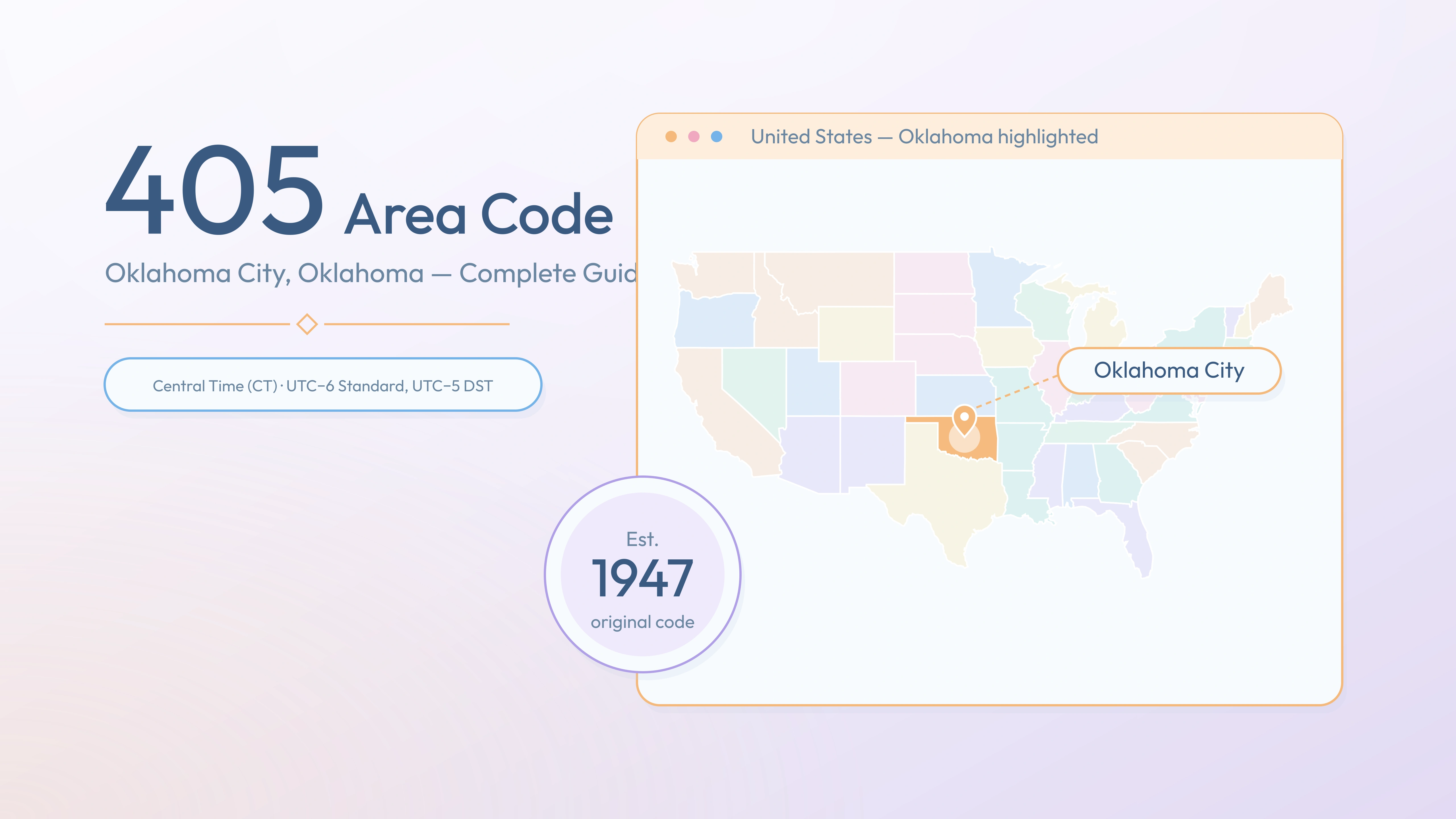
The 405 area code is the telephone code for Oklahoma City, Oklahoma, and the surrounding central-Oklahoma counties — Oklahoma, Cleveland, Canadian, Logan, and Payne among them — all on Central Time. It has appeared on Oklahoma City phone lines since 1947, when the North American Numbering Plan first divided the continent into numbering regions, and it still anchors the capital region today.
From the converted brick warehouses of Bricktown to the university lecture halls of Norman, a 405 number tells callers they have reached the heart of the state — a fact local businesses have traded on for generations.
This guide explains what the code covers, which cities and districts sit inside it, how the 572 overlay changed local dialing habits, which codes border the region, and how the Oklahoma City economy shapes demand for local numbers. It closes with a simple three-step path to claiming a local number, whether a company operates from Automobile Alley or from another state entirely.
Key Takeaways
Covers where is the 405 area code in depth
Covers 405 area code location in depth
Covers 405 area code time zone in depth
Covers 405 vs 572 overlay in depth
Need a business phone number? Get a MeraTalk number in minutes, no contract required.
Get started freeWhat Is the 405 Area Code?
The code serves Oklahoma City and the broad ring of communities around it in central Oklahoma. It was assigned in 1947 as part of the first wave of North American codes, and it originally covered the entire state of Oklahoma. Northeastern Oklahoma split off to form 918 on January 1, 1953, and the southern and western portions of the state followed on November 1, 1997, becoming 580 — leaving 405 concentrated on the central corridor it covers today, the capital metro and the towns radiating outward from it in every direction.
- Dialing format: (405) 555-0123
- International format: +1 405-555-0123
- Time zone: Central Time (CT) — UTC−6 Standard, UTC−5 Daylight Saving
- Introduced: 1947 — one of the original 1947 codes
Because the 572 overlay now shares the same footprint, local calls are dialed with all ten digits. Existing lines kept their numbers when the overlay arrived, so the original prefix remains the most common sight on storefronts, delivery trucks, and business cards across the metro, and it still carries the strongest sense of local identity.
Where Is the 405 Area Code? Cities & Communities
The coverage area centers on Oklahoma City itself and extends into the suburbs and university towns that make up the capital region. The footprint takes in dense downtown blocks, sprawling residential districts, and college campuses alike. Four districts and communities give a good sense of its range.
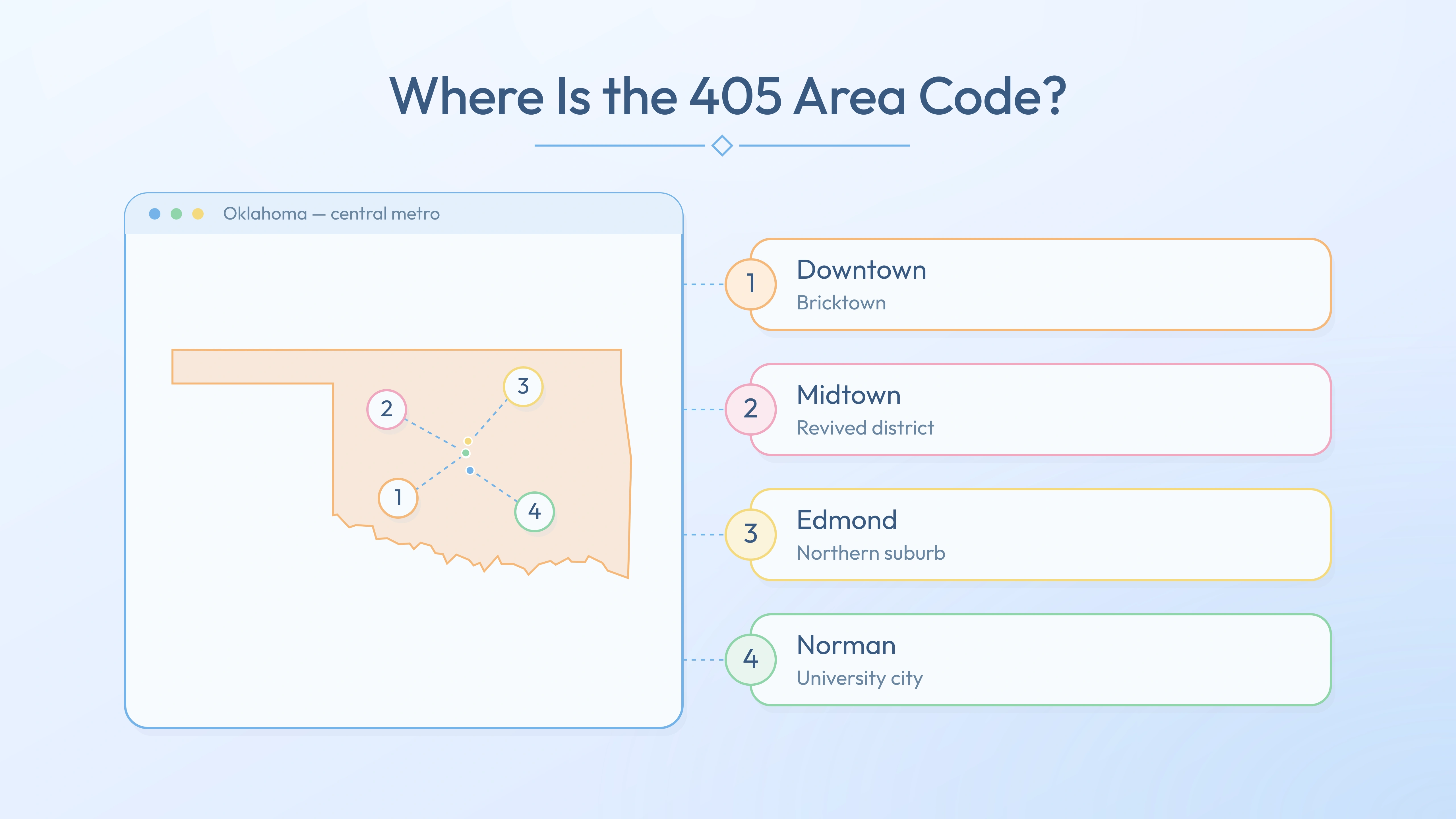
Downtown
Downtown Oklahoma City is the civic and commercial core, and Bricktown is its signature district — a converted warehouse quarter of restaurants, canals, and entertainment venues beside the ballpark. Local numbers are standard issue for the hotels, venues, law firms, and energy companies that fill the surrounding towers, and the district's revival has made a downtown address one of the most desirable in the state.
Midtown
Midtown is the city's revived district, a stretch of restored early-twentieth-century buildings between the downtown core and the health campuses. Independent restaurants, design studios, boutique hotels, and small professional offices have moved in over the past two decades, and most of them answer the phone on a local 405 line that matches the neighborhood's hometown character.
Edmond
Edmond is the metro's northern suburb, known for strong schools, a university campus, and a steady flow of new neighborhoods and retail centers. Its service businesses, medical practices, and family-owned shops share the same code and the same ten-digit dialing habits as the rest of the capital region, and the suburb's growth keeps demand for new local numbers steady.
Norman
Norman, south of the city, is the state's university city — home to the flagship campus, its research institutes, and the national severe-weather community that has grown up around them. The shared code ties Norman's laboratories, startups, and college-town storefronts to the capital next door, making the two cities feel like one continuous market to callers.
Counties and Communities the 405 Code Serves
The prefix radiates from Oklahoma City across the central corridor of the state. Anyone checking whether a local number will land in the right market can use the list below as a quick reference for the cities the code covers.
- Oklahoma County — Oklahoma City, Edmond, Midwest City, and Del City
- Cleveland and McClain counties — Norman and Moore
- Canadian County — El Reno and Yukon
- Outer central Oklahoma — Stillwater, Shawnee, Guthrie, and Chickasha, all sharing the 572 overlay on the identical footprint
405 Overlay and Nearby Area Codes
Central Oklahoma dials under two codes today. The 572 overlay, announced January 9, 2020 and in service the following year, was added on top of the original footprint so that new lines could keep being issued without forcing anyone to change an existing number. Mandatory ten-digit dialing followed in January 2021. The two codes cover identical territory, which is why every local call in the region requires the full ten-digit number, even between neighbors on the same street.
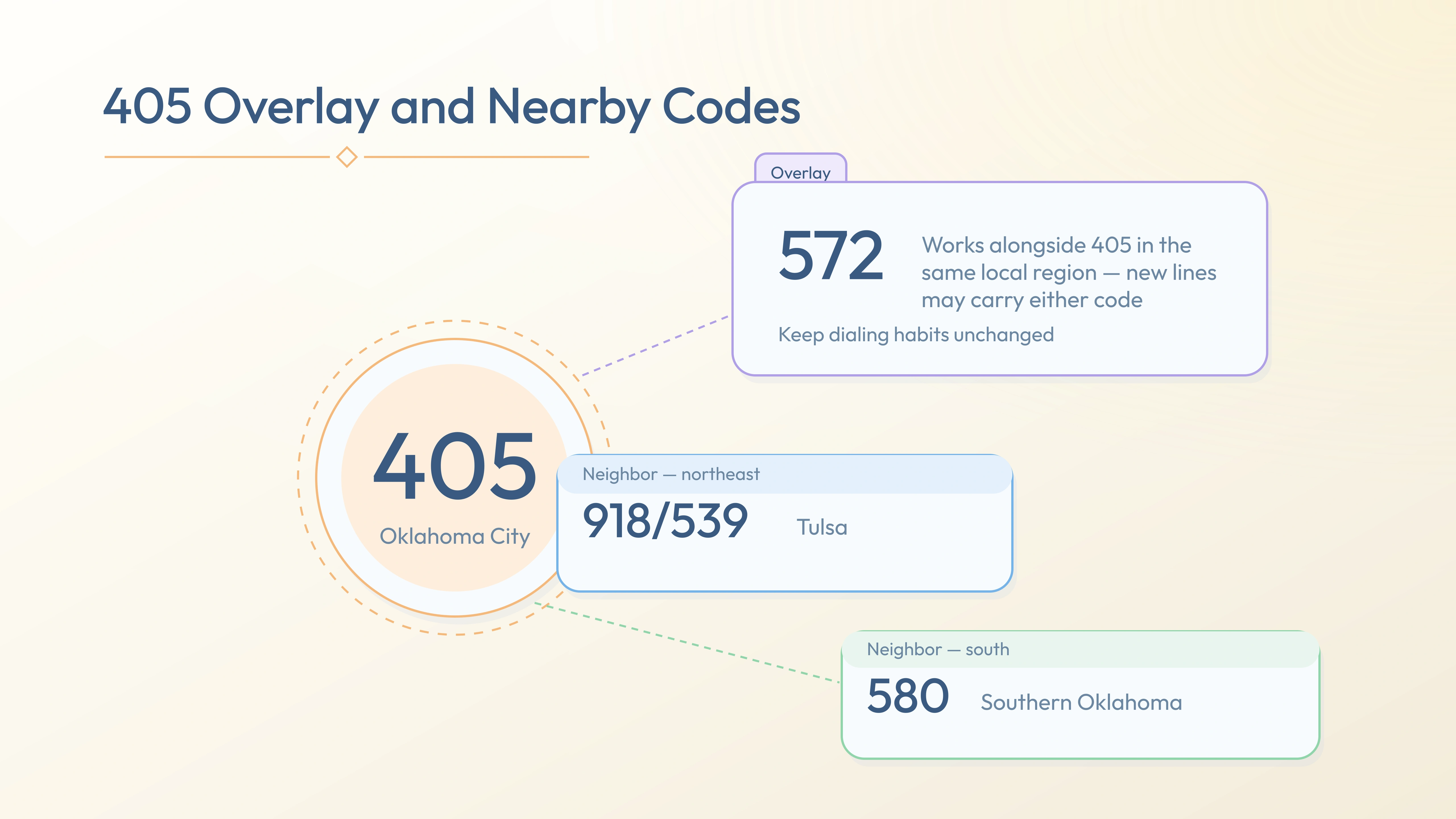
- 405 — the original 1947 code for Oklahoma City and central Oklahoma
- 572 — announced 2020, in service by 2021, the overlay covering the exact same territory and common on newer lines
- 918 / 539 — Tulsa and northeastern Oklahoma, split off from 405 on January 1, 1953
- 580 — southern and western Oklahoma, split off from 405 on November 1, 1997
Beyond the state line, the code's closest big-city neighbor is Dallas, and many Oklahoma firms keep ties in both markets. A local Oklahoma City number carries the same kind of hometown weight here that the 214 area code carries in Dallas — a signal of genuine local presence rather than an out-of-town operation. Tulsa's codes sit to the northeast, while 580 wraps around the southern half of the state, so the three territories together cover Oklahoma completely.
Get a local number in this area code for your business — set up in minutes.
405 Time Zone
The region observes Central Time (CT) — UTC−6 during Standard Time and UTC−5 during Daylight Saving Time, which runs from mid-March to early November. Oklahoma City keeps the same clock as Dallas, Kansas City, and Chicago, so scheduling across the middle of the country involves no mental arithmetic at all.
For businesses, Central Time is a convenient middle position. Morning calls reach the East Coast comfortably after New York offices open, and afternoon calls still land within West Coast working hours, so a locally numbered line can serve customers across the entire country within a single business day. Teams that answer an Oklahoma City line from elsewhere simply set their hours to Central Time and callers never notice the difference.
The Oklahoma City Economy and Business Scene
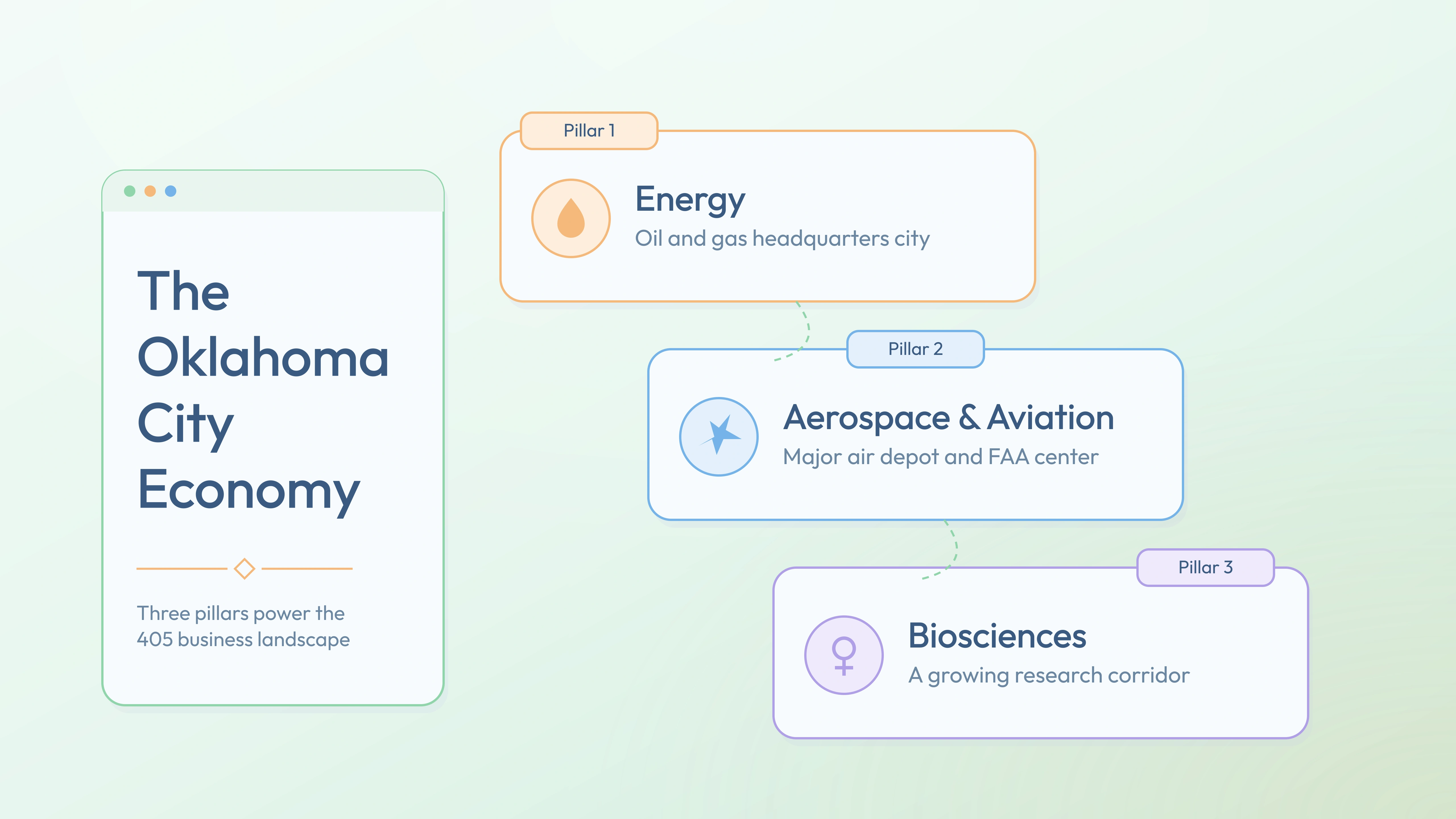
Oklahoma City pairs a state-capital economy with a diversified private sector, and its steady growth keeps demand for local numbering strong. Companies expanding along the I-35 corridor often run an Oklahoma City line alongside a Dallas presence under the 469 area code, keeping a recognizably local number in each market they serve. Three industries define the metro's business identity.
Energy
Oklahoma City is an oil and gas headquarters city. Exploration and production companies, pipeline operators, and the service firms that support them fill the downtown towers, and their field operations keep phones ringing far beyond the metro. The industry's long history in the state is a large part of why the capital grew into the regional business center it is today.
Aerospace & Aviation
The metro hosts a major air depot and FAA center, which together make aviation one of its most stable employers. Maintenance, repair, engineering, and air-traffic work draw contractors and suppliers from across the country, and many of them set up local lines so they can work closely with the installations and the workforce built around them.
Biosciences
A growing research corridor links the health campuses near Midtown with the university laboratories in Norman. Biotech startups, clinical research groups, and medical device firms are clustering along it, adding a newer layer to an economy long defined by energy and aviation — and giving the region a claim on the industries expected to shape its next chapter.
A similar dynamic plays out in the 918 area code, where Tulsa companies weigh the same trade-offs.
How to Get a 405 Phone Number
Cloud phone services have made claiming an Oklahoma City number a same-day task. There is no requirement to live or work in the metro; the number exists in software and rings wherever its owner happens to be. The whole process takes three steps.
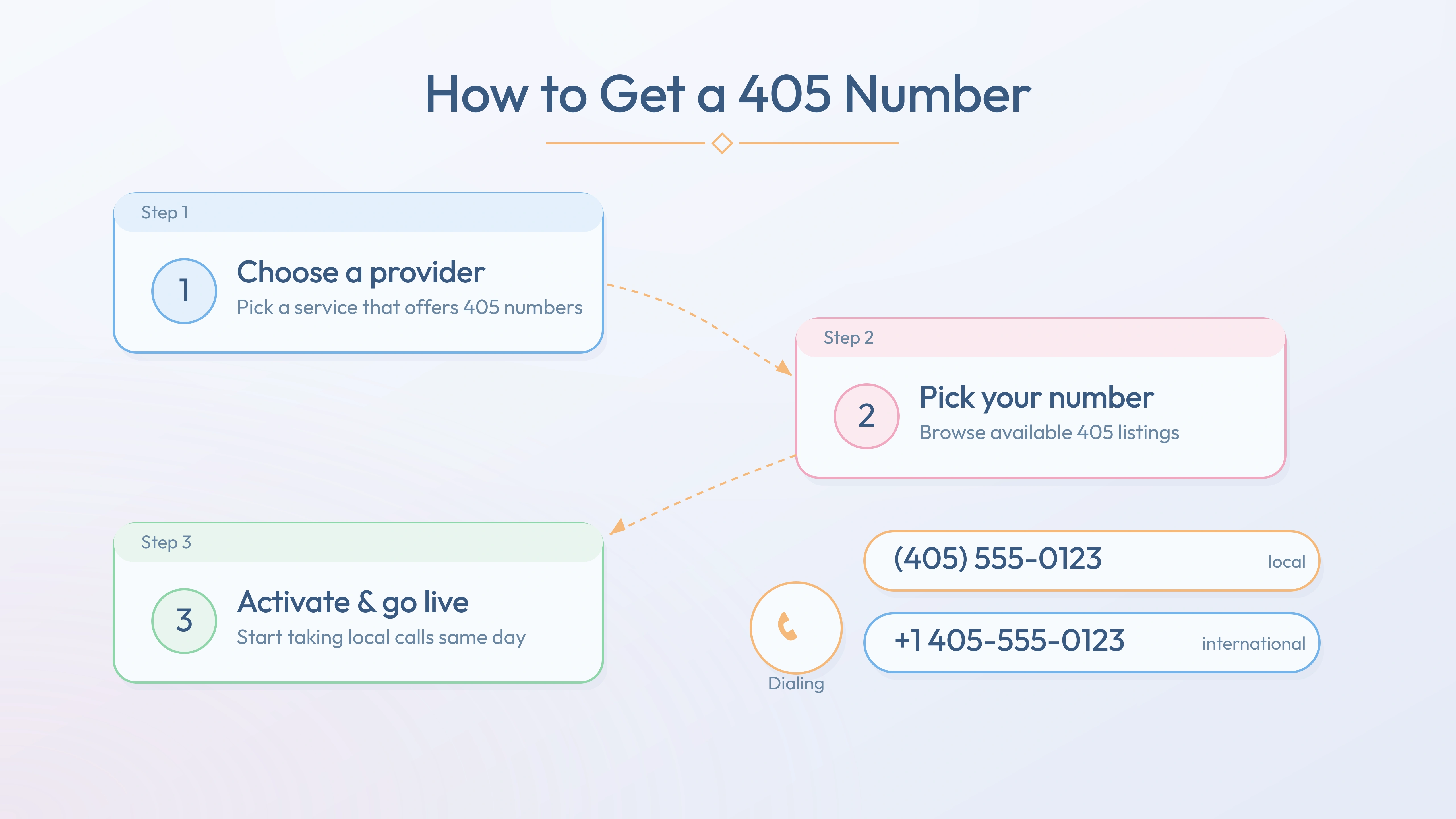
- 1Choose a provider. Pick a cloud phone service that offers Oklahoma City numbers and confirm it includes the routing, voicemail, and call-management features the business needs.
- 2Pick a number. Browse the available options in the local prefix and select one that is easy to say and remember — it will appear as (405) 555-0123 locally and as +1 405-555-0123 in international format.
- 3Activate and route. Complete a short verification, then point the number at any destination. Calls ring on any device — desk phone, laptop app, or mobile — wherever the team happens to work.
Once live, the number behaves like any local line. Customers in Edmond or Norman see a familiar local prefix on their screens, while the calls themselves can be answered from an office across town or a home office across the country.
Setting Up Call Routing for a Local Number
A local Oklahoma City line does its best work when the calls behind it are routed deliberately. Cloud phone platforms let a business decide, rule by rule, where each call should land: front-desk staff during business hours, a mobile phone after closing, or a voicemail-to-email inbox overnight. A Bricktown restaurant might send reservation calls to the host stand while routing supplier calls to a manager's mobile — all behind one public number.
- Business-hours rules — ring the office by day, an on-call phone by night
- Auto-attendant menus — let callers choose sales, support, or billing
- Simultaneous or sequential ring — reach a whole team, or one person at a time
Routing rules can be changed in minutes from a dashboard, so a growing company can start with a single ring-through line and add menus, queues, and departments as headcount grows — without ever changing the number customers already know. For more, see North American codes.
Why Local Numbers Still Matter
In an era of app-based messaging, the humble local prefix keeps earning its place. People screen unfamiliar calls aggressively, and a recognizable central-Oklahoma number is far more likely to be answered than an anonymous out-of-state string. For service businesses — plumbers, clinics, insurance agents — that answer rate is the difference between a booked job and a missed one.
Local digits also carry quieter benefits. They anchor a listing in local search results, reassure customers reading a website that a real regional operation stands behind it, and give field teams a consistent identity when calling customers back. Even fully remote companies serving the capital region adopt a local line for exactly these reasons: the number works as marketing, credibility, and customer service all at once, at a fraction of the effort of any other local signal.
Conclusion
Few codes say Oklahoma as plainly as this one. It has carried the capital region's calls since 1947, absorbed the shift to overlays and ten-digit dialing without losing its identity, and now stretches from Bricktown's canals to Norman's research campuses. For local customers it remains shorthand for the center of the state.
For a business, that shorthand is worth having. A local number signals commitment to the Oklahoma City market, makes callers comfortable before the first hello, and takes only minutes to activate through a modern cloud phone platform — no office lease in the metro required.
Ready to get started with 405 area code?
Join thousands of businesses using MeraTalk for Wholesale Voice, VoIP, and phone number services.
Contact MeraTalk Today