Introduction
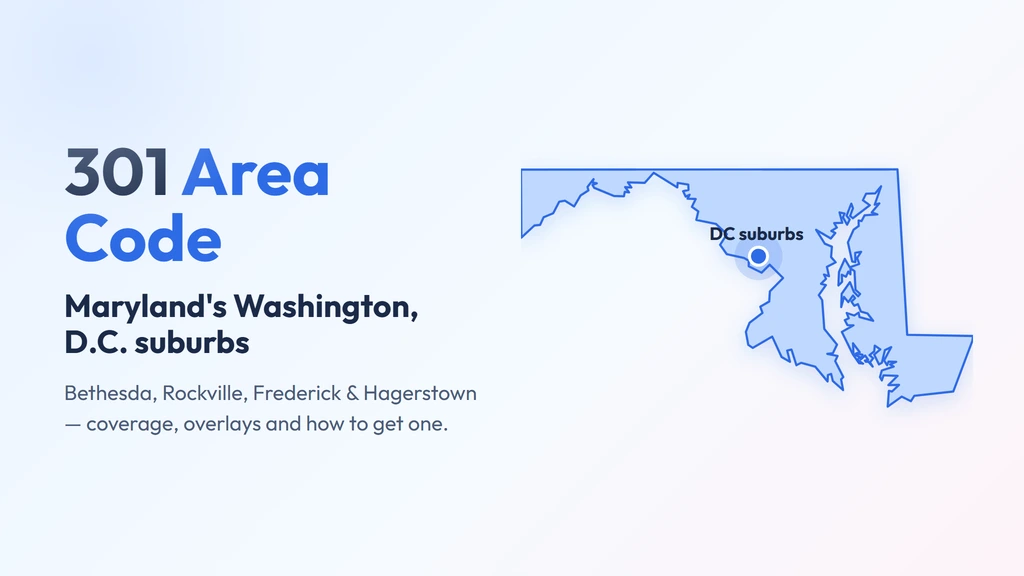
The 301 area code is the sound of Maryland's side of the Washington, D.C. region — not the monuments across the river in the District, but the wide crescent of suburbs, biotech campuses and river towns that wraps around the capital on the Maryland side.
It rings in the research labs of Bethesda and Rockville, the county offices in Upper Marlboro and Rockville, the fast-growing subdivisions of Germantown and Waldorf, and the old brick main streets of Frederick, Hagerstown and Cumberland out in the western panhandle.
If a Montgomery County law firm, a Frederick biotech startup or a Southern Maryland contractor set up a phone line any time in the last three-quarters of a century, there is a strong chance it opens with 301.
Because 301 is Maryland's original 1947 area code and now shares its ground with newer overlays, it turns up in two very different searches: people who just got a 301 number and want to know where it comes from, and people asking whether an unfamiliar 301 call is safe to answer.
This guide covers both — the cities and counties 301 serves, how it fits with the 240 and 227 overlays, why the region sits firmly in Eastern Time, what the spoofed-call risk really is, and how to activate a 301 virtual number for a business in minutes.
Key Takeaways
Covers where is the 301 area code in depth
Covers 301 area code location in depth
Covers is 301 a scam in depth
Covers get a 301 phone number in depth
Need a business phone number? Get a MeraTalk number in minutes, no contract required.
Get started free301 Area Code at a Glance
The 301 area code is in Maryland. It covers western and southern Maryland, including the Washington, D.C. suburbs of Montgomery and Prince George's counties, Frederick and Hagerstown.
- Location: western and southern Maryland, around Washington, D.C.
- State: Maryland
- Main cities: Bethesda, Rockville, Silver Spring, Frederick, Hagerstown, Waldorf, Cumberland
- Time zone: Eastern Time (ET)
- Overlays: 240 (1997) and 227 (2023) share the territory
- In service since: 1947, Maryland's original code; 410 split off in 1991
- Dialing: 10 digits required for every local call
What Is the 301 Area Code?
The 301 area code is a telephone area code serving western and southern Maryland, including the state's populous Washington, D.C. suburbs. It is one of the original North American area codes assigned in 1947, and for decades it was the only area code in Maryland, covering the entire state.
That changed on October 6, 1991, when everything from Baltimore eastward was split off into the new 410 area code, leaving 301 with the western two-thirds of Maryland. As numbers ran short in the booming D.C. suburbs, the 240 area code was added as an overlay on June 1, 1997 — Maryland's first overlay — followed by a third code, 227, on June 14, 2023. All three now share the same territory and require 10-digit dialing.
Dialing Format and Time Zone
- Dialing format: (301) 555-0142
- International: +1 301-555-0142
- Time zone: Eastern Time (ET), UTC−5, the same clock as Washington, D.C. and the rest of Maryland
- 10-digit dialing required for every local call because of the 240 and 227 overlays
Where Is the 301 Area Code? Cities & Communities
Geographically, 301 covers the western and southern portions of Maryland — everything the state kept after the 410 split. That includes all of Montgomery, Prince George's, Charles, St. Mary's, Allegany, Garrett and Washington counties, most of Frederick County, and slivers of Howard, Carroll and Anne Arundel counties.
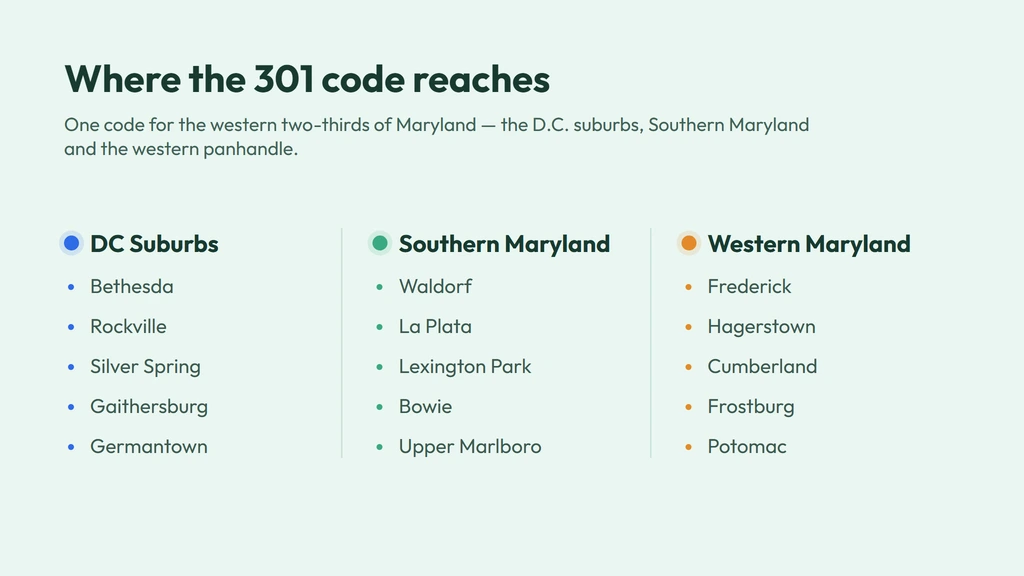
It stretches from the affluent inner suburbs that press right up against the D.C. line, out through the farmland of Southern Maryland, and all the way west along the Potomac to the Appalachian panhandle. Because the region is so large and varied, 301 numbers are spread across dozens of distinct communities rather than one single city.
Major Cities and Communities
- Bethesda & Chevy Chase — affluent inner suburbs on the D.C. line, home to major medical and research institutions
- Rockville & Gaithersburg — the Montgomery County seat and the heart of the I-270 technology corridor
- Silver Spring & Wheaton — dense, diverse suburbs just north of the District
- Germantown, Potomac & Bowie — fast-growing residential communities across Montgomery and Prince George's counties
- Frederick — the historic and rapidly expanding city at the northern edge of the region
- Waldorf, La Plata & Lexington Park — the growing hubs of Southern Maryland in Charles and St. Mary's counties
- Hagerstown — the commercial center of Washington County in the western panhandle
- Cumberland & Frostburg — the Allegany County towns anchoring far-western Maryland
Beyond the 301 region, the surrounding codes take over: the 202 area code covers the District of Columbia itself, 410 and 443 serve Baltimore and the Eastern Shore, 703 and 571 cover the Northern Virginia suburbs across the Potomac, and 304 reaches into neighboring West Virginia. Together this cluster forms one of the busiest calling regions in the country, with 301 carrying Maryland's share of the capital area and its western reaches.
Get a local number in this area code for your business — set up in minutes.
301 Time Zone
The entire 301 region observes Eastern Time (ET), the same clock as Washington, D.C. and the rest of the East Coast, and shifts to Eastern Daylight Time in summer. There is no time-zone line running through Maryland, so every 301 number keeps identical business hours whether it rings in Bethesda, Frederick or Cumberland — a simple but real advantage for any company routing calls across the region.
For businesses, Eastern Time is the country's dominant commercial clock, shared with New York, Washington and the whole eastern seaboard. A 301 line opens the business day at the same moment as the federal government and the East Coast financial centers, then still has the afternoon to reach customers on the West Coast before they finish work. Cloud phone systems lean on that, letting a company set hours, route calls and schedule follow-ups around a predictable Eastern-Time presence.
301 and the 240 Overlay
Since June 1997, the 301 area code has shared its territory with a second code, 240, in an arrangement called an overlay. Rather than splitting western Maryland into smaller pieces again — which would have forced half the region to change their phone numbers — regulators layered 240 directly on top of the same geographic area.

Existing 301 numbers stayed exactly as they were, while new lines began drawing from the 240 code once 301 numbers grew scarce. Demand kept climbing, and in 2023 a third overlay, 227, was added to supply still more numbers across the same ground.
- 301 — the original Maryland code, in service since 1947 and the state's only code until the 410 split in 1991
- 240 — the first overlay covering the identical area, in service since 1997 for new numbers
- 227 — the newest overlay on the same territory, added in 2023 for additional prefixes
- All three require 10-digit dialing for every local call, even between two lines on the same street
Because 240 and 227 overlay the same ground, the codes are functionally interchangeable: they reach the same neighborhoods, share one local calling area, and connect to each other as local calls. For a business, that means a 301 number and a 240 number are equally native to western Maryland — 301 is simply the oldest and most recognizable of the three.
The I-270 Biotech Corridor and Maryland's Federal Economy
A 301 number connects a business to one of the most research-intensive and government-anchored economies in the United States. The Maryland suburbs of Washington blend federal agencies, world-class biomedical research and a dense base of professional services — and 301 reaches every part of it, from the D.C. line out to the western panhandle.

Biotech, Health and Federal Research
The stretch of Interstate 270 running north from Bethesda through Rockville and Gaithersburg to Frederick is known as the I-270 technology corridor, one of the country's leading clusters of biotechnology and life-sciences firms.
It is anchored by major federal institutions — the National Institutes of Health in Bethesda, the Food and Drug Administration's campus in Silver Spring, and the U.S. Army's medical research base at Fort Detrick in Frederick — supporting a highly educated workforce of scientists, physicians and engineers across Montgomery and Frederick counties.
Government, Defense and Professional Services
Beyond the labs, the 301 economy is shaped by the federal government and its contractors. Prince George's County is home to NASA's Goddard Space Flight Center and the University of Maryland, while Southern Maryland's economy centers on the Naval Air Station at Patuxent River. Out west, Hagerstown and Cumberland add distribution, manufacturing and healthcare.
The result is a market rich in professional-services firms, contractors, clinics and startups — exactly the kind of business that benefits from a recognizably local 301 phone number.
How to Get a 301 Area Code Phone Number
Modern cloud phone providers let a business activate a 301 number in minutes — no Maryland office, no hardware, and no long-term contract. Search available 301 numbers, complete a short verification, and route the line to any device anywhere in the world. Because 301 is instantly recognizable across the D.C. suburbs and western Maryland, a 301 number reads as authentically local from Bethesda to Hagerstown, even for a team working entirely remotely.
A 301 number suits anyone who wants to feel rooted in Maryland's capital region: biotech and technology firms along the I-270 corridor, real-estate and home-service businesses across Montgomery and Prince George's counties, professional and medical practices near the federal research campuses, and remote teams targeting the Washington market.
MeraTalk provides 301 numbers as part of its cloud telephony platform — lines activate in minutes, route to any device, and pair with voicemail, call recording, auto-attendant and CRM integration from one dashboard. To set up a dedicated business phone number, search available numbers at meratalk.com.
301 vs 202: Maryland's Suburbs and the District
The best-known number in the capital region is the 202 area code, the code carried by Washington, D.C. itself since 1947. It signals a business rooted inside the District — a lobbying firm, an association, a government-facing office on the federal side of the river.
301, by contrast, signals the Maryland suburbs that surround the capital — the biotech corridor, the county seats and the residential communities where most of the region's people actually live. Neither is 'better'; they simply speak to different audiences within the same metro.
- 202 — the code for Washington, D.C. proper, tightly associated with the federal government and the District's core
- 301 — the Maryland suburbs code covering Montgomery, Prince George's, Frederick and the western counties
- 240 and 227 — the overlays that share the 301 region, equally local to Maryland's side of the capital area
For a business deciding between them, the choice comes down to where its customers are. A District-based advocacy group or federal contractor may prefer the 202 identity, while a Rockville clinic, a Frederick biotech firm or a contractor serving Prince George's homes is far better matched by a 301 number that neighbors instantly read as their own.
Common 301 Phone Scams to Watch For
The same 'local Maryland' quality that makes 301 useful to businesses also makes it a convenient disguise for fraud, and an affluent, densely populated region next to the nation's capital is a rich target. Caller-ID spoofing lets someone anywhere in the world display a 301 prefix, so a resident sees what looks like a nearby business, bank or county office calling.
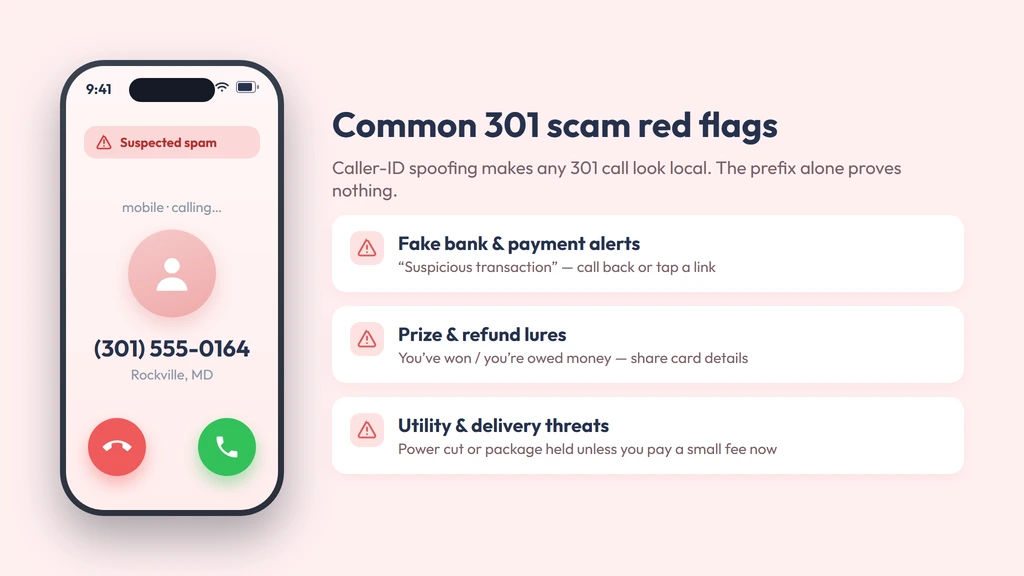
The prefix itself proves nothing — genuine and spoofed calls look identical on screen, and scammers know a familiar local code is more likely to be answered.
- Fake bank or payment alerts — voicemails or texts about a 'suspicious transaction,' pushing you to call back or tap a link
- Prize and refund lures — claims you have won something or are owed a refund, requesting card details to 'process' it
- Utility and delivery threats — messages that your power will be cut or a package held unless you pay a small fee immediately
The reliable defense is to hang up and call back through a number found independently — on a bill, an official site, or a saved contact. No genuine bank, agency or utility demands gift cards or wire transfers over the phone. The federal robocall and caller-ID law makes it illegal to transmit misleading caller-ID information with intent to defraud, but such calls still slip through, so treat any pressure to act immediately as a warning sign in itself. For more, see federal robocall and caller-ID law.
Conclusion
The 301 area code is Maryland's capital region in a single number — not the monuments of the District, but the biotech corridor, county seats and river towns that ring Washington on the Maryland side, from Bethesda and Rockville through Frederick and out to Hagerstown and Cumberland.
It carries the weight of one of the country's most research-driven and government-anchored economies, sits squarely in Eastern Time, and shares its ground with the 240 and 227 overlays while remaining the oldest and most recognizable of Maryland's codes.
Activating a 301 virtual number takes minutes with MeraTalk. Go live with an authentic Maryland presence, route calls to any device, and add call recording, auto-attendant and CRM integration from day one — no physical Maryland office required. Explore the options at meratalk.com.
Ready to get started with 301 area code?
Join thousands of businesses using MeraTalk for Wholesale Voice, VoIP, and phone number services.
Contact MeraTalk Today