Introduction
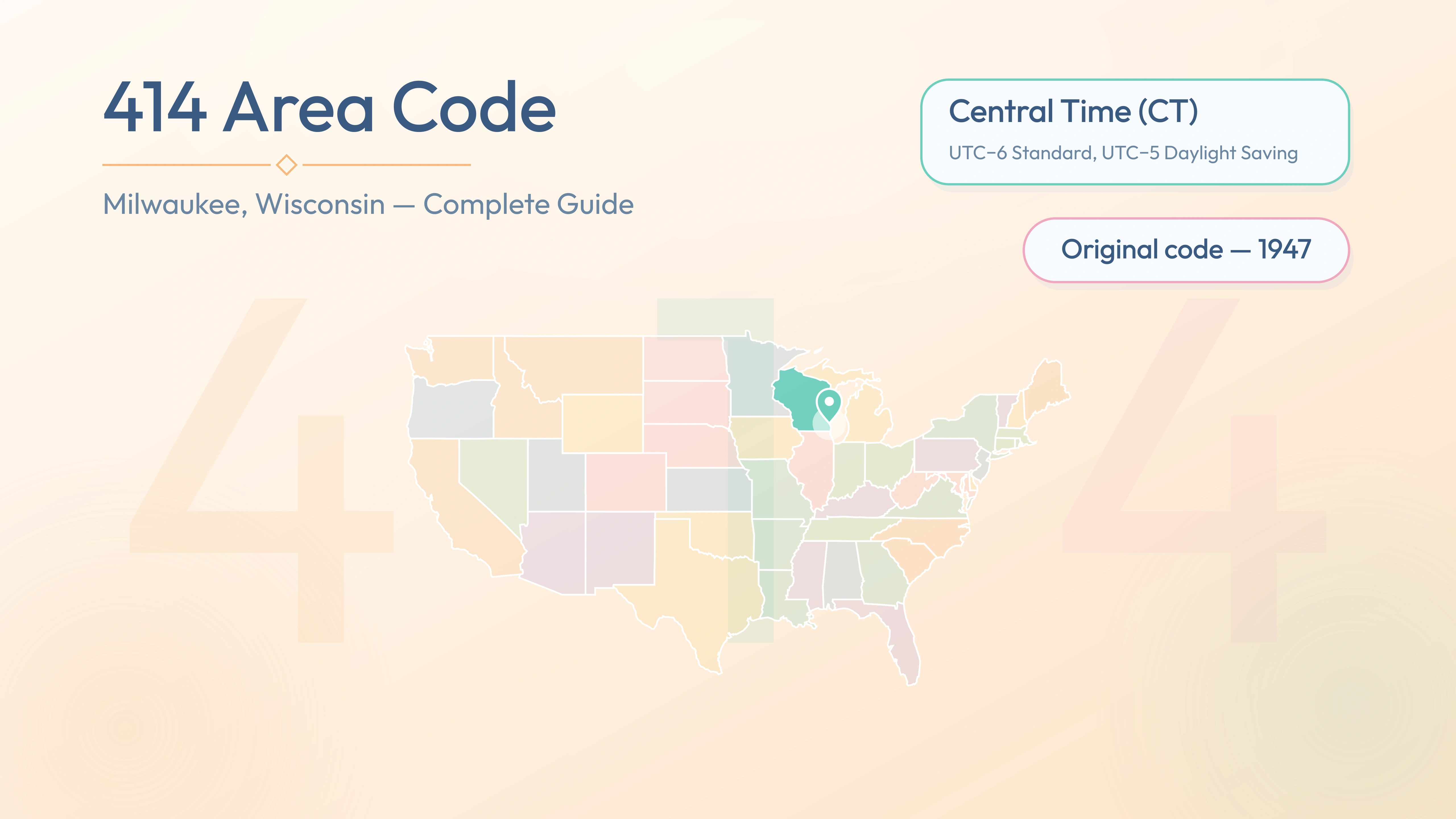
The 414 area code is the telephone code for Milwaukee, Wisconsin. It covers Milwaukee County — the city plus close-in communities such as Wauwatosa, West Allis, and Cudahy — on Central Time. Assigned in 1947 as one of Wisconsin's first codes, it was steadily refined over the decades until it covered just the city and its home county.
Along the way it became a point of local pride, celebrated each spring on the city's unofficial holiday and worn on shirts and caps from the lakefront to the south side.
This guide lays out the full picture: the neighborhoods and communities inside the territory, why it still stands alone without an overlay, the Wisconsin codes that surround it, the Central Time schedule it follows, and the industrial and brewing economy that made the city famous. It ends with the short modern process for activating a local number from anywhere.
Key Takeaways
Covers where is the 414 area code in depth
Covers 414 area code location in depth
Covers 414 area code overlay in depth
Covers get a 414 phone number in depth
Need a business phone number? Get a MeraTalk number in minutes, no contract required.
Get started freeWhat Is the 414 Area Code?
The 414 prefix is the North American Numbering Plan code for Milwaukee County, Wisconsin — the city of Milwaukee plus close-in communities such as Wauwatosa, West Allis, and Cudahy. It was one of just two original Wisconsin codes drawn in 1947 (alongside 715), and it originally covered most of southern and eastern Wisconsin, stretching from Lake Michigan to the Minnesota and Iowa borders. A 1955 boundary rearrangement between 414 and 715 created the new 608 code for Madison and south-central Wisconsin; later splits moved eastern Wisconsin to 920 (1997) and the suburban collar counties to 262 (1999), concentrating the historic code on the urban county at the center. Today's 414 footprint is overwhelmingly Milwaukee County, with only small slivers of neighboring Waukesha and Washington counties still attached.
That long tenure means the prefix reads as authentically Milwaukee to anyone in southeastern Wisconsin. Key facts at a glance:
- Dialing format: (414) 555-0123
- International format: +1 414-555-0123
- Time zone: Central Time (CT) — UTC−6 Standard, UTC−5 Daylight Saving
- Introduced: 1947 — one of the original 1947 codes
Where Is the 414 Area Code? Cities & Communities
The territory follows the Lake Michigan shoreline through Milwaukee County, taking in the downtown core, the historic industrial districts, and the residential neighborhoods that fan out west and south. The four communities below show the character of the region.
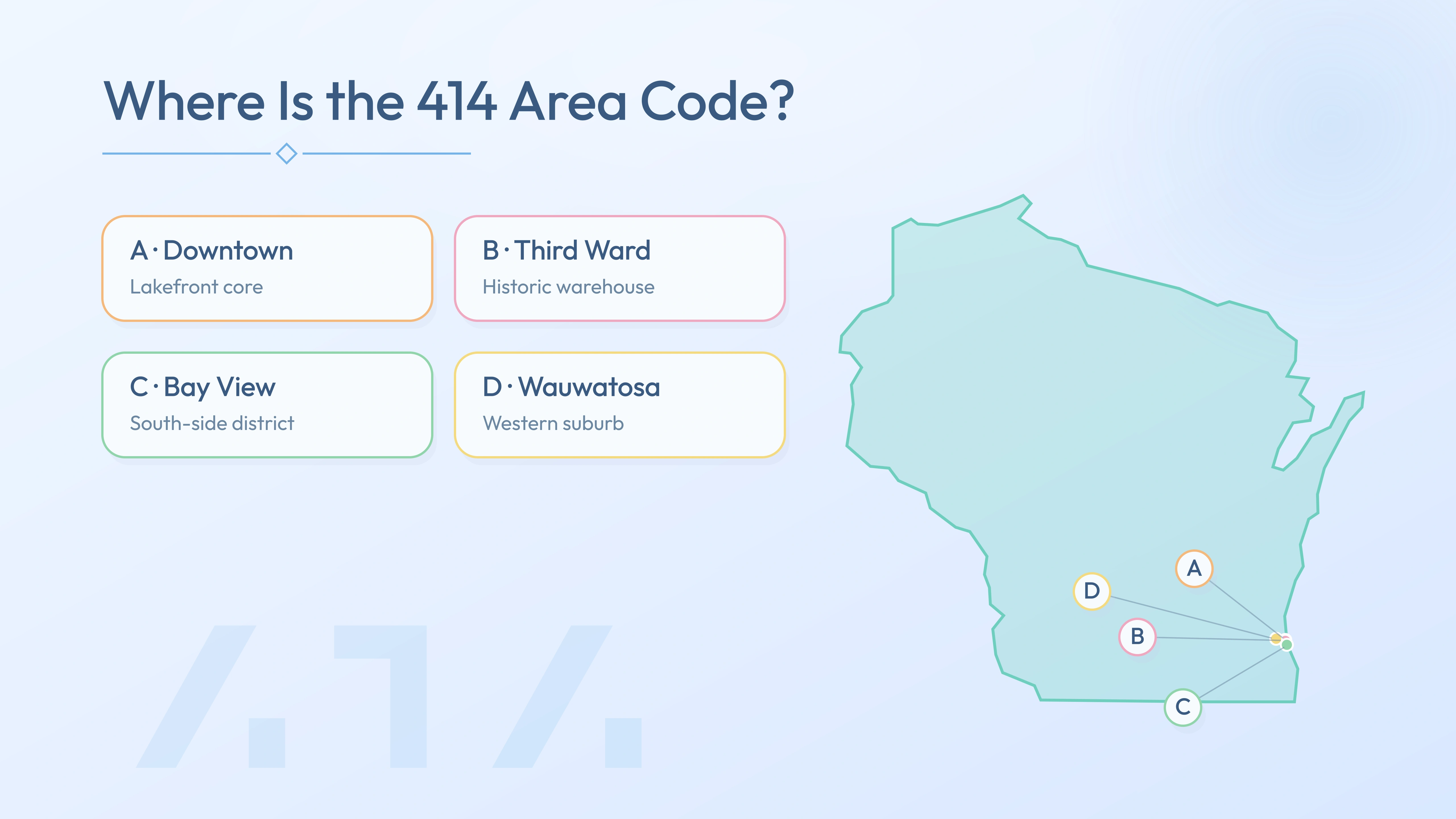
Downtown
Downtown Milwaukee is the lakefront core, where office towers meet the water beside the wing-shaped art museum and a revived riverwalk. Corporate headquarters, the arena district, and a growing residential population keep the district's phone traffic dense and busy.
Third Ward
The Historic Third Ward is the city's converted warehouse district, its brick blocks now filled with galleries, design firms, boutiques, and the Milwaukee Public Market. It is the metro's creative-business address, and its studios and shops run on local lines their customers instantly recognize.
Bay View
Bay View is the south-side district along the lake, a former industrial village turned neighborhood of cafes, music venues, and independent shops on Kinnickinnic Avenue. Its small-business streetscape makes it one of the liveliest commercial corridors outside downtown.
Wauwatosa
Wauwatosa is the western suburb inside the county line, balancing a walkable historic village center with one of the state's largest medical campuses. Hospitals, research facilities, and retail corridors give it a daytime economy that rivals much larger cities.
Communities the 414 Code Serves
Because the code is contained within a single county, its coverage maps almost exactly to Milwaukee County's municipalities. Anyone checking whether a local number will land in the right market can use the list below as a quick reference for the communities the code covers.
- City of Milwaukee — Downtown, the Historic Third Ward, Bay View, and the north and south sides
- Western county — Wauwatosa, West Allis, Greenfield, and Hales Corners
- Southern county — Oak Creek, Franklin, South Milwaukee, and Cudahy
- Northern county — Glendale, Shorewood, Whitefish Bay, and Brown Deer
414 Overlay and Nearby Area Codes
Milwaukee County still has the 414 code to itself — there is no overlay, and every local number in the county carries the same prefix. That keeps the code an unusually clean geographic signal, a distinction it shares with a shrinking club of single-code urban cores.
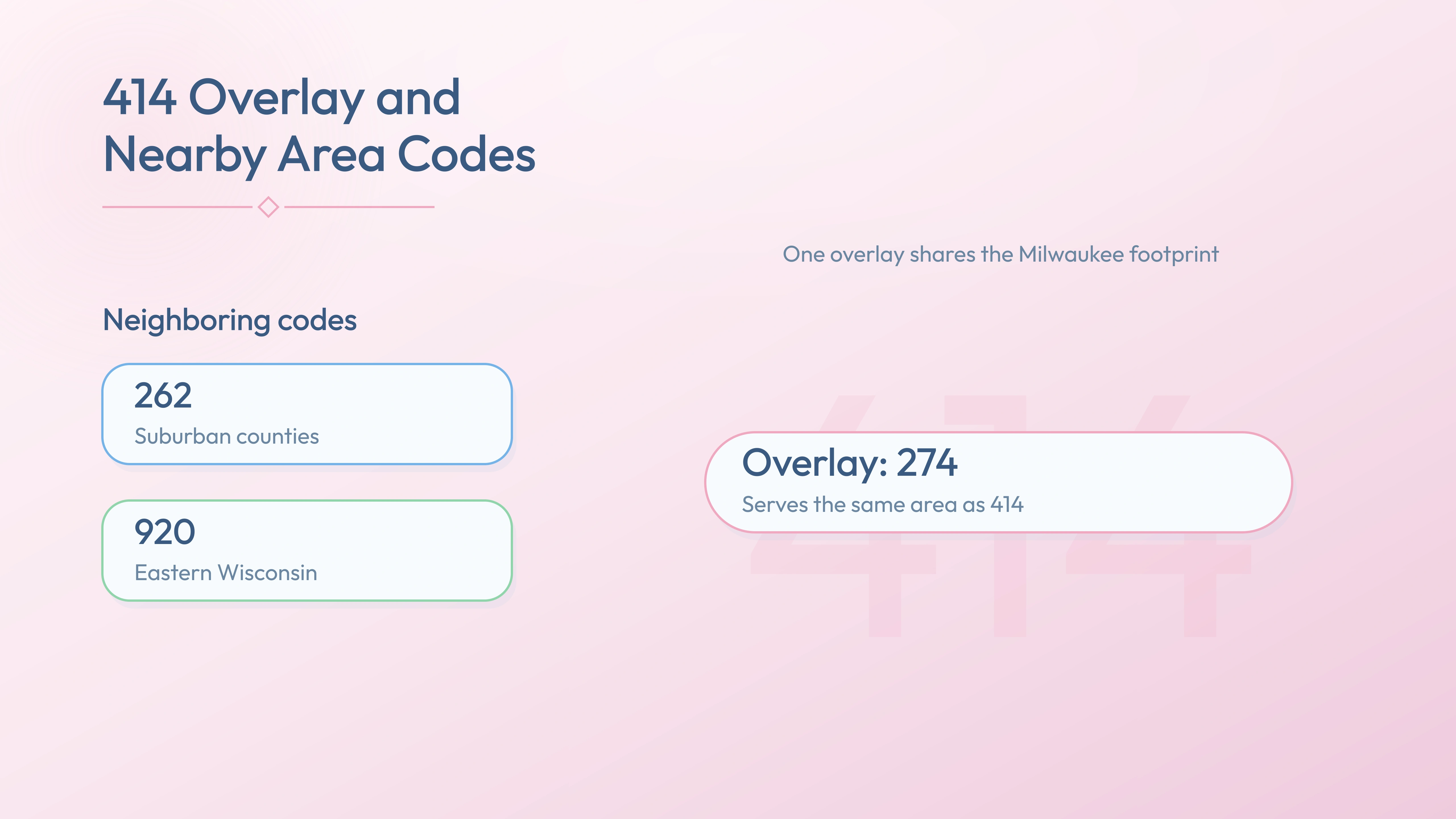
The territory reached its current size through splits rather than overlays: a 1955 boundary rearrangement with 715 created Madison's 608 code, on July 26, 1997 the 920 code took eastern Wisconsin, and on September 25, 1999 the 262 code took the suburban collar counties, leaving 414 concentrated on Milwaukee County, with only small pockets of Waukesha and Washington counties still attached.
Two neighbors frame the county. The 262 code rings the metro through the suburban counties — Waukesha, Ozaukee, Washington, Racine, and Kenosha — where much of the region's manufacturing and residential growth has spread. To the north, 920 — overlaid by the newer 274 code since May 5, 2023 — covers eastern Wisconsin, including Green Bay, Appleton, and Oshkosh. Businesses serving the whole southeastern corner of the state often hold numbers in more than one territory to stay visibly local everywhere they sell.
Get a local number in this area code for your business — set up in minutes.
414 Time Zone
The territory observes Central Time (CT) — UTC−6 during Standard Time and UTC−5 during Daylight Saving, which runs from mid-March to early November. Milwaukee keeps the same clock as Chicago, just down the lakeshore, along with Minneapolis and St. Louis.
Central Time gives Milwaukee businesses comfortable overlap with both coasts: New York is an hour ahead, California two hours behind, and the full national business day fits inside local working hours. For teams handling customers across the Midwest, sharing Chicago's clock keeps scheduling friction near zero.
The Milwaukee Economy and Business Scene
Milwaukee built its reputation on making things, and it still does — while adding research strengths that few cities can match. Milwaukee County is home to roughly 924,740 people as of 2024 — its first year of population growth since 2014 — with the city of Milwaukee itself accounting for about 566,973. Three sectors define the market for anyone planning a local presence.
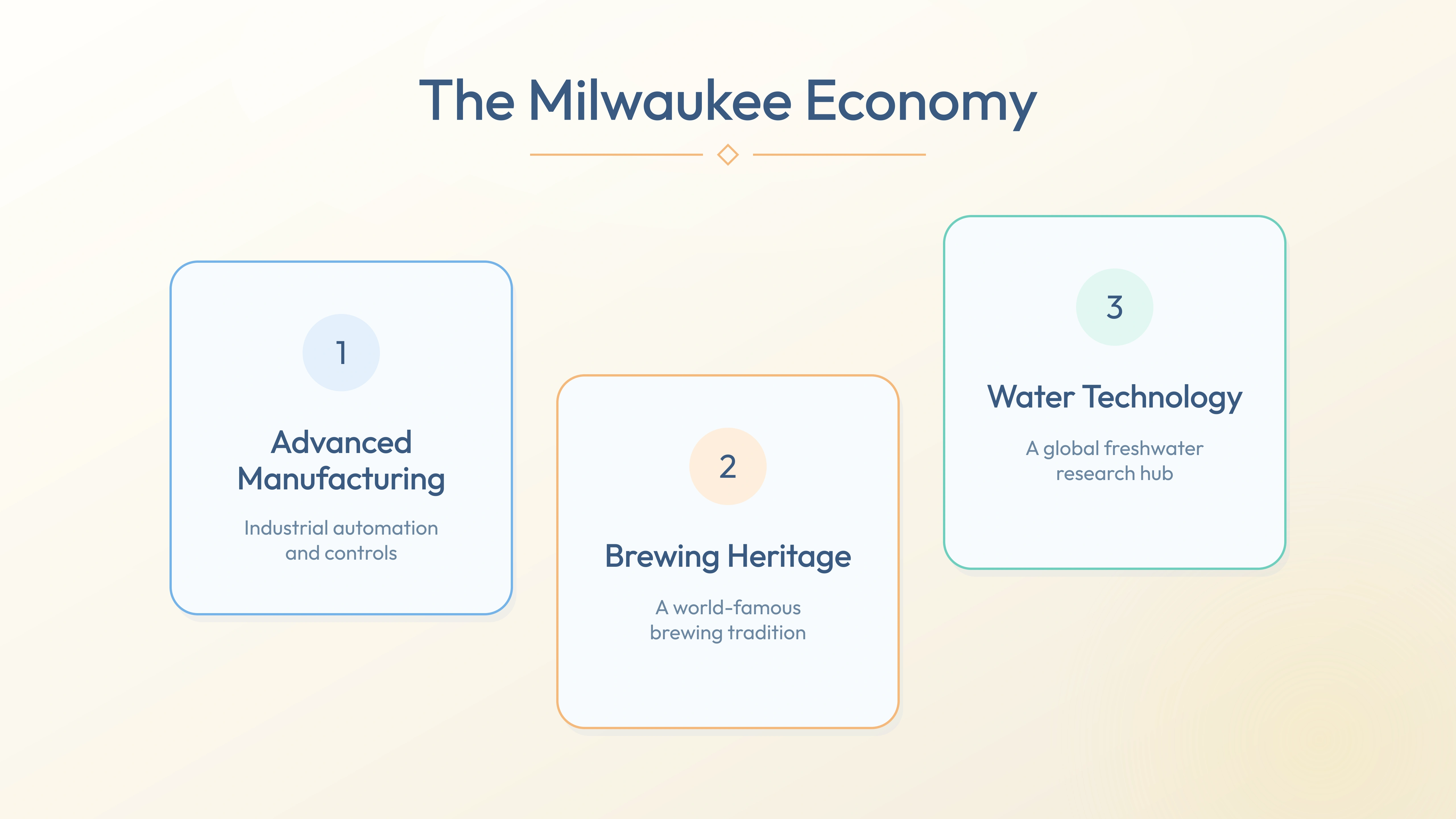
Advanced Manufacturing
Industrial automation and controls are the region's modern signature. Global manufacturers headquartered in the metro produce the drives, switches, and control systems that run factories worldwide, supported by a deep bench of precision machine shops and engineering firms. Sales and support desks in this sector run on dependable phone infrastructure, frequently pairing local lines with toll-free forwarding so national customers can reach Milwaukee engineers at no cost.
Brewing Heritage
A world-famous brewing tradition shaped the city's identity, its architecture, and even its baseball team's name. The legacy breweries have been joined by a thriving craft scene occupying restored brewhouses and warehouse taprooms, and beer tourism now draws visitors year-round to the city that beer made famous.
Water Technology
A global freshwater research hub has grown up around the harbor. The University of Wisconsin-Milwaukee's School of Freshwater Sciences — the only graduate-level school of its kind in the United States and the third in the world — anchors the district, alongside The Water Council, a nonprofit founded in 2009 and headquartered at the Global Water Center that links water-technology companies, entrepreneurs, and researchers. Sitting on one of the world's great freshwater seas, Milwaukee has turned its location into a specialized industry cluster with international reach.
The pattern mirrors the 317 area code, where the Indianapolis economy shapes number demand in much the same way.
How to Get a 414 Phone Number
A Milwaukee number no longer requires a Wisconsin address or an installer's visit. Cloud phone providers keep local inventory on hand, and the entire process runs online in a few minutes.
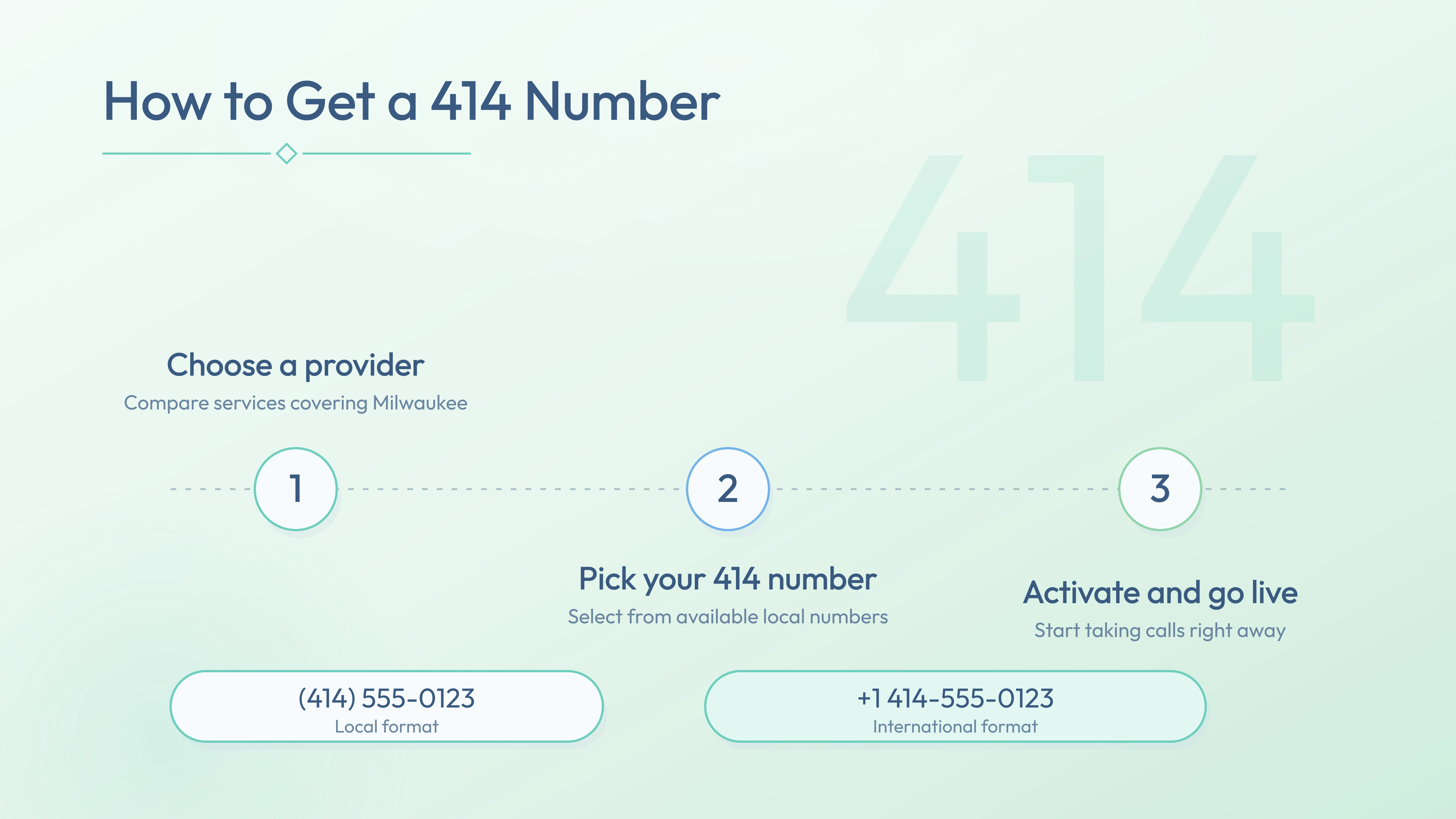
- 1Choose a provider. Pick a cloud phone service with Wisconsin coverage and the business features that matter — call routing, auto-attendant, voicemail transcription, and CRM integration.
- 2Pick a number. Search the available 414 inventory and choose a combination that looks clean on a storefront and rolls off the tongue in a radio spot.
- 3Activate and route. Complete verification and go live — calls ring on any device, from a desk phone in the Third Ward to a mobile in Madison or a laptop app abroad.
The active line presents in the standard local format, (414) 555-0123, and takes international calls as +1 414-555-0123. Remote companies use the prefix to establish Milwaukee credibility before opening a location, while local firms add lines to keep sales, service, and delivery calls neatly separated.
Porting a Number Into or Out of Milwaukee's Prefix
Number portability rules let a Milwaukee business keep its long-held line when switching carriers, moving from a landline to a cloud platform, or relocating within the county. The number itself is the asset — decades of business cards, truck decals, and word-of-mouth referrals point to it — so porting protects that investment while the underlying service changes.
The process is straightforward when handled in the right order:
- 1Keep the existing service active — canceling before the port completes can forfeit the number.
- 2Gather the account number, service address, and port-out PIN from the current carrier, exactly as they appear on the bill.
- 3Submit the port request through the new provider and confirm the scheduled cutover date.
- 4Test inbound calls, voicemail, and caller ID display once the transfer completes, then close the old account.
Most local ports finish within a few business days, and calls keep flowing throughout — customers never notice the switch. For more, see economy.
Why a Local Milwaukee Number Still Matters
In an era of national toll-free lines and app-based calling, a hometown prefix still carries weight in southeastern Wisconsin. Caller ID is a first impression: a familiar local number signals a business rooted in the county rather than a distant call center, and residents are noticeably more willing to answer it. For service trades, restaurants, and clinics whose customers all live nearby, that recognition translates directly into connected calls.
The signal works in marketing, too. A local number on a storefront window, a brewery tour flyer, or a Third Ward gallery listing quietly tells customers the business belongs to the neighborhood. Even fully remote companies entering the market lease local lines for exactly this reason — the prefix does the introduction before anyone says a word, and cloud routing means the call can still ring a team anywhere in the world.
Conclusion
The 414 prefix has carried Milwaukee's story since 1947 — through the 1955 boundary rearrangement that gave Madison its own code, the brewing era, the machine-shop decades, and the city's reinvention as a hub for automation and freshwater science at institutions like UWM's School of Freshwater Sciences. From the lakefront towers to Bay View's corner taps, it remains the number a county of nearly a million people answers to.
For businesses targeting southeastern Wisconsin, a local line is a fast credibility win: minutes to activate, no office required, and a caller ID that tells every customer the call is coming from Milwaukee's home code.
Ready to get started with 414 area code?
Join thousands of businesses using MeraTalk for Wholesale Voice, VoIP, and phone number services.
Contact MeraTalk Today