Introduction
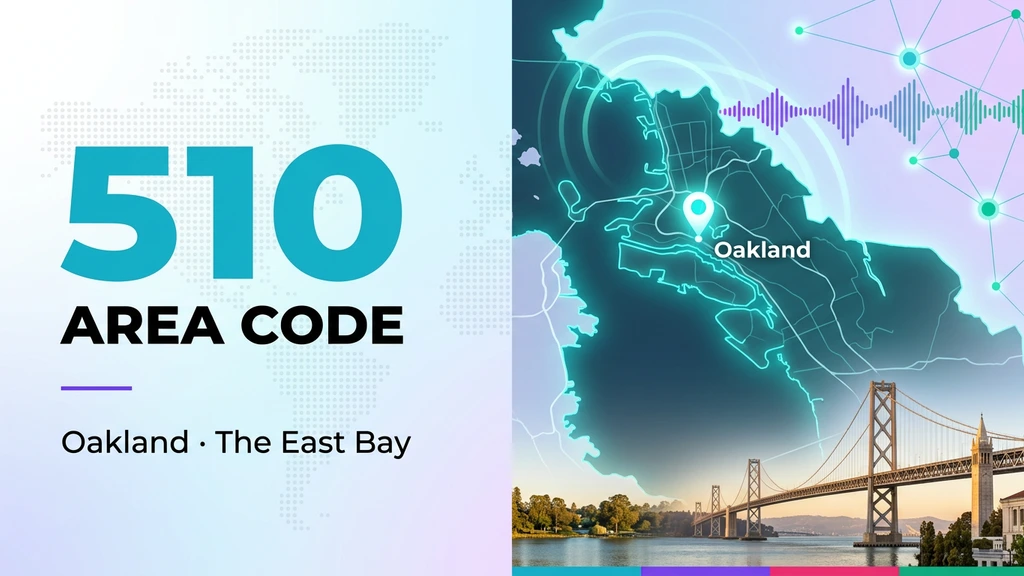
The 510 area code is the East Bay's defining telephone prefix — the digits Oaklanders, Berkeley students, and Fremont engineers recite with a particular sense of local pride. Established in 1991, 510 wraps around the eastern shore of San Francisco Bay, from the cranes of the Port of Oakland to the lecture halls of UC Berkeley and the biotech labs of Emeryville.
A 510 number plants your business firmly inside one of the most diverse and economically active regions on the West Coast.
This guide lays out the complete picture: which East Bay cities and neighborhoods 510 serves, how it relates to the 341 overlay and the neighboring 925, 415, and 628 codes, the history of the code since its 1991 split from 415, and exactly how to activate a 510 virtual number for your business in minutes.
Key Takeaways
Covers where is the 510 area code in depth
Covers 510 area code cities in depth
Covers 510 area code overlay in depth
Covers get a 510 phone number in depth
Need a business phone number? Get a MeraTalk number in minutes, no contract required.
Get started free510 Area Code at a Glance
The 510 area code covers the western East Bay in California, including Oakland, Berkeley and Fremont. It runs on Pacific Time.
- Location: western Alameda County and a strip of western Contra Costa County
- State: California
- Main cities: Oakland, Berkeley, Fremont, Hayward, Richmond, San Leandro, Alameda, Emeryville
- Time zone: Pacific Time (UTC-8 standard, UTC-7 daylight saving)
- Overlay or split: split from 415 in 1991; inland East Bay moved to 925 in 1998; 341 overlay since 2019
- In service since: September 2, 1991
- Dialing: 10-digit dialing required because of the 341 overlay
What Is the 510 Area Code?
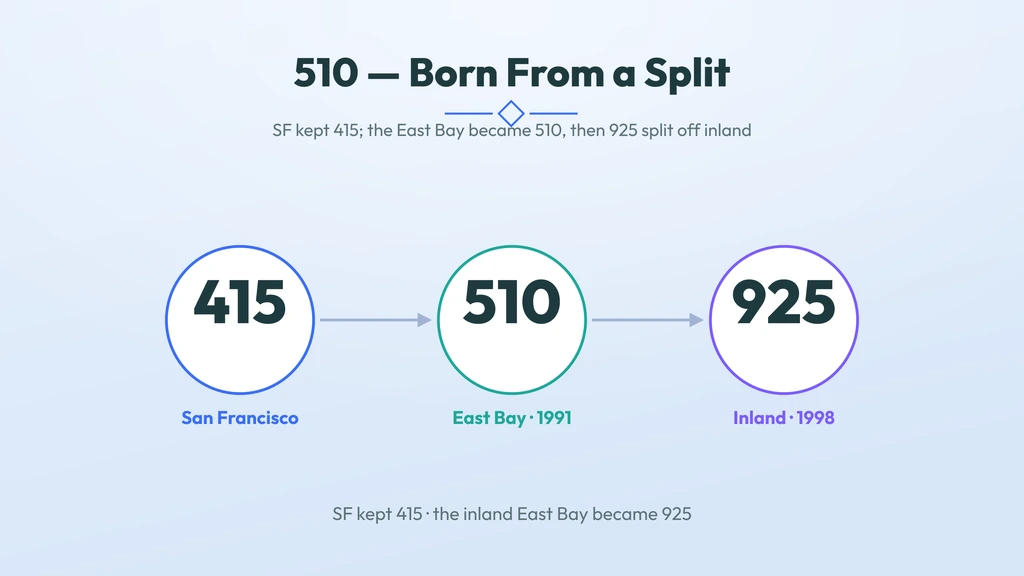
The 510 area code serves much of the East Bay in California's San Francisco Bay Area, spanning western Alameda County and the western part of Contra Costa County. It was created on September 2, 1991, when it was split from area code 415, which until then had covered both San Francisco and the East Bay.
In 1998, the inland East Bay was carved off into the new 925 area code, with the dividing line running roughly along the Berkeley Hills — almost everything west of the ridge stayed in 510. Since 2019, 510 has shared its territory with the 341 overlay.
Dialing Format and Time Zone
- Dialing format: (510) 555-0182
- International: +1 510-555-0182
- Time zone: Pacific Time (PT) — UTC−8 Standard, UTC−7 Daylight Saving (March–November)
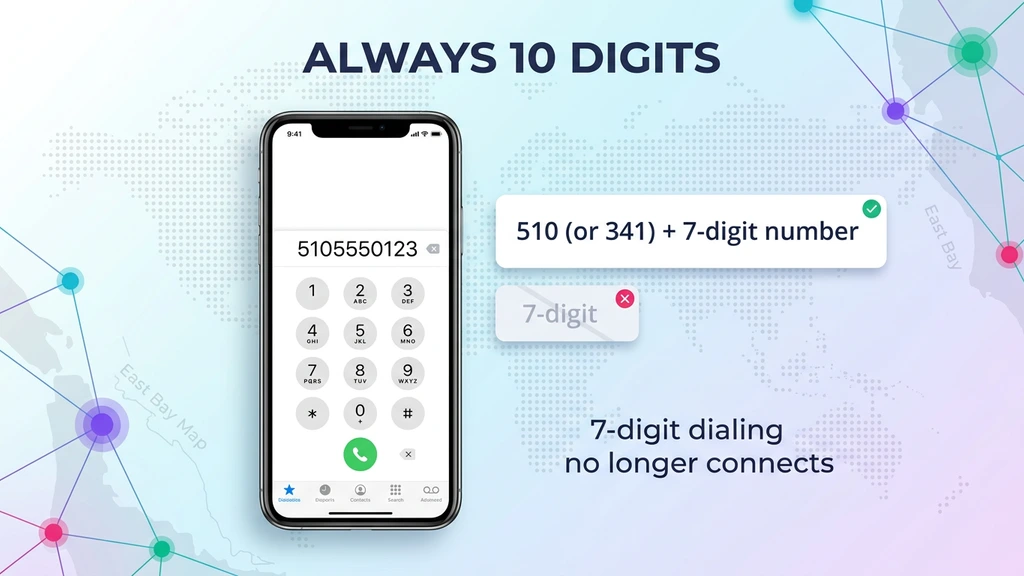
- 10-digit dialing required for all local calls due to the 341 overlay
Where Is the 510 Area Code? Cities & Neighborhoods
The 510 area code covers the western East Bay — the band of cities hugging the eastern side of San Francisco Bay, from Richmond in the north down through Oakland and Hayward to Fremont in the south. It includes most of western Alameda County and a strip of western Contra Costa County. Notably, it excludes the inland Tri-Valley cities of Dublin, Livermore, Pleasanton, and Sunol, which fall under 925 instead.
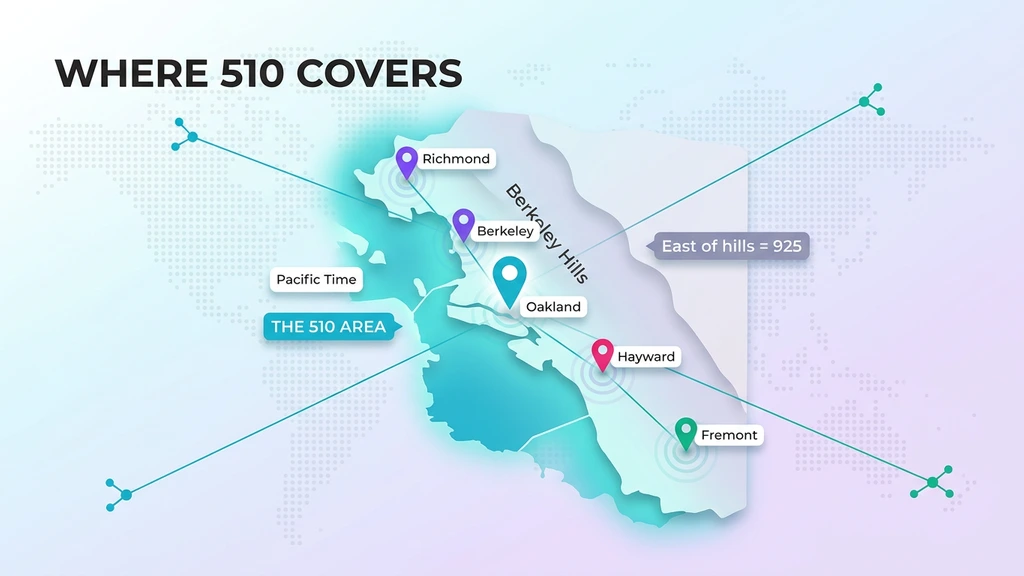
- Oakland — the East Bay's largest city and economic anchor; home to the Port of Oakland, a thriving arts scene, and a fast-growing tech and startup community
- Berkeley — home to the University of California, Berkeley, one of the world's leading research universities and a magnet for science and innovation
- Fremont — a manufacturing and clean-tech hub at the southern end of 510, known for advanced electric-vehicle and hardware production
- Hayward — a diverse residential and industrial city in the central East Bay with a strong logistics and small-business base
- Richmond — a Contra Costa port and refining city on the northern edge of the code with growing biotech and waterfront development
- San Leandro — an industrial and commercial city just south of Oakland with a maturing advanced-manufacturing corridor
- Alameda — an island city in the bay, former naval air station turned mixed-use and maker-space district
- Emeryville — a compact biotech and creative-tech hub between Oakland and Berkeley, headquarters to several life-sciences and media firms
- Union City and Newark — southern Alameda County cities with logistics, retail, and light-industrial economies
- El Cerrito, San Pablo, Hercules, and Pinole — western Contra Costa communities along the I-80 corridor
- Piedmont, Albany, and Castro Valley — established residential communities woven through the 510 footprint
While San Francisco across the bay uses 415 and 628, and the inland Tri-Valley uses 925, the 510 cities form one contiguous East Bay economy linked by BART, the Bay Bridge, and the I-80 and I-880 freeways. Many Bay Area businesses hold numbers across several of these codes.
Get a local number in this area code for your business — set up in minutes.
510 Time Zone
The entire 510 area code observes Pacific Time (PT). That means UTC−8 during Pacific Standard Time, from early November through mid-March, and UTC−7 during Pacific Daylight Time, from mid-March through early November. The East Bay shares this clock with San Francisco, Silicon Valley, Los Angeles, and the rest of the West Coast.
For businesses, Pacific Time shapes the working day. The East Bay opens three hours behind the East Coast, so a 510 line that needs to serve New York or Chicago clients should plan early-morning coverage. The upside is a long overlap with Asia-Pacific markets — a meaningful advantage for the Port of Oakland's trade partners and the region's many import, logistics, and biotech firms doing business across the Pacific.
510 Overlay and Nearby Area Codes
As the East Bay's population and demand for mobile numbers grew, the 510 numbering pool ran low. To add capacity without redrawing the map, regulators introduced an overlay rather than another geographic split.
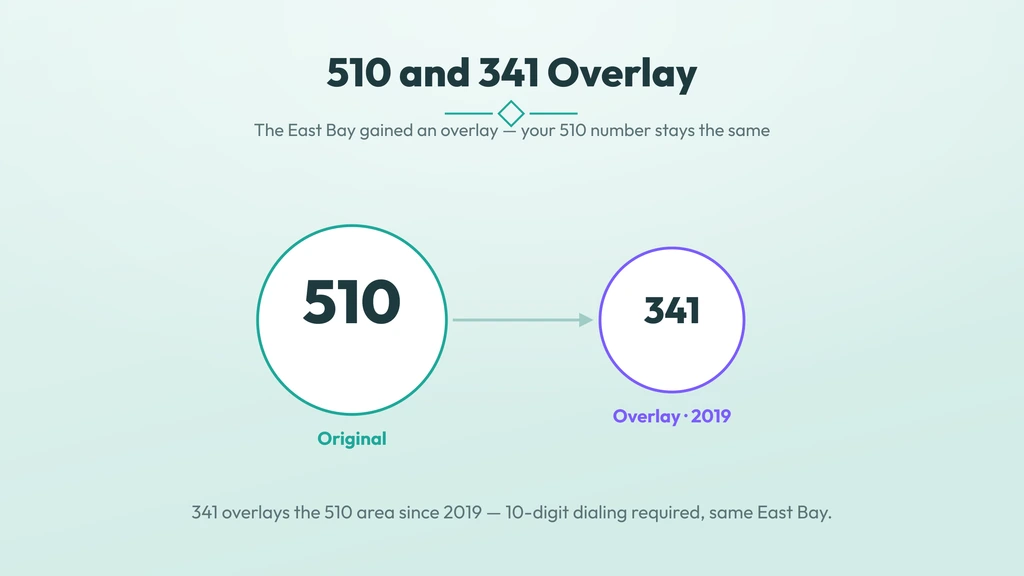
- 341 — the overlay code that now covers the exact same East Bay territory as 510. Ten-digit dialing became mandatory on June 22, 2019, and new numbers in the 341 code became available the following month. Existing 510 numbers were never changed; 341 simply adds fresh inventory across the same cities.
- 925 — the inland East Bay code split from 510 in 1998, covering Concord, Walnut Creek, the Tri-Valley (Dublin, Livermore, Pleasanton), and points east of the Berkeley Hills.
- 415 and 628 — San Francisco and northern San Mateo County, directly across the bay to the west; 415 is the original San Francisco code, with 628 added later as its overlay.
- 408 and 669 — Silicon Valley to the south, centered on San Jose; the southern tip of Fremont sits just north of this boundary.
Because 510 and 341 share the same area, every local call within the East Bay must be dialed using all ten digits. For a business, the practical takeaway is simple: 510 remains the recognizable, established East Bay prefix, while 341 is the newer code you may encounter on recently issued numbers in the same cities.
For deeper context on the codes across the bay, see our guides to the 415 San Francisco area code and the 408 Silicon Valley area code.
The Oakland and East Bay Economy Behind the 510 Area Code
The 510 area code covers one of the most varied regional economies in California — a blend of global trade, world-class research, advanced manufacturing, and a deep small-business and creative culture. Few area codes pack as much economic diversity into as compact a footprint.
Trade, Research, and Industry
The Port of Oakland is one of the busiest container ports in the United States and a primary gateway for goods moving between the U.S. and Asia, anchoring a vast logistics, warehousing, and trucking economy across the 510 footprint. Inland, advanced manufacturing and clean technology cluster in Fremont and San Leandro, while Richmond contributes refining, port activity, and a growing life-sciences presence along its waterfront.
Education and Biotech
The University of California, Berkeley sits at the heart of 510 and feeds a steady stream of talent into the region's research, engineering, and startup scenes. Nearby Emeryville has become a dense node for biotechnology and creative technology, hosting life-sciences companies and well-known media and software studios in a remarkably small area between Oakland and Berkeley.
Small Business and Culture
Beyond the big institutions, 510 is defined by independent businesses — restaurants, breweries, design studios, music venues, and neighborhood retailers across Oakland, Berkeley, and Alameda. The code itself has become a cultural badge in the East Bay, appearing in local music, streetwear, and civic identity, which makes a 510 number an unusually strong signal of authentic local roots.
How to Get a 510 Area Code Phone Number
Modern VoIP and cloud phone providers let you activate a 510 East Bay number in minutes — no Oakland office, no hardware, and no long-term contract required. You choose a provider with 510 inventory, search for an available number, complete brief verification, and configure routing to ring on any device, anywhere in the world.
A 510 number is a strong fit for businesses targeting Oakland, Berkeley, Fremont, and the wider East Bay — local sales teams, service providers, e-commerce brands, logistics firms working with the Port of Oakland, and remote companies that want a credible Bay Area presence. Local numbers consistently earn higher answer rates than out-of-area ones because recipients recognize the prefix.
MeraTalk provides 510 East Bay virtual numbers as part of its cloud telephony platform; numbers activate in minutes, route to any device, and pair with voicemail, auto-attendant, call recording, and CRM integration from a single dashboard. Search available 510 numbers at meratalk.com.
Landlines, Mobiles, and 510 Numbers
One detail that surprises many people is that the prefix itself says nothing about the type of line behind it. A 510 number can ring a copper landline in an Oakland storefront, a mobile handset in Berkeley, or a softphone app running on a laptop anywhere in the world. The North American numbering system assigns codes by geography, not by device, so all three line types draw from the same East Bay inventory.
That flexibility is what makes local numbers so useful in the cloud era. A business can retire an aging desk phone, move the same number to a VoIP service, and forward it to team mobiles — all without customers seeing any change. For households, it also explains why a neighbor's cell phone can carry a decades-old family number that started life on a wall-mounted landline. For more, see 510 area code.
Setting Up Call Routing for a 510 Number
Once an East Bay line is active on a cloud platform, routing rules determine what actually happens when it rings. Well-designed routing is the difference between a number that simply receives calls and one that runs a front desk on its own.
- Business-hours schedules send daytime calls to the team and after-hours calls to voicemail or an answering message.
- Ring groups let a single Oakland number ring several employees at once, so the first available person answers.
- Failover rules push calls to a mobile automatically if the office internet connection drops.
- Menu options separate sales, support, and billing traffic before a human ever picks up.
Most platforms configure these rules through a simple web dashboard, and changes take effect immediately — useful for adjusting coverage during holidays, events, or sudden staffing gaps.
Conclusion
The 510 area code has represented California's East Bay since 1991 — through the rise of the Port of Oakland as a Pacific trade gateway, the steady influence of UC Berkeley, the growth of biotech in Emeryville, and the enduring small-business culture that makes Oakland, Berkeley, and their neighbors so distinctive. With the 341 overlay now sharing the same cities, 510 remains the recognized, established prefix that locals identify with.
Activating a 510 virtual number takes minutes with MeraTalk. Go live with an East Bay area code, route calls to any device, and pair it with auto-attendant, call recording, and CRM integration from day one — no physical Oakland office required. Explore MeraTalk's virtual number options at meratalk.com.
Ready to get started with 510 area code?
Join thousands of businesses using MeraTalk for Wholesale Voice, VoIP, and phone number services.
Contact MeraTalk Today