Introduction
The 512 area code is Austin's original telephone prefix — assigned in 1947 and still the number the rest of the world associates with the Texas capital. Austin is the seat of Texas state government, home to the University of Texas flagship campus, the host city of South by Southwest, and the anchor of Silicon Hills, the fast-growing tech corridor that drew Tesla, Oracle, and Dell to Central Texas. A 512 number places your business inside all of that.
This guide covers the full picture: which Central Texas cities 512 serves, how it works alongside the 737 overlay that shares the same territory, the code's history from its 1947 origins through the San Antonio and Corpus Christi splits, and exactly how to activate a 512 virtual number for your business in minutes.
Key Takeaways
Covers where is the 512 area code in depth
Covers 512 area code cities in depth
Covers 512 area code overlay in depth
Covers get a 512 phone number in depth
Need a business phone number? Get a MeraTalk number in minutes, no contract required.
Get started freeWhat Is the 512 Area Code?
The 512 area code is assigned to Austin and a cluster of Central Texas counties surrounding it. It was one of the original area codes established under the North American Numbering Plan in October 1947, when it covered most of south-central Texas — stretching from the Gulf of Mexico to the Mexican border and including San Antonio, Corpus Christi, and the Rio Grande Valley.
A series of splits over the following decades narrowed 512 down to the Austin metropolitan area, where it remains today, now paired with the 737 overlay across the same footprint.
Dialing Format and Time Zone
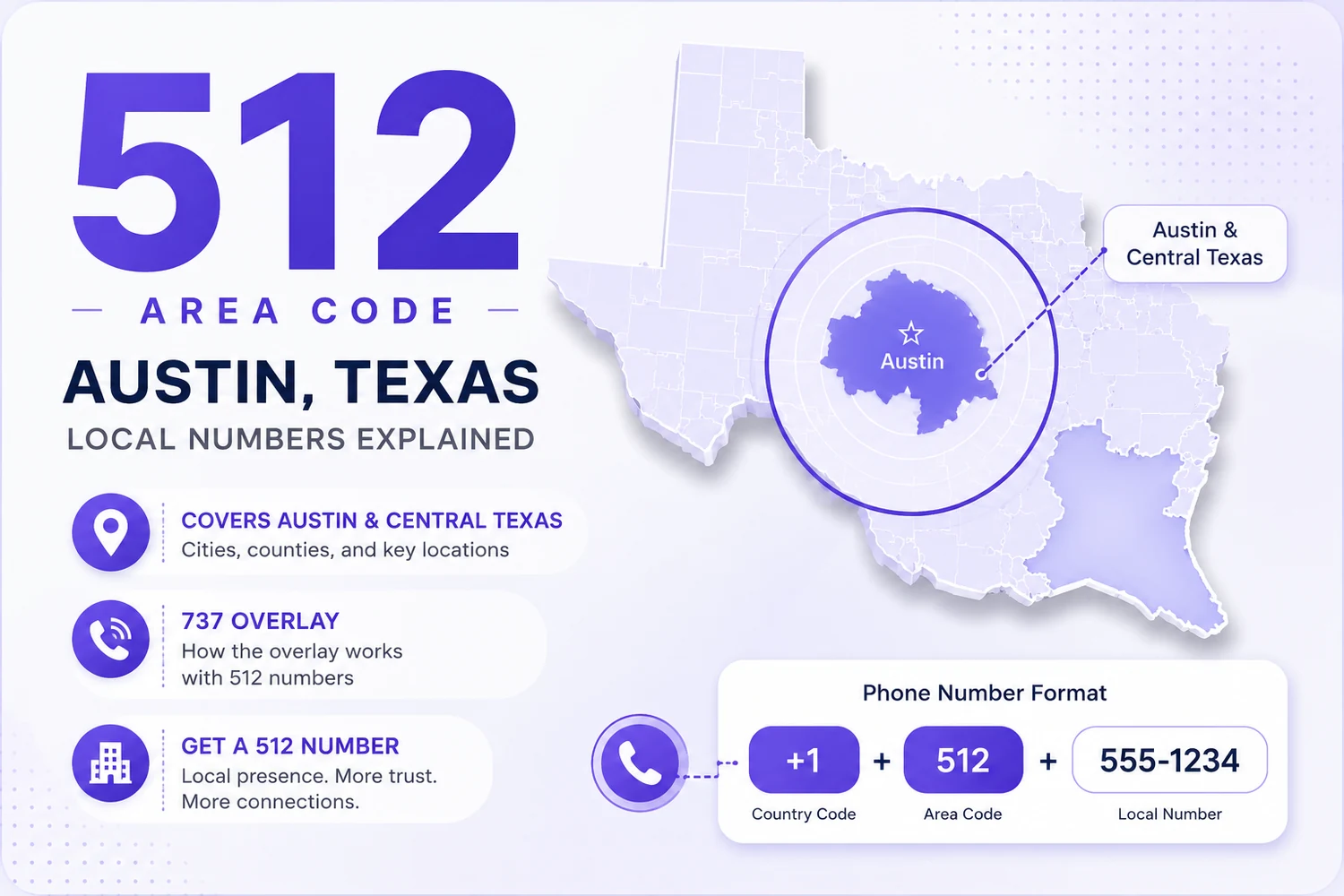
- Dialing format: (512) 555-0184
- International: +1 512-555-0184
- Time zone: Central Time (CT) — UTC−6 Standard, UTC−5 Daylight Saving (March–November)
- 10-digit dialing required for all local calls due to the 737 overlay
Where Is the 512 Area Code? Cities & Neighborhoods
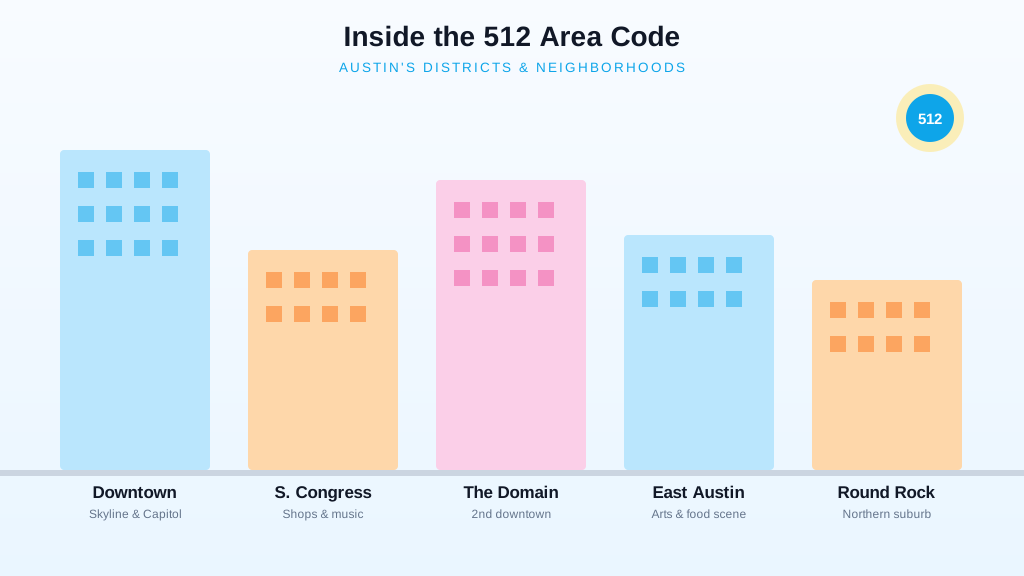
The 512 area code covers Austin and the surrounding Central Texas region, spanning roughly seven counties — Travis, Williamson, Hays, Bastrop, Caldwell, Burnet, and Milam. The territory takes in the city of Austin itself along with the rapidly expanding suburbs that ring it to the north, south, and east, forming one of the fastest-growing metro areas in the United States.
Cities and Communities
- Austin — the Texas state capital and cultural anchor; home to the Capitol, the University of Texas, and SXSW
- Round Rock — northern suburb in Williamson County and the worldwide headquarters of Dell Technologies
- Cedar Park — fast-growing community northwest of Austin with a strong residential and small-business base
- Georgetown — Williamson County seat known for its historic courthouse square and rapid population growth
- Pflugerville — northeast suburb expanding alongside Austin's tech and logistics corridor
- Leander — northwestern community on the metro's outer edge, one of the area's fastest-growing cities
- San Marcos — Hays County city between Austin and San Antonio, home to Texas State University
- Kyle and Buda — Hays County communities along the I-35 corridor south of Austin
- Bastrop — historic town east of Austin anchoring the eastern edge of the 512 region
- Taylor — Williamson County city tied to Central Texas's growing semiconductor footprint
Together these communities form a single contiguous metro economy. While San Antonio to the south sits in a separate area code, the Austin–San Marcos corridor along Interstate 35 ties the 512 region into one of the busiest growth axes in Texas.
512 Time Zone
The 512 area code observes Central Time (CT) — UTC−6 during Standard Time and UTC−5 during Daylight Saving Time, which runs from mid-March through early November. All of Central Texas shares this single time zone, so there is no internal time difference anywhere within the 512 footprint.
For businesses, Central Time is a practical advantage: it overlaps the morning with the East Coast and the late afternoon with the West Coast, making a 512 number convenient for reaching contacts across the continental United States in a single working day. A 512 line signals that your business keeps Central Texas hours.
Get a local number in this area code for your business — set up in minutes.
512 Overlay and Nearby Area Codes
Unlike many older codes, 512 is not a stand-alone prefix anymore — it is paired with an overlay that covers the exact same geography. Understanding how the two work together explains why dialing in Austin looks the way it does.
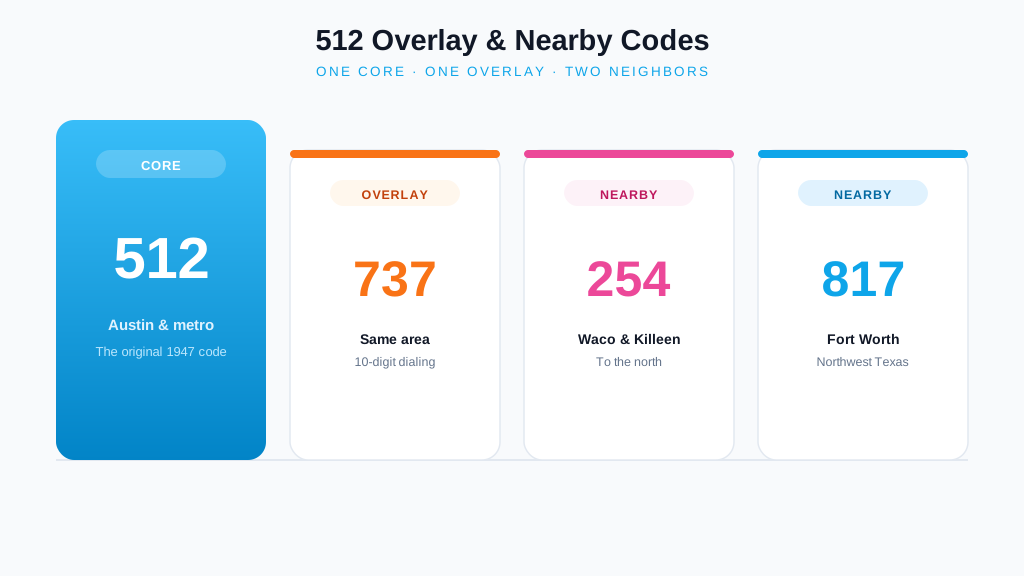
- 512 — the original Austin code, in continuous use since 1947. It carries the strongest Austin and Central Texas brand recognition and is the prefix most longstanding local businesses hold.
- 737 — introduced in July 2013 as an overlay of 512 to prevent number exhaustion. It serves the identical Austin metro territory; a 737 number is geographically the same as a 512 number, just newer.
- 210 and 726 — San Antonio and surrounding Bexar County to the south. 210 was split off from 512 in 1992, and 726 was later added as its overlay.
- 361 — Corpus Christi and the Coastal Bend, split from 512 in 1999.
Because 512 and 737 share the same region, 10-digit dialing is mandatory for every local call — phased in starting in late 2012 and required since June 2013. Always dial the full area code plus the seven-digit number. For a business, holding a 512 number rather than the newer 737 still signals deeper Austin roots, since 512 is the prefix locals recognize first. South of Austin, businesses instead carry the 210 area code around San Antonio.
The Austin Economy and the 512 Area Code
Austin has become one of the most economically dynamic cities in the country, fueled by a powerful mix of government, education, and technology. A 512 number positions your business inside that ecosystem from day one.
Silicon Hills and the Tech Sector
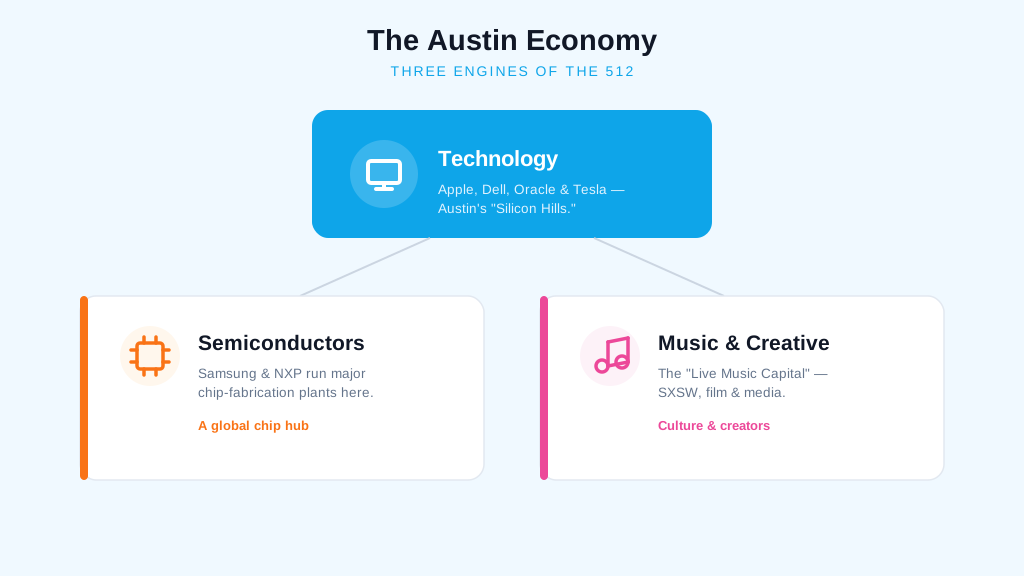
Austin's tech corridor — nicknamed Silicon Hills since the mid-1990s — spans enterprise software, semiconductors, corporate R&D, and a deep startup community. Tesla relocated its corporate headquarters to Austin and built Gigafactory Texas in the 512 region, where it manufactures vehicles at scale. Oracle moved its headquarters to Austin's Riverside corridor, and Dell Technologies has long been headquartered in the suburb of Round Rock.
Samsung, Apple, Amazon, Google, AMD, and a broad roster of software and chip companies all maintain a major Central Texas presence.
Government, Education, and Culture
Austin is the capital of Texas, and state government is one of the largest employers in the metro. The University of Texas at Austin anchors a highly educated workforce and feeds talent directly into local industry, while Texas State University in San Marcos adds to the regional talent pool.
The city's identity as a music and film hub — crowned each year by the South by Southwest festival — sustains a large creative-media sector that draws visitors and businesses from around the world.
Landmarks and Identity
From the Texas State Capitol and the UT Tower to the music venues of Sixth Street and the festival grounds that host SXSW, the landmarks tied to the 512 region are recognized far beyond Texas. For a business, a 512 number connects directly to that distinctive Austin identity — equal parts capital city, college town, and tech magnet.
How to Get a 512 Area Code Phone Number
Modern VoIP and cloud phone providers let you activate a 512 Austin number in minutes — no Texas office, no hardware, and no long-term contract required. You search the available 512 inventory, pick your number, complete a short verification, and configure how calls route to your team. The number is typically live and callable within minutes of activation.
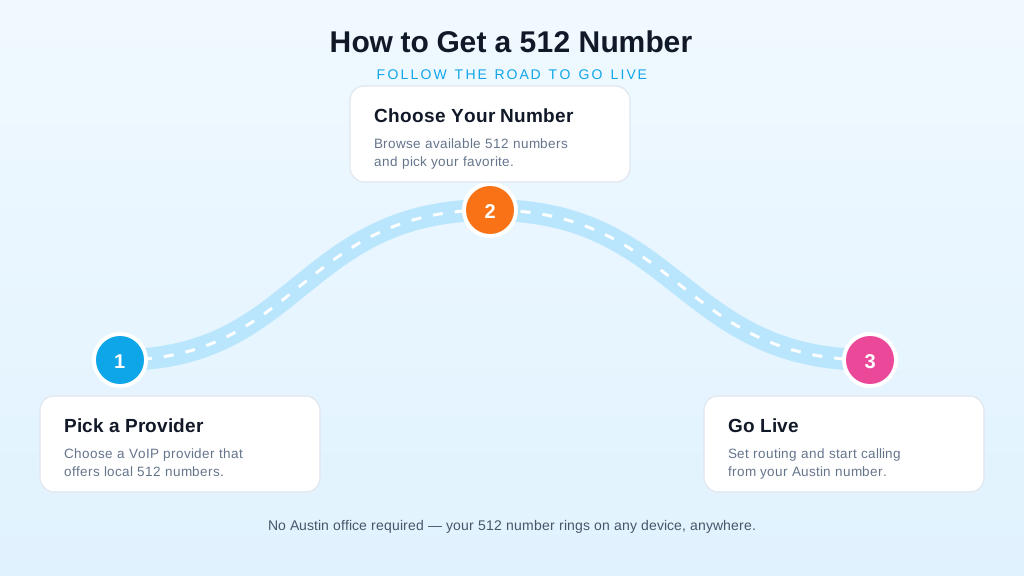
A 512 number benefits any business that wants a credible Central Texas presence: startups courting Austin investors, sales teams calling into the Silicon Hills market, service businesses targeting Round Rock or Georgetown, or remote companies that want local answer rates without a physical office.
MeraTalk provides 512 Austin virtual phone numbers as part of its cloud telephony platform — numbers activate in minutes, route to any device, and pair with call recording, auto-attendant, and CRM integration from a single dashboard. Search available 512 numbers at meratalk.com.
Choosing Between a Local Austin Number and a Toll-Free Line
Businesses serving Central Texas often weigh a local 512 line against a national toll-free number, and the right answer depends on who is calling. A local prefix signals neighborhood presence — ideal for restaurants, clinics, real estate agents, and service companies whose customers live within the metro. A toll-free number projects national scale and works better for support desks and order lines that field calls from every state.
- Local number: stronger answer rates from Austin-area residents, familiar caller ID, community credibility.
- Toll-free number: consistent brand identity nationwide, no geographic association, memorable vanity options.
- Hybrid approach: many companies run both, advertising the local line in-market and the toll-free line everywhere else.
Cloud phone systems make the hybrid model painless, since both numbers can route to the same team, share the same voicemail, and appear in the same dashboard. For more, see 512 area code.
The Future of Numbering in the Austin Region
Few American metros have absorbed population and business growth as quickly as Central Texas, and phone numbers are one of the quieter resources that growth consumes. Every new resident, startup, connected device, and delivery fleet draws lines from the regional inventory, which is why regulators track number utilization closely in fast-growing markets like this one.
When a region's supply tightens, the modern remedy is an overlay — a new code layered over the same geography — rather than a painful split that forces existing subscribers to change numbers. Overlays preserve every number already in service; the visible effect is simply that new assignments may carry a different prefix.
For businesses, the practical takeaway is straightforward: numbers already secured are safe indefinitely, and companies that want the classic Austin prefix specifically should claim their line sooner rather than later, while inventory remains available.
Conclusion
The 512 area code has represented Austin since 1947 — through its years as a quiet state capital and college town, the rise of Silicon Hills, and the recent wave that brought Tesla, Oracle, and Dell's leadership to Central Texas. Paired with the 737 overlay, it remains the prefix the region is known by, and the one local customers recognize first.
Activating a 512 virtual number takes minutes with MeraTalk. Go live with an Austin area code, route calls to any device, and add call recording, auto-attendant, and CRM integration from day one — no physical Texas office required. Explore MeraTalk's virtual number options at meratalk.com.
Ready to get started with 512 area code?
Join thousands of businesses using MeraTalk for Wholesale Voice, VoIP, and phone number services.
Contact MeraTalk Today