Introduction
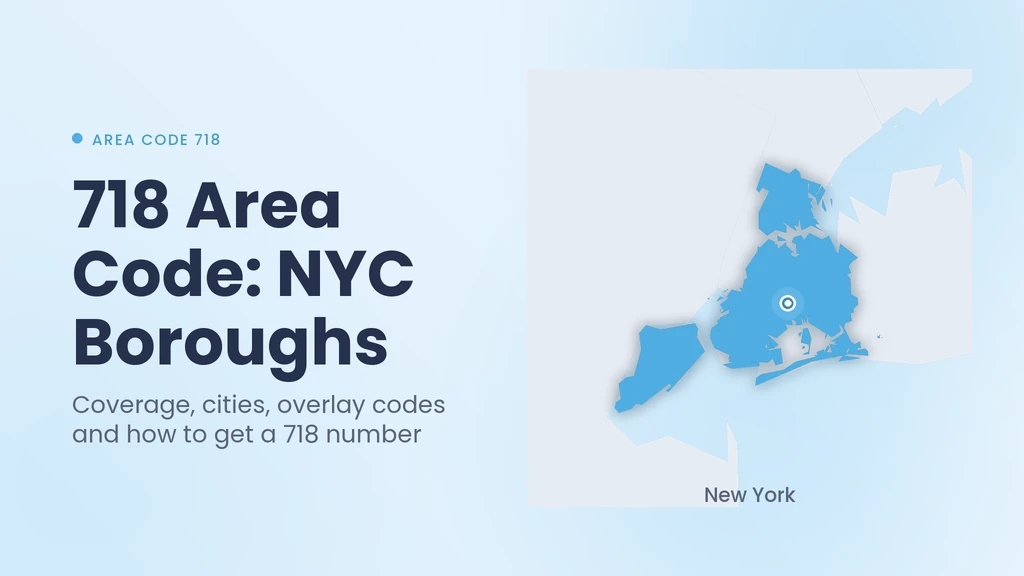
The 718 area code is the original telephone prefix of New York City's outer boroughs — Brooklyn, Queens, the Bronx and Staten Island. Introduced on September 1, 1984 when the city outgrew its single 212 code, 718 has come to represent everyday New York: the brownstones of Brooklyn, the cultural mosaic of Queens, the energy of the Bronx, and the harbor communities of Staten Island.
A 718 number plants your business firmly inside the most populous part of the most populous city in the United States.
This guide covers the full picture: exactly which boroughs and neighborhoods 718 serves, how it relates to the 347 and 929 overlays that now share the same footprint, why Manhattan uses different codes, the code's history since 1984, and how to activate a 718 virtual number for your business in minutes.
Key Takeaways
Covers where is the 718 area code in depth
Covers 718 area code location in depth
Covers get a 718 phone number in depth
Covers 718 vs 347 area code in depth
Need a business phone number? Get a MeraTalk number in minutes, no contract required.
Get started freeWhat Is the 718 Area Code?
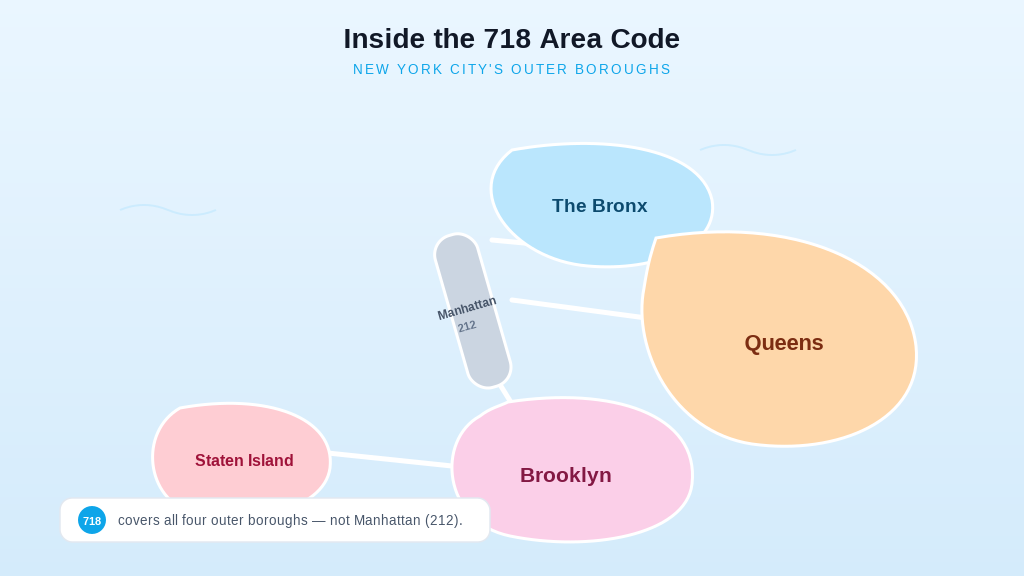
The 718 area code is assigned to four of New York City's five boroughs — Brooklyn (Kings County), Queens (Queens County), the Bronx (Bronx County) and Staten Island (Richmond County) — along with the Marble Hill section of Manhattan. It was the first area code created when New York City split its long-standing 212 code in 1984, and it remains the defining prefix for life beyond Manhattan.
Because demand for numbers grew so quickly, 718 is now part of an overlay complex, sharing its geography with the 347 and 929 codes.
Dialing Format and Time Zone
- Dialing format: (718) 555-0182
- International: +1 718-555-0182
- Time zone: Eastern Time (ET) — UTC−5 Standard, UTC−4 Daylight Saving (March–November)
- 10-digit dialing required for all local calls
The History of the 718 Area Code
When AT&T and the Bell System drew up the North American Numbering Plan in 1947, the whole of New York City received one area code: 212. All five boroughs shared it, and for thirty-seven years a Staten Island number and a Wall Street number opened with the same three digits.
That ended on February 1, 1984, when the New York Public Service Commission voted on New York Telephone’s request to split the city. The carrier had warned of an impending exhaustion of 212 numbers, and the Commission chose a geographic split rather than an overlay: Brooklyn, Queens and Staten Island would get a new code, while 212 was restricted to Manhattan and the Bronx.
718 entered service on September 1, 1984. Callers could still dial 212 for the transferred exchanges during a permissive period that ran until January 1, 1985, after which the new code was required.
The Bronx kept 212 for another eight years. On July 1, 1992, it was split out and added to 718, and the Marble Hill section of Manhattan went with it. Permissive dialing of either 212 or 718 for those exchanges lasted until May 16, 1993. That is the date 718 took on the four-borough footprint it still has.
Why Marble Hill Dials Like the Bronx
Marble Hill is legally part of Manhattan, but it has not been physically part of the island since 1895, when the Harlem River Ship Canal was cut across the neck of land that joined it to the rest of the borough. The old channel on its other side was filled in by 1914, leaving the neighborhood attached to the Bronx mainland. Its telephone trunks run to a Bronx wire center, and rerouting them to a Manhattan one was never judged worth the cost — so Marble Hill uses 718 and its overlays while the rest of Manhattan uses 212, 646 and 332.
Every Change to the Outer-Borough Numbering, With Dates
| Date | What Changed |
|---|---|
| 1947 | The North American Numbering Plan assigns 212 to all five New York City boroughs |
| February 1, 1984 | The New York PSC votes to split Brooklyn, Queens and Staten Island out of 212 |
| September 1, 1984 | 718 enters service for Brooklyn, Queens and Staten Island |
| January 1, 1985 | Permissive dialing of 212 for the transferred exchanges ends |
| July 1, 1992 | The Bronx and Marble Hill move from 212 into 718 |
| May 16, 1993 | Permissive 212-or-718 dialing ends for the Bronx and Marble Hill |
| December 1998 | The PSC approves 347 as the first overlay on 718 |
| October 1, 1999 | 347 enters service across the same four boroughs |
| April 15, 2000 | Ten-digit dialing becomes mandatory throughout the 718 and 347 area |
| December 16, 2009 | The PSC approves a second overlay for the region |
| January 22, 2010 | NeuStar announces that the second overlay will be 929 |
| April 16, 2011 | 929 enters service |
| January 24, 2025 | The PSC approves 465 as an all-services distributed overlay |
| June 18, 2026 | 465 enters service, the first New York area code beginning with 4 |
The four-code complex is not out of numbers yet. Central office code exhaustion for 347, 718, 917 and 929 was projected for the fourth quarter of 2026 when the forecast was made in April 2024, but a September 2025 revision pushed that back to the third quarter of 2027 on lower demand for new prefixes. That is why 465 is in service but not yet being handed out.
Where Is the 718 Area Code? Cities & Neighborhoods
The 718 area code covers all of New York City except Manhattan. That makes it one of the most densely populated and culturally diverse numbering areas in the country, spanning four boroughs and hundreds of distinct neighborhoods — from waterfront brownstone districts to immigrant commercial corridors known across the world.
Major Neighborhoods and Districts
- Brooklyn Heights & Downtown Brooklyn — historic brownstone district and the borough's fast-growing commercial and civic core
- Williamsburg & Greenpoint — north Brooklyn creative, nightlife and tech-startup hubs along the East River
- Park Slope & Prospect Heights — residential neighborhoods around Prospect Park and the Brooklyn Museum
- Long Island City & Astoria — Queens waterfront districts with rising office, film and tech presence facing the Manhattan skyline
- Flushing & Jackson Heights — among the most ethnically diverse commercial neighborhoods in the United States
- Jamaica & Forest Hills — Queens transit, retail and residential centers near JFK Airport
- South Bronx & Riverdale — the Bronx's revitalizing industrial corridor and its leafy northwest residential area
- Fordham & Yankee Stadium area — civic, university and sports anchor of the central Bronx
- St. George & Stapleton — Staten Island's North Shore civic center and ferry gateway to Manhattan
- Coney Island & Bay Ridge — southern Brooklyn's iconic boardwalk and harborside residential communities
Manhattan, by contrast, sits outside 718 — it is served by the 212, 646 and 917 codes. The 917 overlay is unusual in that it covers all five boroughs at once, so a 917 mobile number could belong to a resident of any borough, including the 718 outer boroughs.
What Is Not in the 718 Zone
Because 718 is read as shorthand for “New York” by people outside the city, it is worth being precise about where it stops. The metro area is a dense patchwork of numbering plan areas, and several of them sit within a short train ride of a 718 exchange.
| Area | Area Code |
|---|---|
| Manhattan, everything south of Marble Hill | 212, 646, 332 |
| All five boroughs, as a citywide overlay | 917 |
| Nassau County, Long Island | 516 |
| Suffolk County, Long Island | 631 and 934 |
| Westchester County | 914 |
| Rockland and Orange counties | 845 |
| Northern New Jersey across the Hudson | 201, 551, 973, 862 |
| Central New Jersey | 732, 848, 908 |
| Southwestern Connecticut | 203 and 475 |
Get a local number in this area code for your business — set up in minutes.
718 Time Zone
The entire 718 area code sits within the Eastern Time Zone (ET), the same time zone as the rest of New York City, Boston, Philadelphia and Washington, D.C. Eastern Time runs at UTC−5 during Standard Time and shifts to UTC−4 during Daylight Saving Time, which spans from mid-March through early November.
For businesses, this is the most convenient time zone in the country to operate from. A 718 number aligns with standard East Coast business hours, overlaps the full working day with Europe in the morning and the US West Coast in the afternoon, and matches the schedules of the financial, media and commercial customers concentrated across the New York metro area.
Calling 718 from Other Time Zones
The windows below assume a 9:00 AM to 6:00 PM working day in the 718 boroughs during Eastern Standard Time. Between mid-March and early November, New York moves to UTC−4, so shift each window by an hour unless your own region observes daylight saving on the same calendar.
| Your Time Zone | Call Between, Local Time |
|---|---|
| Central Time (UTC−6) | 8:00 AM – 5:00 PM |
| Mountain Time (UTC−7) | 7:00 AM – 4:00 PM |
| Pacific Time (UTC−8) | 6:00 AM – 3:00 PM |
| United Kingdom (UTC+0) | 2:00 PM – 11:00 PM |
| Central Europe (UTC+1) | 3:00 PM – midnight |
| Dubai (UTC+4) | 6:00 PM – 3:00 AM |
| India (UTC+5:30) | 7:30 PM – 4:30 AM |
| Singapore (UTC+8) | 10:00 PM – 7:00 AM |
718 Overlay and Nearby Area Codes
The outer boroughs grew far too quickly for a single area code to keep up. Rather than splitting 718 again and forcing residents to change numbers, regulators introduced overlay codes that layer new prefixes on top of the same geography. Today several codes share the exact same four-borough footprint.
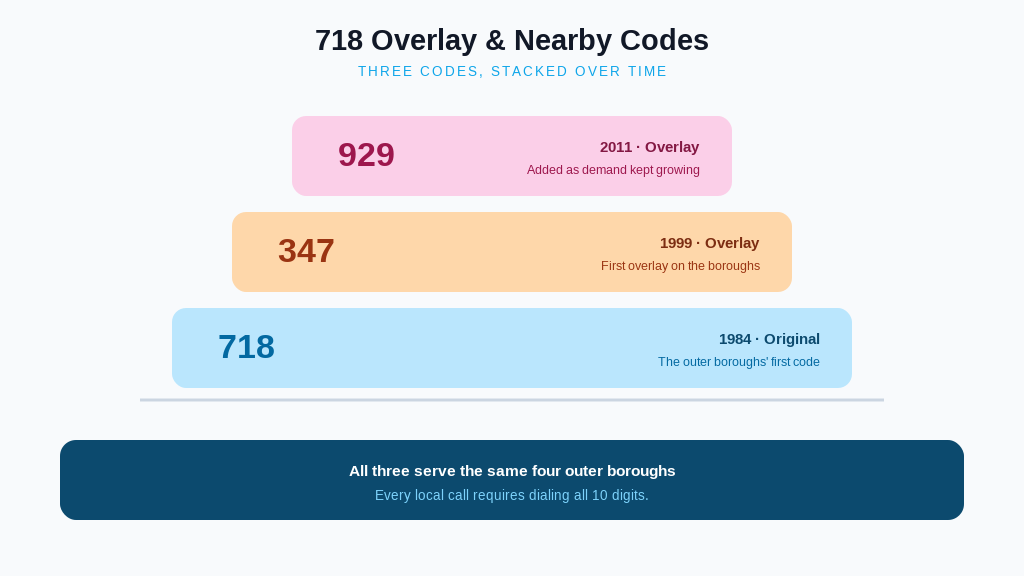
- 718 — the original outer-borough code and the one with the strongest local identity. Covers Brooklyn, Queens, the Bronx and Staten Island.
- 347 — the first overlay, effective October 1, 1999. It shares the full 718 territory; a 347 number signals the same outer-borough presence as a 718 number.
- 929 — added April 16, 2011 as a second overlay across the same four boroughs once 718 and 347 inventory tightened.
- 465 — the newest overlay for the area, launched June 18, 2026 and notable as one of the first New York area codes to start with a 4.
- 917 — an overlay covering all five boroughs, commonly associated with mobile phones across the entire city.
- 212 / 646 — Manhattan's primary codes. Manhattan is the one borough not part of the 718 group, although Marble Hill at its northern tip uses 718, 347 and 929.
Because multiple codes overlap the same area, 10-digit dialing has been mandatory across the 718 region since April 15, 2000 — you must dial the full area code even for a call across the street. Adjacent metro codes you may encounter include 516 and 631 on Long Island, 914 in Westchester County to the north, and 201 and 973 across the river in northern New Jersey.
The Five Codes Side by Side
| Code | In Service | Footprint | What It Signals |
|---|---|---|---|
| 718 | September 1, 1984 | Brooklyn, Queens, the Bronx, Staten Island, Marble Hill | The original outer-borough code and still the strongest local signal |
| 347 | October 1, 1999 | Identical to 718 | First overlay; after twenty-five years it reads as ordinary outer-borough |
| 929 | April 16, 2011 | Identical to 718 | Second overlay; newer, with no settled associations either way |
| 465 | June 18, 2026 | Identical to 718 | Newest overlay; assignments wait until the older codes are exhausted |
| 917 | 1992 | All five boroughs, Manhattan included | Citywide overlay tied historically to mobile and pagers; signals no borough |
| 212 / 646 / 332 | 1947 / 1999 / 2017 | Manhattan only, Marble Hill excepted | Reads as Manhattan, and specifically not as the boroughs |
For a business that wants to be read as outer-borough, 718 remains the clearest choice and 347 is a close second. 929 carries the same geography without the history. 465 will eventually do the same job, but because assignments only begin once the other codes run short, it is not an option you can request today.
The Outer-Borough Economy and the 718 Area Code
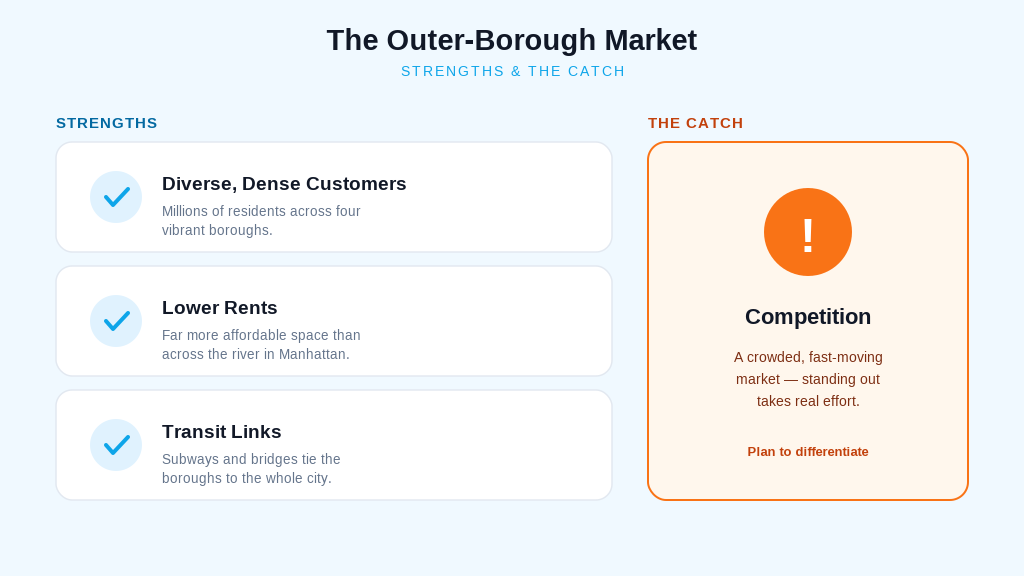
If the 718 boroughs were a separate city, they would be the second-largest in the United States on their own. Together, Brooklyn, Queens, the Bronx and Staten Island are home to roughly 6.3 million people as of 2024 — more than double Los Angeles's population, and well ahead of Chicago, Houston or any other single US city outside New York itself. Together they form an enormous, diversified economy that extends well beyond the office towers of Manhattan, and a 718 number connects a business to all of it.
Key Industries
The outer boroughs anchor a remarkably broad economic base. Queens has one of the most diversified economies of any borough, spanning health care, manufacturing, construction, education, transportation and retail, and is home to both JFK and LaGuardia airports. Brooklyn has become a magnet for technology, media, food production and creative firms, while the Bronx is a center for health care, distribution and logistics.
Staten Island plays a major role in shipping, port operations and logistics through its harbor and container terminals.
Notable Landmarks and Anchors
The 718 area is dense with recognizable landmarks: the Brooklyn Bridge and Brooklyn Bridge Park, the Brooklyn Museum and Botanic Garden, Coney Island's boardwalk, Yankee Stadium and the Bronx Zoo, Citi Field and the USTA tennis center in Queens, and the Staten Island Ferry. These are not just tourist sites — they sit at the heart of neighborhoods full of small businesses, professional services and growing startups that all carry 718 numbers.
A Center of Diversity
Queens is frequently described as one of the most ethnically diverse places on earth, and neighborhoods like Jackson Heights and Flushing host thriving immigrant-owned commercial districts. For businesses serving these communities, a 718 number reads as genuinely local in a way that a generic toll-free or out-of-state number never can.
The Sectors Behind the 718 Prefix
| Sector | Where It Clusters | Why It Shows Up on 718 Lines |
|---|---|---|
| Health care | Montefiore and the central Bronx hospital corridor, NYU Langone Brooklyn, SUNY Downstate, Jamaica Hospital, Staten Island University Hospital | Among the largest employers in all four boroughs |
| Food distribution | Hunts Point, the Bronx | The Hunts Point market is the largest food distribution complex in the United States |
| Aviation and air freight | JFK and LaGuardia, Queens | Cargo handlers, customs brokers and freight forwarders all work from Queens addresses |
| Port and logistics | Howland Hook on Staten Island, Red Hook in Brooklyn | Container terminals and the trucking and warehousing that feed them |
| Technology, media and creative | DUMBO, Downtown Brooklyn, Long Island City | Firms that want a Brooklyn or Queens identity rather than a Midtown one |
| Light manufacturing and studios | Brooklyn Navy Yard, Industry City | Film and television production, food producers and fabricators in reclaimed industrial space |
| Courts and professional services | Kings, Queens, Bronx and Richmond County courthouses | Firms practising before the borough courts keep borough numbers |
How to Get a 718 Area Code Phone Number
Modern VoIP and cloud phone providers let you activate a 718 number in minutes — no New York office, no hardware, and no long-term contract required. You search available 718 numbers, complete a short verification, and route the number to any device anywhere in the world. The same applies to the 347 and 929 overlays if your preferred 718 combination is already taken.
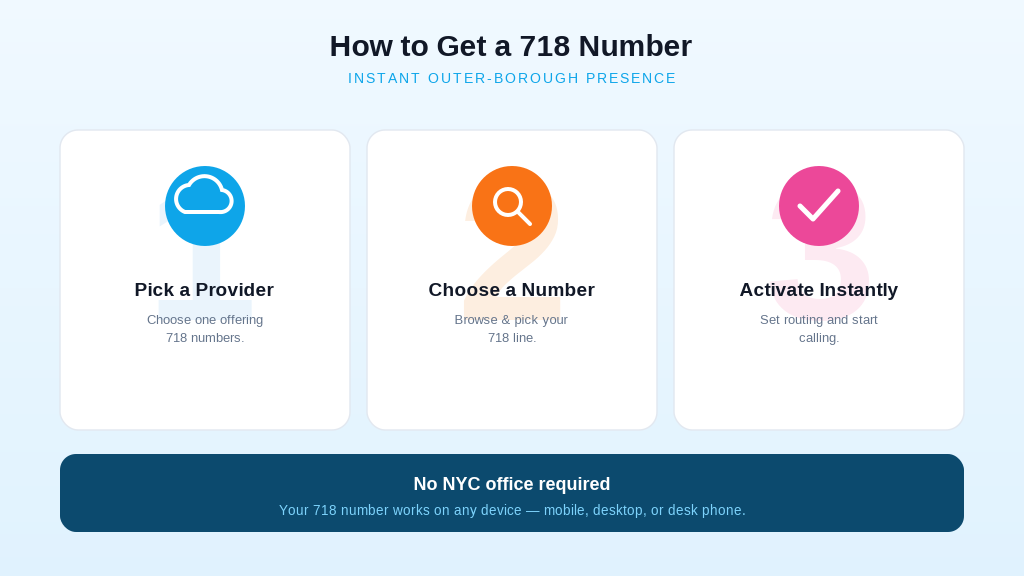
A 718 number benefits anyone who wants to feel local to New York's outer boroughs: real estate agents, contractors, medical and legal practices, e-commerce sellers, and remote teams targeting Brooklyn, Queens, the Bronx and Staten Island. MeraTalk provides 718 virtual phone numbers as part of its cloud telephony platform — numbers activate in minutes, route to any device, and pair with voicemail, call recording, auto-attendant and CRM integration from a single dashboard. You can search available 718 numbers at meratalk.com.
Why an Outer-Borough Number Still Matters
New Yorkers read phone prefixes the way other cities read street addresses. Digits associated with Brooklyn, Queens, and the Bronx carry a different social weight than a Manhattan prefix — less corporate, more neighborhood — and for many businesses that is precisely the point. A contractor, restaurant, or family practice serving borough customers benefits when its number sounds like it comes from the same block as its clientele.
- Neighborhood trust — borough residents answer familiar local digits more readily than unknown or distant prefixes
- Brand authenticity — long-standing outer-borough digits signal a business with real roots, not a pop-up operation
- Local search presence — a number matching the service area reinforces listings and word-of-mouth referrals
Because virtual numbers detach digits from wiring, even a business without a borough storefront can present that hometown identity while routing calls to any device.
Multilingual Routing Is Not Optional in Queens
Queens is routinely described as the most linguistically diverse urban area on earth, with well over a hundred and fifty languages spoken across neighborhoods like Jackson Heights, Elmhurst and Flushing, and Brooklyn carries large Spanish, Haitian Creole, Russian, Arabic and Bengali speaking communities of its own. A 718 number that answers only in English discards part of the advantage it was bought for. Offering Spanish in the first menu layer, and Mandarin or Cantonese where a Flushing customer base warrants it, reaches a materially larger share of callers than a single-language greeting. For more, see 718 area code.
Call Recording on a 718 Number: New York Is One-Party Consent
New York is a one-party consent state. Under Penal Law §§ 250.00 and 250.05, eavesdropping is a crime only where no party to the conversation has consented, so a business that is itself a party to the call may record it without announcing that it is doing so. There is no state notification requirement, and no beep tone obligation.
That is the law of the number’s state, not the law of the call. California requires every party to consent under Penal Code § 632, and Illinois does the same under 720 ILCS 5/14. A 718 line that takes inbound calls from anywhere in the country will take calls from both, and in a dispute the stricter state’s rule is the one that gets argued.
The practical answer is the one most contact centers already use: a short spoken notice at the top of every recorded call, applied to all calls rather than selectively. It costs a few seconds, it satisfies all-party states, and it removes the need to decide the question caller by caller. Where recording policy carries real exposure, take it to counsel rather than to a help article.
Common Phone Scams to Watch For on Borough Lines
The trust that borough digits carry also makes them a favorite disguise for scammers. Caller ID spoofing lets a fraudster anywhere in the world display a familiar local prefix, so residents see what looks like a neighbor calling. The prefix itself proves nothing — legitimate and spoofed calls look identical on screen.
- Utility shut-off threats — demands for immediate payment to keep electricity or gas connected, often targeting small restaurants and shops
- Fake delivery or customs fees — callers claiming a package is held pending a small payment or personal details
- Grandparent and family-emergency schemes — urgent pleas for money, common in the boroughs' many multigenerational households
The reliable defense is to hang up and call back through a number found independently — on a bill, an official website, or a saved contact. No genuine utility, agency, or courier demands gift cards or wire transfers over the phone.
Conclusion
The 718 area code has represented New York City's outer boroughs since 1984 — through the rise of Brooklyn as a global creative capital, the extraordinary diversity of Queens, the revitalization of the Bronx, and the harbor industries of Staten Island. Joined now by the 347, 929 and 465 overlays, it remains the prefix most New Yorkers associate with life beyond Manhattan.
Activating a 718 virtual number takes minutes with MeraTalk. Go live with an authentic outer-borough New York presence, route calls to any device, and add call recording, auto-attendant and CRM integration from day one — no physical New York office required. Explore the virtual number options at meratalk.com.
Ready to get started with 718 area code?
Join thousands of businesses using MeraTalk for Wholesale Voice, VoIP, and phone number services.
Contact MeraTalk Today