Introduction
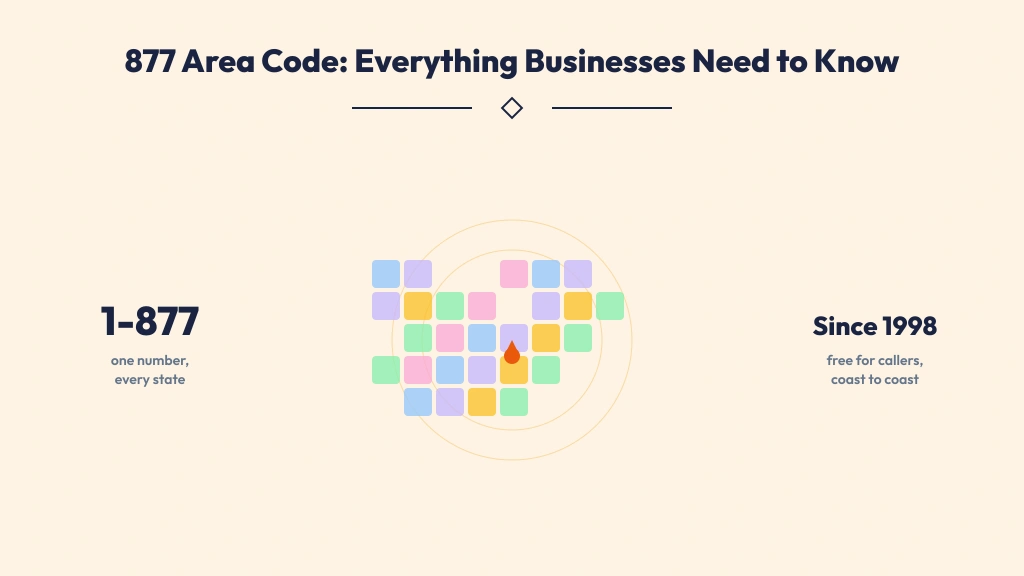
Millions of customer service calls in North America begin with the digits 877. The 877 area code is a toll-free prefix under the North American Numbering Plan (NANP), meaning the caller pays nothing while the business receiving the call covers the cost.
Activated in April 1998 to relieve pressure on the original 800 code, the prefix is now a familiar sight on support lines and helplines across the United States and Canada. This guide explains where it came from, how it compares with other toll-free codes, why some people associate it with spam calls, and how a business can secure its own 877 number.
Key Takeaways
- 877 is a toll-free prefix, not a geographic region — callers are never charged for dialing it.
- The code was activated in April 1998, making it the third toll-free code after 800 and 888.
- Numbers are assigned first-come, first-served through FCC-certified Responsible Organizations (RespOrgs).
- 877 numbers are fully portable, so a business keeps its number when switching providers.
- Legitimate companies use 877 heavily, but scammers can spoof any prefix — verify before sharing information.
Key Takeaways
877 is a toll-free prefix, not a geographic region — callers are never charged for dialing it.
The code was activated in April 1998, making it the third toll-free code after 800 and 888.
Numbers are assigned first-come, first-served through FCC-certified Responsible Organizations (RespOrgs).
877 numbers are fully portable, so a business keeps its number when switching providers.
Need a business phone number? Get a MeraTalk number in minutes, no contract required.
Get started free877 Area Code at a Glance
877 is not tied to a city or state. It is a toll-free prefix in the North American Numbering Plan, so callers are not charged and the business pays.
- Type: toll-free prefix, not a geographic area code
- Location: none; one 877 number can ring an office or call center anywhere
- State: none, usable across the United States and Canada
- Time zone: none, since it is not tied to a region
- In service since: April 4, 1998, the third toll-free code after 800 and 888
- Assignment: first-come, first-served through FCC-certified RespOrgs
- Routing: the national toll-free database, administered by Somos
What Is the 877 Area Code?
The 877 prefix is a toll-free code within the North American Numbering Plan, the shared numbering system used by the United States, Canada, and roughly twenty other countries and territories. When someone dials a number beginning with 877, the call is free for the caller from landlines, and the subscribing business pays for the connection instead. That cost reversal removes any hesitation a customer might feel about picking up the phone.
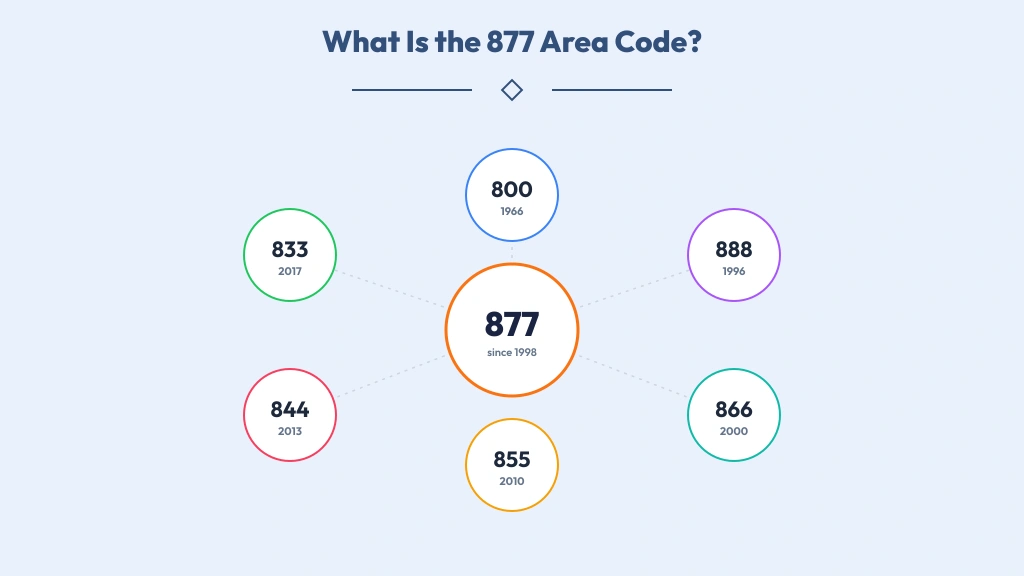
The code went into service on April 4, 1998, as the third toll-free release, following the original 800 code and the 888 code that arrived in 1996. Later releases added 866, 855, 844, and 833 to the same family. All of these prefixes are classed as easily recognizable codes because the second and third digits repeat, which helps callers instantly identify a number as toll-free.
How an 877 Number Is Structured
Every toll-free number follows the standard ten-digit NANP format:
- Prefix: 877 — identifies the call as toll-free
- Exchange code: three digits assigned through the toll-free numbering database
- Line number: four digits unique to the subscriber
Routing works differently from a regular phone line. When a caller dials an 877 number, the carrier queries the national toll-free database, administered by Somos, to find the destination — which is how one toll-free number can ring a call center in one state, an office in another, or a mobile phone anywhere.
Is the 877 Area Code Legitimate or a Scam?
The prefix itself is completely legitimate. It is issued under FCC oversight, and the overwhelming majority of 877 traffic comes from banks, insurers, airlines, government help desks, and everyday businesses running support lines. A number is not suspicious simply because it starts with 877.
That said, the code's credibility is exactly why bad actors imitate it. Scammers can spoof caller ID to display an 877 number, or rent one briefly for fake debt collection, prize, tech support, or charity schemes. The same tactics appear on every toll-free code — the pattern is covered in more depth in this 800 number guide, and the warning signs are identical across prefixes.
Red Flags on an Incoming 877 Call
- Pressure to act immediately or threats of arrest, fines, or account closure
- Requests for payment by gift card, wire transfer, or cryptocurrency
- Unsolicited requests for Social Security numbers, banking logins, or one-time passcodes
- Robocalls announcing prizes, refunds, or debts you do not recognize
How to Verify a Caller
- 1Hang up and call the organization back on the number printed on its website, statement, or card.
- 2Never share verification codes or account credentials with an inbound caller.
- 3Report suspected fraud to the FTC and note the number with your carrier.
- 4Use your phone's built-in call blocking or a carrier spam filter for repeat offenders.
Get a local number in this area code for your business — set up in minutes.
877 vs Other Toll-Free Prefixes
Functionally, all seven North American toll-free codes — 800, 888, 877, 866, 855, 844, and 833 — behave the same way: free for the caller, non-geographic, and managed through the same national database. The differences that matter are age, perception, and availability.
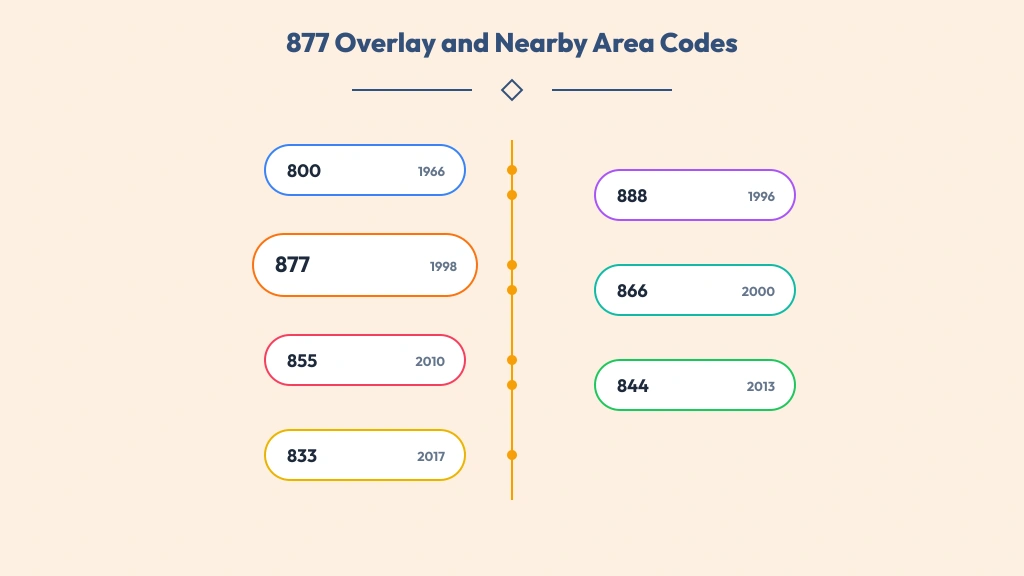
- 800 — the original code, in service since 1967; instantly recognized but heavily depleted, so desirable combinations are scarce.
- 888 — the first overflow code, released in 1996; strong recognition with slightly better availability.
- 877 — released in 1998; long-established and trusted, with a wider selection of memorable numbers than 800 or 888.
- 866, 855, 844, 833 — later additions with the deepest inventory, useful when a specific vanity pattern is required.
Under FCC toll-free rules, no code outranks another. Numbers in every prefix are assigned on a first-come, first-served basis, subscribers may not hoard numbers they do not use, and brokering — selling a toll-free number for a fee — is prohibited. The practical takeaway: choose the prefix with the most memorable available number, because callers treat all of them as equally toll-free.
One quiet advantage of 877 is inventory depth. Because it arrived after 800 and 888, more short, repeating, and vanity-friendly combinations remain available, making it easier to secure a number that matches a brand name.
Coverage and Location Flexibility
Unlike a geographic code such as 212 or 415, the 877 prefix has no home city, state, or time zone. An 877 number works identically whether the business answering it sits in Miami, Toronto, or a home office in Montana. Coverage spans the entire NANP footprint:
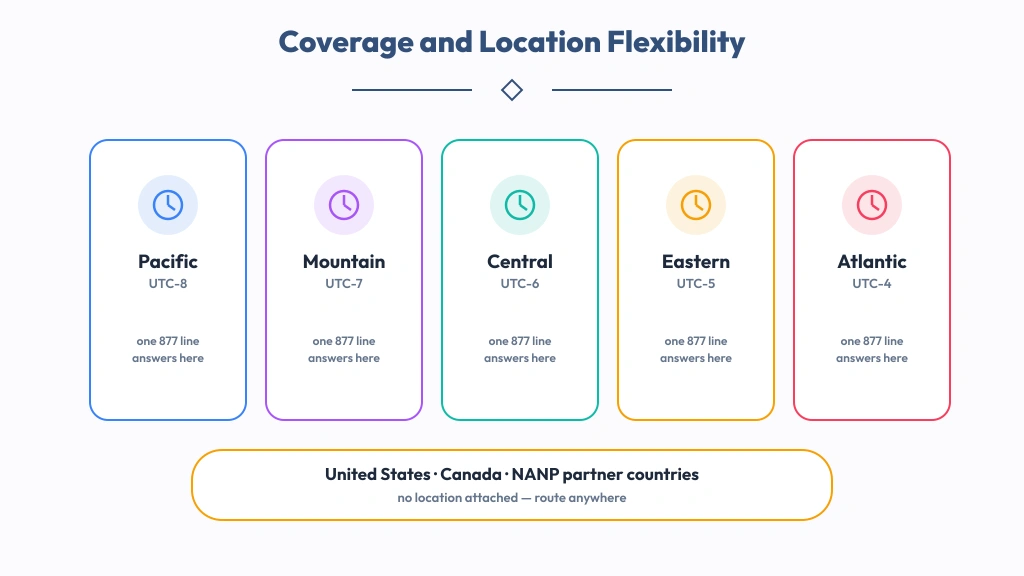
- All 50 US states, plus US territories such as Puerto Rico and Guam
- Every Canadian province and territory
- Caribbean nations participating in the NANP
This location independence is a genuine operational asset. A company can advertise one national number while routing calls by time of day, caller location, or team availability. If the business relocates or shifts to remote work, the number never changes — routing rules are simply updated in software.
Portability Protects the Number
Toll-free portability has been required since 1993, and it applies fully to the 877 prefix. The number belongs to the subscribing business, not the carrier, so it can move to a new RespOrg at any time without missing a call or reprinting a brochure. That protection makes a toll-free number one of the safest long-term marketing assets a company can own.
Benefits of an 877 Number for Business
For most companies, the case for a toll-free number comes down to perception and reach: a national prefix signals an established operation, and a free call removes the last bit of friction before a conversation.
Credibility and National Presence
An 877 number presents a business as national rather than local — customers in Texas and Vermont see the same trustworthy, toll-free contact point instead of an unfamiliar out-of-state code.
More Inbound Conversations
Because the call costs the customer nothing, toll-free lines consistently encourage inquiries, support requests, and order calls. Pairing the toll-free line with a broader business phone number strategy — local numbers for regional campaigns, toll-free for national ones — lets a company match the right identity to each audience.
Marketing Measurement and Vanity Branding
Toll-free numbers are easy to assign per campaign, so a business can run distinct 877 numbers on radio, print, and digital ads and see exactly which channel drives calls. Deep inventory also makes vanity numbers — where digits spell a word or brand — easier to obtain than on 800 or 888.
Modern Cloud Features
On a cloud platform, a toll-free number arrives with capabilities that once required enterprise hardware: IVR menus, time-based routing, voicemail transcription, and real-time analytics. Providers such as MeraTalk activate 877 numbers with routing and analytics included, so even a small team can answer like a national brand from day one.
Businesses comparing prefixes often shortlist the 888 area code alongside this one before deciding.
How to Get an 877 Number
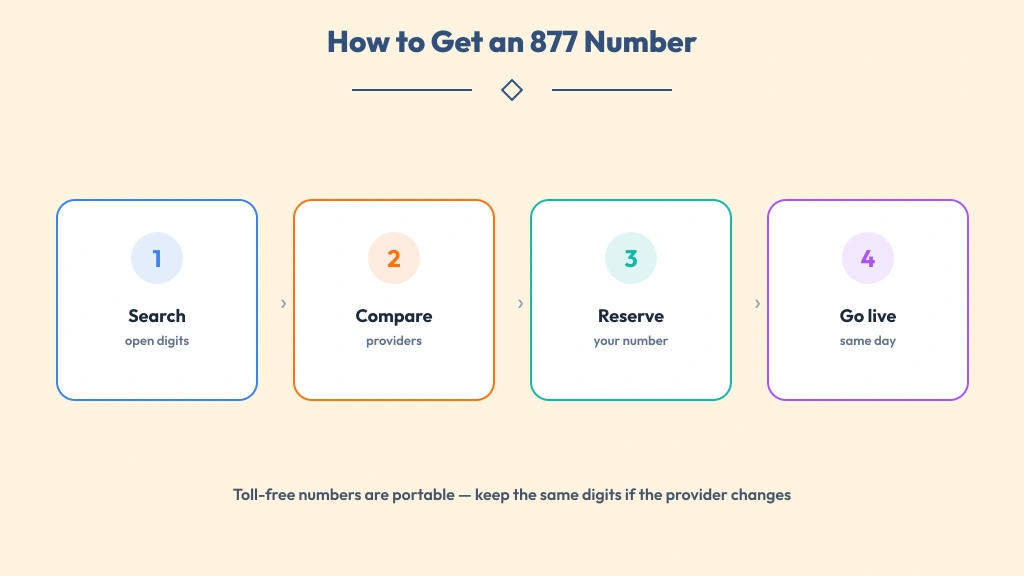
Securing a toll-free number is quick, but it must go through the proper channel. The FCC does not sell numbers directly; assignments flow through Responsible Organizations — RespOrgs — with access to the national toll-free database, and most cloud phone providers either are RespOrgs or work with one.
Step-by-Step Process
- 1Choose a provider that offers toll-free service with the routing features the business needs.
- 2Search available 877 inventory, filtering for memorable patterns or vanity words that fit the brand.
- 3Reserve and activate the number — with cloud providers this typically takes minutes, not days.
- 4Configure routing: business hours, IVR menus, failover destinations, and voicemail.
- 5Publish the number consistently across the website, ads, invoices, and directory listings.
What to Look For in a Provider
- Transparent toll-free minute handling and clear service terms
- Instant number search and same-day activation
- Routing, IVR, and analytics included rather than bolted on
- Support for porting the number in or out without friction
Businesses that already own a toll-free number can port it to a new platform at any time, since the number belongs to the subscriber. Companies ready to claim a memorable 877 number can compare available inventory and activation options at meratalk.com.
Enabling SMS on an 877 Line
Toll-free lines are not limited to voice traffic. A number on this prefix can be text-enabled, letting a business send and receive SMS on the same digits customers already know from its ads and invoices. Activation runs through the toll-free messaging verification process, a one-time registration the provider submits on the subscriber's behalf.
- Support teams can move quick questions to text and keep phone queues clear for complex issues
- Appointment reminders, shipping notices, and follow-up surveys all travel well over toll-free SMS
- Verified toll-free routes offer dependable deliverability compared with unregistered traffic
- Every outbound campaign needs recorded opt-in consent and a working opt-out keyword
Consolidating calls and texts onto one number also simplifies marketing: a single contact point appears everywhere, and customers never have to guess which number accepts messages.
Preparing a Toll-Free Line for Traffic Surges
Because callers pay nothing, toll-free lines absorb the full force of a successful campaign. A television spot, a viral mention, or a seasonal rush can multiply inbound volume in minutes, and an unprepared line answers that surge with busy signals and abandoned calls.
- 1Set up an IVR menu so callers route themselves to sales, support, or billing without agent triage
- 2Configure overflow destinations — backup teams, mobile devices, or voicemail with callback promises
- 3Apply schedule-based routing so evening and weekend callers hear accurate information immediately
- 4Watch real-time analytics during launches and shift staffing before queues build up
Cloud routing makes all of this adjustable from a dashboard, so a small team can tighten its call flow the same morning a campaign goes live and relax it again once the wave passes.
Conclusion
More than a quarter century after its April 1998 launch, the 877 prefix remains one of the most practical tools for national customer communication. It is regulated, portable, location-independent, and instantly recognized as toll-free — a combination that builds caller trust while giving the business full control over routing and measurement.
For customers, the rule of thumb is simple: 877 calls are free, but any caller demanding urgent payment or personal data deserves verification first. For businesses, a well-chosen toll-free number is a small investment that signals credibility, invites conversation, and stays with the company for life.
Ready to get started with 877 area code?
Join thousands of businesses using MeraTalk for Wholesale Voice, VoIP, and phone number services.
Contact MeraTalk Today