Introduction
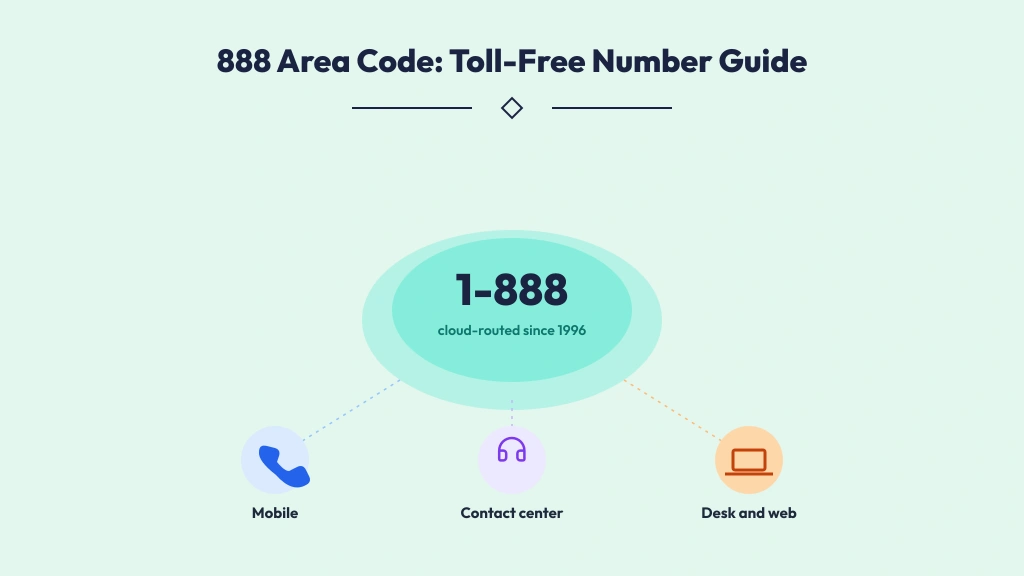
When a call arrives from a number starting with 888, many people pause. Is it a bank, a delivery service, or a scammer? The answer starts with history: 888 was the very first toll-free prefix added after the original 800 code, entering service on March 1, 1996, when demand for toll-free numbers outgrew the supply. Nearly three decades later, the prefix carries customer support desks, healthcare hotlines, and national brands across North America.
This guide explains what the prefix is, whether calls from it can be trusted, how it compares to other toll-free codes, and how a business can claim its own 888 number.
Key Takeaways
- 888 is a genuine toll-free prefix, live since March 1, 1996 — the first expansion beyond 800.
- Calls to an 888 number are free for the caller; the business that owns the number pays for the call.
- The prefix is non-geographic and works across the United States, Canada, and other NANP countries.
- Legitimate organizations use 888 lines heavily, but scammers can spoof any number, so verify unexpected calls.
- Businesses can activate an 888 number quickly through a toll-free provider such as MeraTalk.
Key Takeaways
888 is a genuine toll-free prefix, live since March 1, 1996 — the first expansion beyond 800.
Calls to an 888 number are free for the caller; the business that owns the number pays for the call.
The prefix is non-geographic and works across the United States, Canada, and other NANP countries.
Legitimate organizations use 888 lines heavily, but scammers can spoof any number, so verify unexpected calls.
Need a business phone number? Get a MeraTalk number in minutes, no contract required.
Get started free888 Area Code at a Glance
The 888 area code is not tied to any location. It is a toll-free prefix in the North American Numbering Plan, so it belongs to no city or state.
- Location: none; non-geographic, works across the US, Canada and other NANP countries
- State: none; not assigned to any state
- Type: toll-free prefix, in the same family as 800, 877, 866, 855, 844 and 833
- Cost: free for callers; the number owner pays for inbound calls
- In service since: March 1, 1996, the first expansion beyond 800
- Administration: Somos registry, with numbers assigned by RespOrgs
What Is the 888 Area Code?
The 888 area code is a toll-free prefix within the North American Numbering Plan, the framework that coordinates phone numbers for the United States, Canada, and many Caribbean nations. Unlike a geographic code such as 212 or 415, the 888 prefix is not tied to any city, state, or region. It exists so that customers anywhere in the coverage area can call an organization without paying long-distance charges.
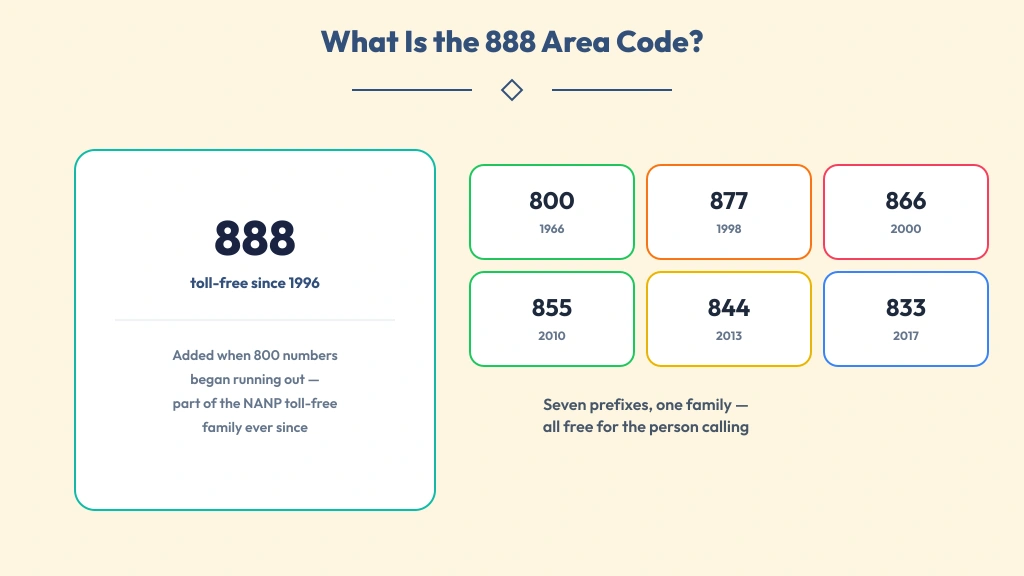
The code was activated on March 1, 1996, after the pool of available 800 numbers had been nearly exhausted. That launch made 888 the second-oldest member of the toll-free family, which today includes 800, 888, 877, 866, 855, 844, and 833. Because it arrived so early, the prefix has decades of consumer recognition behind it — many people instinctively read an 888 number as a business line.
Behind the scenes, every toll-free number is administered through a central registry managed by Somos and assigned by Responsible Organizations, known as RespOrgs. When someone dials an 888 number, the registry routes the call to whatever destination the owner has chosen — an office landline, a mobile phone, a call center, or a cloud calling platform.
Quick Facts About the 888 Prefix
- Activated: March 1, 1996, as the first relief code for 800
- Type: Toll-free, non-geographic
- Coverage: United States, Canada, and other NANP participants
- Cost: Free for callers; the number owner pays for inbound calls
- Administration: Somos registry, with numbers assigned by RespOrgs
Is the 888 Area Code Legitimate or a Scam?
The prefix itself is completely legitimate. It is a regulated part of the national numbering system, and the overwhelming majority of 888 lines belong to real businesses, government help desks, charities, and support centers. A toll-free number follows the standard US number format — a three-digit prefix, a three-digit exchange, and a four-digit line number — so an 888 call dials like any other ten-digit number.
Why Scammers Imitate Toll-Free Lines
Because consumers associate toll-free prefixes with established companies, fraudsters sometimes spoof 888 caller IDs to borrow that credibility. Spoofing means the number shown on your screen is faked; the call may actually originate anywhere. Common schemes include fake bank fraud alerts, bogus tech support, prize notifications, and robocalls pushing warranties or debt relief.
Red Flags on Any Inbound Call
- Pressure to act immediately or threats of arrest, fines, or account closure
- Requests for passwords, one-time codes, Social Security numbers, or card details
- Demands for payment through gift cards, wire transfers, or cryptocurrency
- Prizes or refunds that require an upfront fee to release
- Robotic voices asking you to press a key to speak with an agent
How to Handle a Suspicious 888 Call
- 1Hang up without sharing any personal or financial information.
- 2Look up the organization's official number on its website and call back directly.
- 3Block the number on your device and report the call to the FTC or FCC.
- 4Register your line with the National Do Not Call Registry to cut telemarketing volume.
Get a local number in this area code for your business — set up in minutes.
888 vs Other Toll-Free Prefixes
All seven toll-free codes — 800, 888, 877, 866, 855, 844, and 833 — work identically. Callers pay nothing, the owner covers the cost, and routing is handled through the same registry. The differences come down to age, recognition, and availability. The 800 code dates back to the 1960s and carries the deepest recognition, but attractive combinations were claimed long ago.
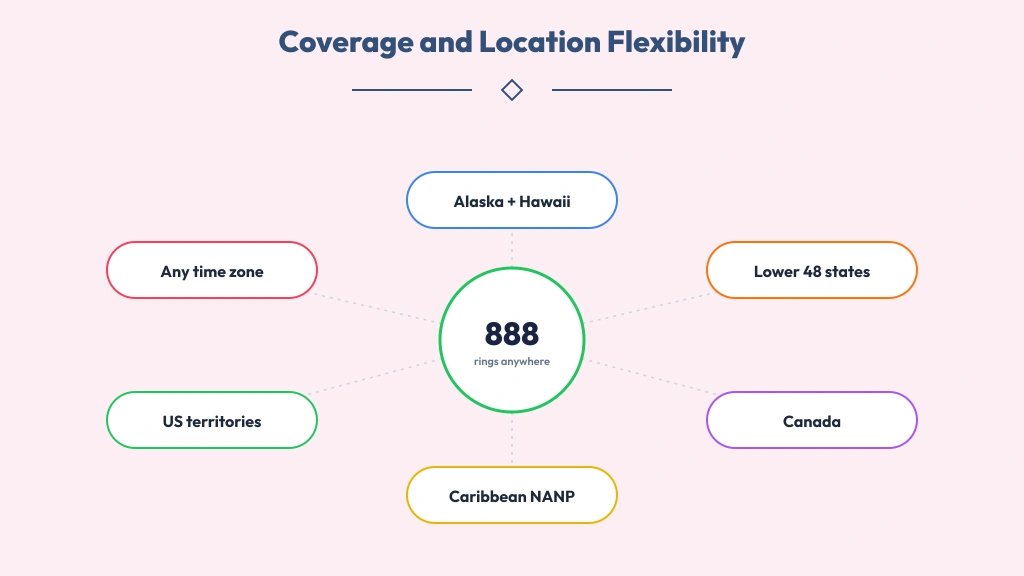
As the first relief code, 888 offers the next-strongest familiarity while retaining somewhat better availability, especially for memorable vanity patterns.
- 800 — the original code; iconic but heavily depleted
- 888 — launched 1996; strong recognition with better availability than 800
- 877 and 866 — added in 1998 and 2000 as demand kept climbing
- 855, 844, 833 — the newest codes, with the widest selection of open numbers
One important detail: the prefixes are not interchangeable. Dialing 888 followed by the digits of a company's 800 number reaches a completely different subscriber. Under the NANPA numbering plan, each toll-free number is a distinct assignment, which is why many brands register the same digits across several prefixes. FCC rules add guardrails: numbers are assigned on a first-come, first-served basis, and hoarding or brokering toll-free numbers for resale is prohibited.
For a business choosing today, the practical question is availability. If the digits or vanity word you want are taken in 800, checking 888 is the natural next step before moving to the newer codes.
Coverage and Location Flexibility
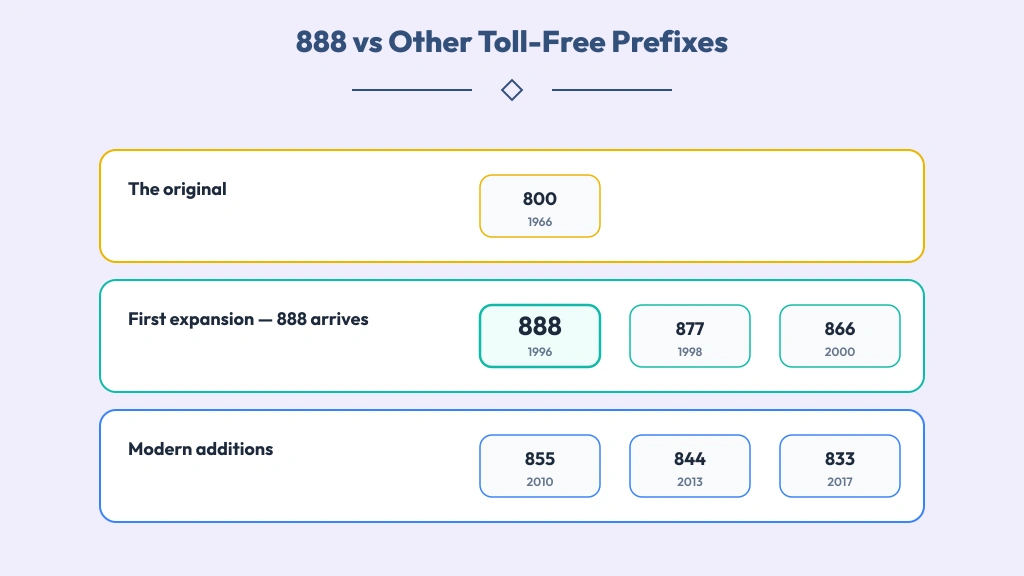
Because the prefix is non-geographic, an 888 number carries no clue about where the owner is based. A company headquartered in Denver, a remote team spread across five states, and a Toronto support desk can all answer the same toll-free line. Callers from any participating country reach the business without thinking about distance or long-distance charges.
Where the Prefix Works
- All 50 US states, plus US territories in the numbering plan
- Every Canadian province and territory
- Caribbean nations that participate in the NANP
Why Location Independence Matters
- One number can serve a national customer base from day one
- Businesses can relocate offices without changing their public number
- Remote and hybrid teams can answer calls from anywhere
- Routing rules can send calls to different sites by time of day
Toll-free portability strengthens this flexibility further. The owner can move a toll-free number between providers while keeping the number itself, so the line printed on packaging and contracts stays constant even if the carrier behind it changes.
Benefits of an 888 Number for Business
Instant Credibility
A toll-free line signals an established, service-oriented operation. For a small company competing against national brands, an 888 number replaces the small-business look of a local cell number with a professional front.
Lower Barriers for Customers
When calls are free, customers are more willing to pick up the phone — to ask questions before buying, resolve issues instead of churning, or respond to a campaign. Removing cost friction lifts both inquiry volume and satisfaction.
Marketing Measurement
Companies often assign different toll-free numbers to different campaigns — one for radio, one for print, one for online ads — and compare inbound volume to see which channel performs. Call analytics turn the phone line into a measurable marketing asset.
Vanity Branding
Vanity numbers spell a word or brand on the keypad, making the line easy to remember from a billboard or podcast ad. Because 888 still has reasonable availability, businesses have a realistic chance of finding a pattern that matches their name.
A toll-free line works best when connected to a proper business phone system rather than a single desk phone, so routing menus, voicemail, and call queues ensure the calls it attracts are answered well. Providers such as MeraTalk activate toll-free numbers with call routing and analytics included, so growing teams can manage national volume without extra hardware.
Businesses comparing prefixes often shortlist the 844 area code alongside this one before deciding.
How to Get an 888 Number
Claiming a toll-free number is a straightforward process handled through a provider that works with the national registry. Most businesses complete it in a single sitting.
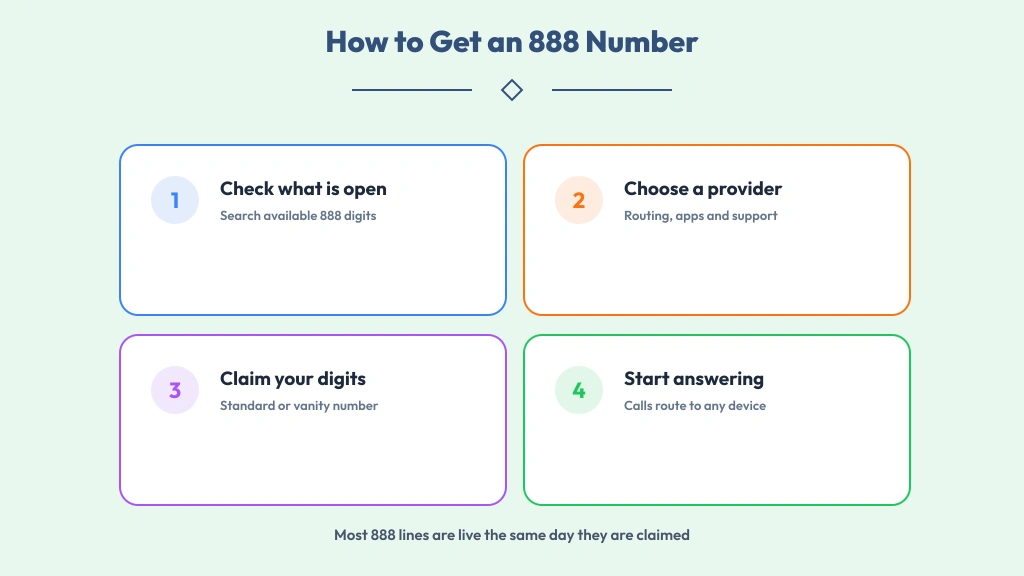
- 1Search availability — use a provider's lookup tool to find open 888 combinations or a vanity pattern that fits your brand.
- 2Choose a provider — compare routing features, analytics, support quality, and scalability, not just the number itself.
- 3Reserve the number — availability is first-come, first-served, so register the number you want promptly.
- 4Set up routing — decide where calls should land: a main line, a mobile device, a team queue, or different destinations by schedule.
- 5Test and publish — place test calls, confirm voicemail and greetings, then add the number to your website and marketing.
If a business already owns a toll-free number, portability rules allow it to move that number to a new provider without disruption. MeraTalk provisions 888 numbers alongside cloud calling features, and its team can guide the search for a memorable combination — details are available at meratalk.com.
Texting Customers from an 888 Line
A toll-free number can carry more than phone calls. Once the owner text-enables the line and completes toll-free messaging verification, the same digits handle two-way SMS — customers text the number they already recognize from the website or packaging, and the business replies from a shared inbox.
- Appointment confirmations, delivery updates, and support follow-ups suit toll-free SMS well
- Verified toll-free messaging enjoys reliable deliverability and reduced spam filtering
- Two-way texting shortens resolution times for questions that never needed a phone call
- Marketing texts require documented opt-in consent and a clear opt-out keyword on every message
For customers, the experience is seamless — one number for everything. For the business, it turns an existing voice asset into a second channel without printing a single new contact detail. For more, see toll-free rules.
Compliance Essentials for Outbound Toll-Free Campaigns
Using a toll-free line for outbound calling or texting brings regulatory responsibilities that every campaign should be built around from day one. The Telephone Consumer Protection Act sets the rules for automated calls and marketing texts in the United States, and the National Do Not Call Registry limits unsolicited sales calls to consumers who have registered their numbers.
- Secure and archive consent records before any marketing call or text goes out
- Process opt-out requests promptly and keep an internal suppression list current
- State the business name clearly at the start of every outbound call
- Finish toll-free messaging verification before the first SMS campaign launches
Beyond avoiding penalties, disciplined compliance protects the number itself: carriers score toll-free traffic for spam behavior, and a clean sending history keeps legitimate calls and texts flowing to customers unblocked.
Conclusion
The 888 prefix has earned its place as one of the most recognizable pieces of the toll-free system. Launched in 1996 to relieve the original 800 code, it delivers the same core promise: customers call for free, businesses answer from anywhere, and the number stays with the company for as long as it wants to keep it.
For callers, the practical rule is simple — the prefix is trustworthy, but any individual call should be judged on its behavior, not its caller ID. For businesses, an 888 number remains a fast, affordable way to look national, measure marketing, and make it easy for customers to get in touch.
Ready to get started with 888 area code?
Join thousands of businesses using MeraTalk for Wholesale Voice, VoIP, and phone number services.
Contact MeraTalk Today