Introduction
SIP trunking lets US businesses replace traditional phone lines with voice calls carried over an internet connection, and the saving against legacy PSTN circuits is usually why the conversation starts. The pricing is where it gets confusing.
Per channel, per minute, metered, unlimited and wholesale all mean different things, and the advertised rate is rarely the full-loaded cost. This guide sets out what a US buyer actually pays, which model suits which call volume, and the four additions that inflate a bill after sign-up.
- US SIP trunk pricing comes in three shapes: metered (per channel plus per minute), unlimited (flat per channel), and wholesale (negotiated per minute, tiered by volume).
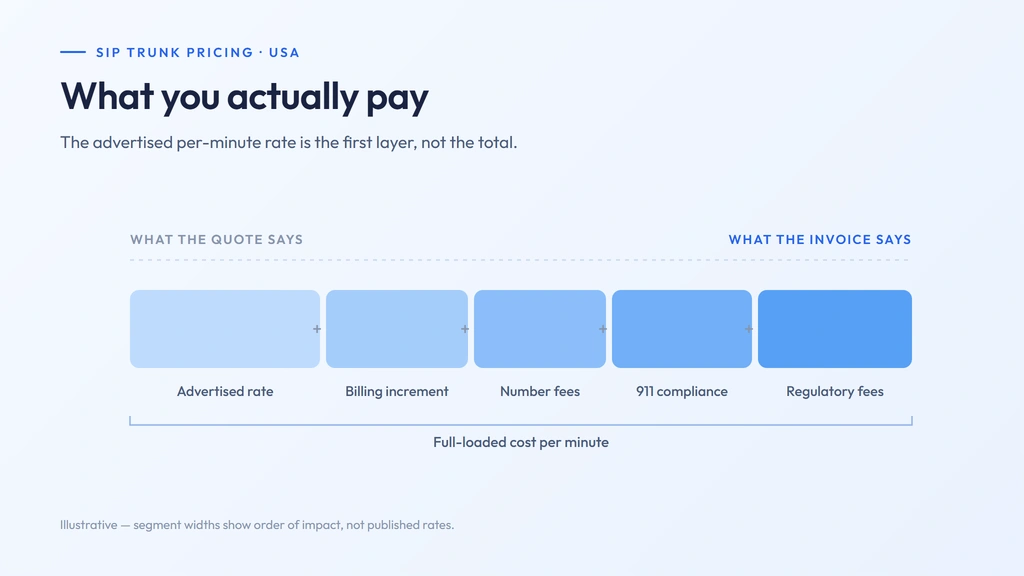
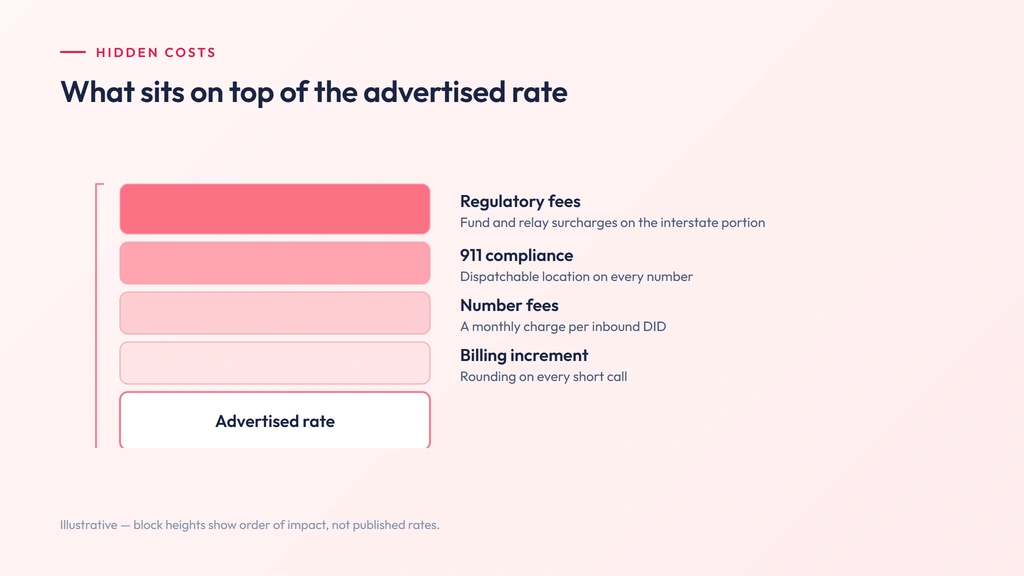
- The advertised per-minute rate is never the full-loaded cost. Billing increments, DID fees, 911 obligations and regulatory recovery fees all sit on top of it.
- Federal Universal Service Fund contributions alone were set at 42.0% of interstate and international end-user revenue for the final quarter of 2026.
- Metered usually wins below roughly 500 minutes per channel per month; unlimited usually wins above roughly 1,500. Between the two, the billing increment decides it.
- Negotiate the increment before the headline rate. Carriers concede on increments more readily, and on short calls the saving is larger.
Key Takeaways
US SIP trunk pricing comes in three shapes: metered (per channel plus per minute), unlimited (flat per channel), and wholesale (negotiated per minute, tiered by volume).
The advertised per-minute rate is never the full-loaded cost. Billing increments, DID fees, 911 obligations and regulatory recovery fees all sit on top of it.
Federal Universal Service Fund contributions alone were set at 42.0% of interstate and international end-user revenue for the final quarter of 2026.
Metered usually wins below roughly 500 minutes per channel per month; unlimited usually wins above roughly 1,500. Between the two, the billing increment decides it.
Explore MeraTalk's Wholesale VoIP solutions — built for carriers, resellers, and enterprises.
Learn moreWhat Is SIP Trunking?
A SIP trunk is a virtual phone line that runs over an internet connection using the Session Initiation Protocol. It connects an on-premise PBX or IP phone system to the public switched telephone network without physical copper lines.
The unit that matters is the channel — one simultaneous call. An office that peaks at twenty concurrent calls needs twenty channels. Unlike legacy lines, channels can be added or removed as demand changes, which is why capacity planning and pricing are tied so tightly together.
SIP trunking vs. hosted VoIP
A hosted VoIP or UCaaS service bundles the phones, the software and the trunk into a single per-seat subscription. SIP trunking sells only the carrier layer: the buyer brings their own PBX, and the provider terminates calls onto the public network. Wholesale SIP termination goes one step further again — it is sold to carriers, contact centers and resellers at volume-negotiated rates rather than per seat.
How SIP Trunk Pricing Works in the USA
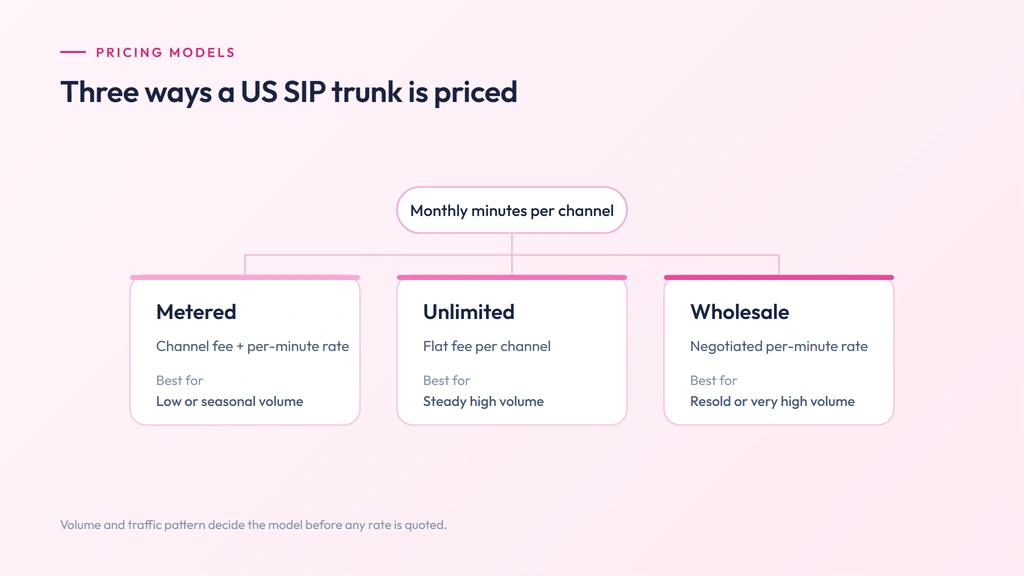
US pricing follows one of two retail models, or a hybrid of both, with a third wholesale model sitting underneath them.
Metered (pay per minute)
A monthly fee per channel plus a per-minute rate on every call made or received. Cost tracks usage directly, which suits low, seasonal or unpredictable call volumes.
Unlimited (flat rate per channel)
A fixed monthly fee per channel covering unlimited inbound and outbound calling to US and Canadian numbers. The attraction is predictability rather than the lowest achievable per-minute cost.
Wholesale (negotiated volume rate)
No per-seat or per-channel component at all. Carriers, resellers and large contact centers buy termination capacity at a rate set by monthly volume and destination mix, and wholesale VoIP rates step down as committed minutes rise.
Which Pricing Model Fits Which Business
Matching the model to the traffic profile matters more than shaving a fraction of a cent off the per-minute rate.
| Pricing model | Best for | Typical buyer |
|---|---|---|
| Metered | Low, seasonal or unpredictable volume | Small offices, professional services |
| Unlimited | Steady high volume where predictability matters | Contact centers, busy support lines |
| Wholesale | Large or resold volume across many destinations | Carriers, resellers, large contact centers |
Get Wholesale VoIP rates with transparent wholesale pricing.
Metered vs. Unlimited: Which Is Cheaper?
The answer depends on monthly minutes per channel rather than on headcount.
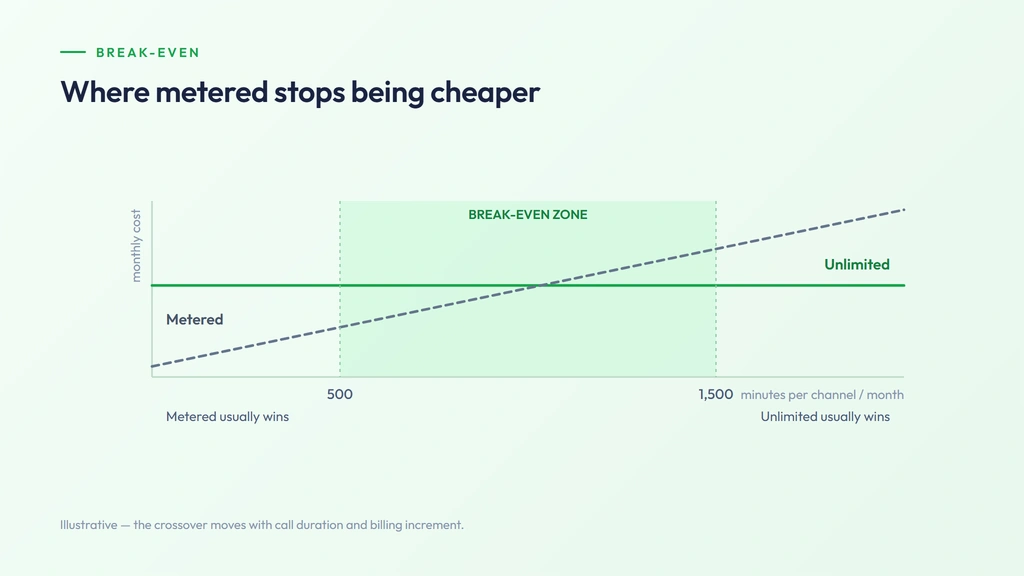
- Under roughly 500 minutes per channel per month — metered usually wins.
- Between 500 and 1,500 — the break-even zone, where average call duration and the billing increment decide it.
- Over roughly 1,500 — unlimited usually wins, because a flat channel caps exposure even when agents are on calls all day.
Outbound-heavy contact centers almost always land on unlimited. Mixed organizations often do best on a hybrid: unlimited channels for the support team, metered channels for executives and administrative staff who use the phone lightly. Above roughly 10,000 minutes a month, wholesale termination usually beats both retail models, and MeraTalk quotes that tier against a real traffic profile rather than a generic A-Z deck.
STIR/SHAKEN: What It Costs US SIP Trunk Buyers
STIR/SHAKEN is the caller ID authentication framework the FCC requires on US voice networks. Every call placed over a SIP trunk to a US number carries an attestation level set by the originating carrier.
| Attestation | What the carrier is asserting | Practical effect |
|---|---|---|
| A (Full) | It knows the customer and has verified their right to use the calling number | Least likely to be flagged or blocked |
| B (Partial) | It knows the customer but cannot confirm the number belongs to them | Treatment varies by analytics engine |
| C (Gateway) | The call entered its network from a source it cannot vouch for, typically an international gateway | Most likely to be labelled or blocked |
Carriers set their own criteria for assigning each level, so the same traffic can be attested differently on different networks. The cost impact is small next to the risk: without A-attestation on outbound numbers, calls are far more likely to surface as “Spam Likely” on the recipient’s handset, which depresses answer rates and the return on every outbound campaign.
How to Get the Best SIP Trunk Rate
Five moves separate an advertised rate from a good one.
- 1Commit to volume. Providers price predictable traffic more keenly than hopeful traffic, and even a soft projection opens a lower tier in negotiation.
- 2Negotiate the increment before the per-minute rate. Carriers concede on increments more readily than on headline rates, and on short-duration traffic the increment is worth more than a small rate cut.
- 3Ask for a fully-loaded quote, with regulatory fees, 911 charges, number fees and any porting costs included in the same figure.
- 4Test quality before committing. Run calls across the top destination codes and measure ASR, ACD and MOS — a cheap rate on a poor route costs more in failed and repeated attempts than it saves per minute.
- 5Clarify the rate-change policy. Get the notice period in writing, and check whether there is a penalty-free exit if rates rise past an agreed threshold.
The third point carries the most weight, because the surcharges are larger than most buyers expect. The federal USF contribution factor was set at 42.0% of interstate and international end-user revenue for the October to December 2026 quarter, its highest on record. It applies to the interstate portion of a bill rather than the whole of it, but it is large enough that a low base rate carrying heavy surcharges can cost more than a higher base rate carrying none.
Conclusion
SIP trunk pricing in the USA is rarely decided by the advertised per-minute rate. The model, the increment, the number fees, the 911 obligations and the regulatory surcharges together determine what the invoice says at the end of the month. A business that maps its own call pattern first — minutes per channel, average call duration, how many inbound numbers it needs — can read any quote quickly and compare two of them honestly.
For US and international termination priced by destination and committed volume, MeraTalk issues destination-level rate sheets on request and states the billing increment alongside the rate.
Ready to get started with sip trunk pricing usa?
Join thousands of businesses using MeraTalk for Wholesale Voice, VoIP, and phone number services.
Contact MeraTalk Today