Introduction
Most businesses that still run on physical phone lines did not choose them. The lines came with the building, the PBX was specified a decade ago, and nobody has had a reason to revisit either until a renewal notice arrived.
A SIP trunk is what replaces them. This guide explains what one actually is, how a call travels across it, how it compares with the PRI and analog lines it supersedes, and the situations where switching is clearly the right call.
- A SIP trunk is a virtual phone line that carries calls over an internet connection instead of copper or a dedicated circuit.
- One simultaneous call uses one channel, and channels are configured in software rather than ordered as hardware.
- A deployment has three parts: the trunk provider, a session border controller, and the PBX or UCaaS platform itself.
- PRI fixes capacity at 23 channels on a T1 or 30 on an E1; a SIP trunk scales in minutes and is not tied to a physical site.
- Copper is being retired on a published timetable in several markets, which is turning the upgrade from optional into scheduled.
Key Takeaways
A SIP trunk is a virtual phone line that carries calls over an internet connection instead of copper or a dedicated circuit.
One simultaneous call uses one channel, and channels are configured in software rather than ordered as hardware.
A deployment has three parts: the trunk provider, a session border controller, and the PBX or UCaaS platform itself.
PRI fixes capacity at 23 channels on a T1 or 30 on an E1; a SIP trunk scales in minutes and is not tied to a physical site.
Need a business phone number? Get a MeraTalk number in minutes, no contract required.
Get started freeWhat Is a SIP Trunk?
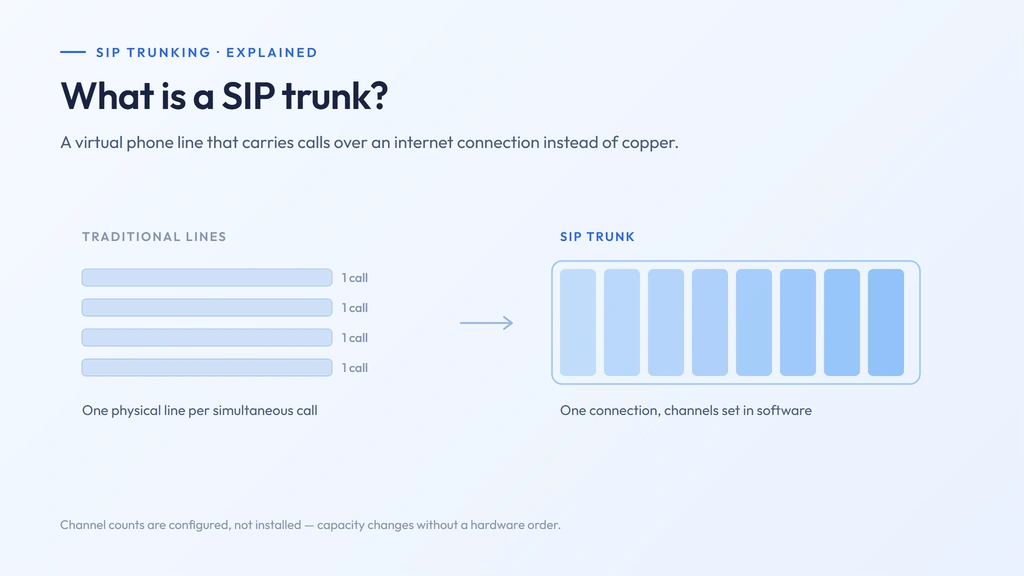
A SIP trunk is a virtual phone line that delivers voice calls over an internet connection instead of physical copper wire. The name comes from the protocol it uses — SIP, or Session Initiation Protocol — the standard for setting up, managing and ending voice and video calls across IP networks.
In plain terms: instead of a bundle of analog or ISDN lines running into an office from a telephone company, a SIP trunk connects a phone system to the public switched telephone network through the internet. Calls are made and received exactly as before, but the underlying infrastructure is software-defined and delivered over broadband.
SIP trunking has replaced traditional lines as the standard for business telephony. It works with most modern PBX systems and UCaaS platforms, scales up or down in minutes, and removes the per-line hardware that made legacy systems slow to change and expensive to provision — which is also why SIP trunk pricing is structured so differently from a per-line phone bill.
How SIP Trunking Works
When someone dials a number on a SIP-connected phone system, four things happen in sequence.
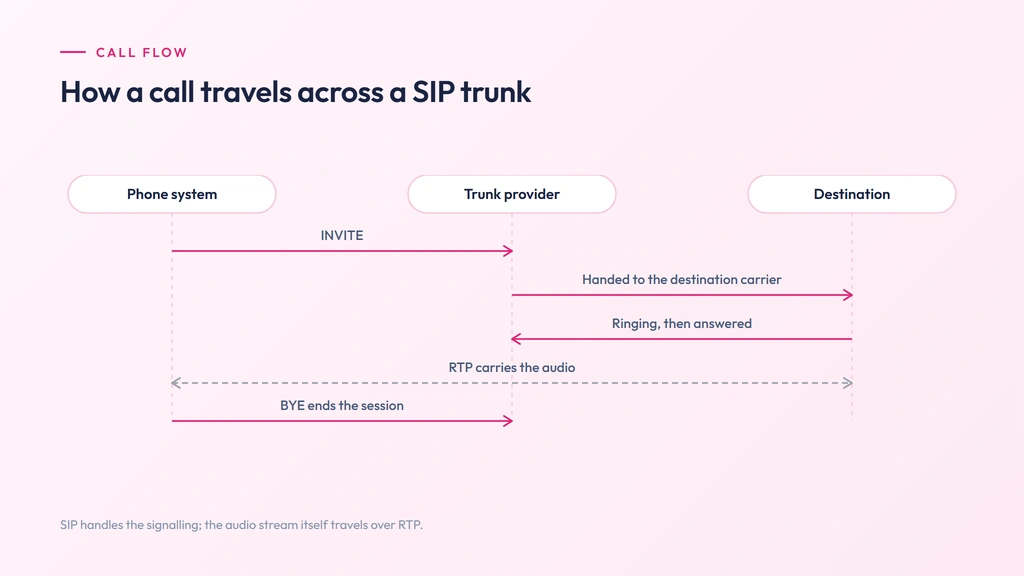
- 1The PBX or UCaaS platform sends a SIP INVITE message to the trunk provider, carrying the destination number, the calling number to present, and the codecs it is willing to use.
- 2The provider routes the call across its network and hands it to the carrier serving the destination, whether that is a landline or a mobile number in another country.
- 3The destination rings. If the far end answers, both sides negotiate a media path and the audio itself travels over RTP, the Real-time Transport Protocol. SIP handles the signalling; RTP carries the voice.
- 4When either party hangs up, a SIP BYE message closes the session.
From the caller's side this is invisible and takes a couple of seconds. What matters operationally is that each simultaneous call occupies one channel, so the channel count sets how many conversations a business can hold at once. Unlike a physical line, channels are a configuration value rather than a hardware order.
A SIP trunk also carries more than voice. The same connection handles inbound and outbound calling, fax over IP using T.38, SMS in many configurations, and video in some deployments. That breadth is a large part of why SIP became the dominant protocol for business communications.
SIP Trunk vs. Traditional Phone Lines
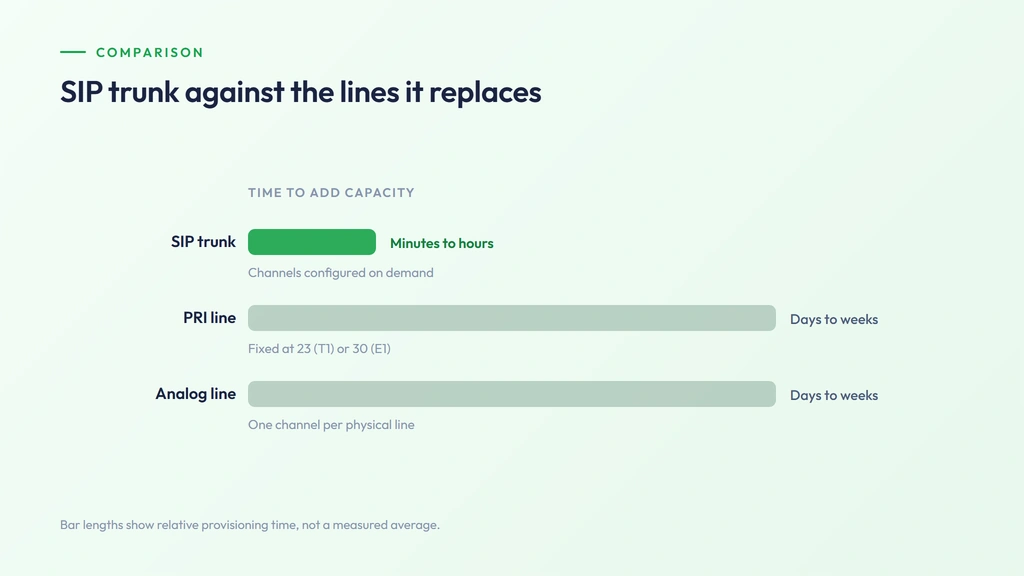
Before SIP, businesses reached the phone network through PRI circuits or analog POTS lines. The contrast explains why SIP displaced both.
| SIP trunk | PRI line | Analog (POTS) | |
|---|---|---|---|
| Connection medium | Internet broadband | Dedicated T1 or E1 circuit | Copper pair |
| Channels | Configurable, added on demand | Fixed at 23 (T1) or 30 (E1) | One per physical line |
| Geographic tie | Any location with connectivity | Tied to the physical circuit | Tied to the physical line |
| Provisioning | Minutes to hours | Days to weeks | Days to weeks |
| International calling | Built in through one provider | Needs additional routing | Limited |
| Failover | Redirect to any site or device | Circuit dependent | Circuit dependent |
The core difference is infrastructure. PRI and POTS depend on physical circuits a carrier installs and maintains at the premises, so adding capacity means ordering circuits and waiting for an engineer. A SIP trunk exists in software, and the channel count changes in a portal or through an API — which is why wholesale VoIP rates are quoted per minute and per channel rather than per installed line.
For most businesses PRI is no longer the sensible choice, and the migration path is well worn: most PBX systems that supported PRI also speak SIP, often after a configuration change or a firmware update rather than a replacement.
Get virtual phone numbers for your business — set up in minutes.
Key Components of a SIP Trunk Setup
Three components work together in any deployment.
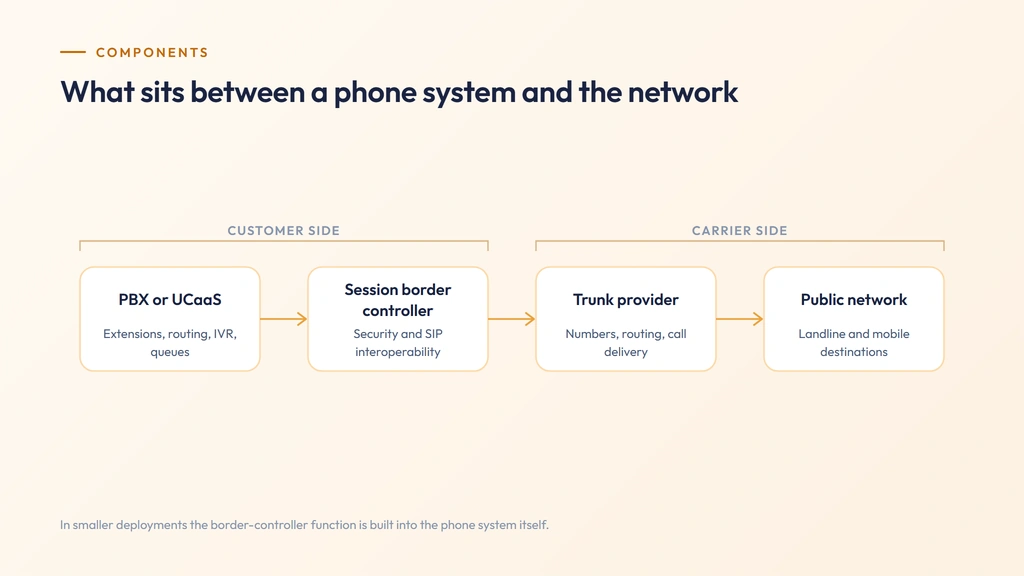
The SIP trunk provider
The carrier that connects the phone system to the public network. It issues DID numbers, routes outbound calls and delivers inbound ones. Provider quality varies more than buyers expect, and the things worth comparing are the uptime commitment, call completion rates, and how much of the destination network the provider reaches directly rather than through intermediaries.
The session border controller
An SBC sits at the edge of the network as a security and interoperability layer between the phone system and the trunk. It handles NAT traversal so calls cross firewalls cleanly, enforces call admission control, blocks unauthorised SIP traffic, and translates between SIP dialects when the PBX and the provider do not implement the protocol identically. In most smaller deployments the SBC function is built into the PBX or the platform; larger estates run dedicated hardware or virtual appliances.
The PBX or UCaaS platform
The phone system itself — extensions, routing rules, IVR menus, queues and voicemail. On-premise systems such as Asterisk, FreePBX, Cisco CUCM and Avaya connect to a trunk directly. Cloud platforms generally handle trunking internally, though some enterprises bring their own trunks to a cloud platform for cost or compliance reasons.
When to Use SIP Trunking
SIP suits a wide range of deployments, but five situations make it the obvious answer rather than merely a reasonable one.
Replacing aging PRI or analog lines
A maintenance renewal, a carrier end-of-life notice or a PBX upgrade are all natural switching points, and in several markets the decision is no longer open-ended. UK government guidance states that the analog telephone network is being retired in January 2027 and that every device depending on it has to be migrated by then, through an industry-led programme rather than a regulatory order. Other markets are retiring copper on their own timetables, so the question for most businesses is when rather than whether.
Multi-site businesses
A trunk is not tied to a building. Offices in three cities can consolidate onto one provider, route all calls through a single phone system and drop the per-site carrier contracts entirely.
Remote and hybrid teams
Because SIP runs over IP, staff working from home reach the same phone system as the head office. Calls ring on softphones, desk phones and mobile apps without regard to where the person happens to be.
High call volume and contact centers
Contact centers need elastic capacity — channels added for a campaign and released afterwards. A trunk scales on demand with no hardware order and no installation window, which is why high-volume operations tend to buy wholesale rather than retail.
International calling
International routes are provisioned in software, so one provider can cover dozens of countries from a single configuration instead of requiring a carrier relationship in each one.
Conclusion
A SIP trunk is not a new kind of phone service so much as the same service delivered over a different kind of wire — and freed from the constraints that the wire imposed. Capacity becomes a setting rather than an order, location stops mattering, and international reach comes from a configuration rather than a contract per country.
The practical questions are how many simultaneous calls the business actually needs, whether the existing PBX already speaks SIP, and what the per-minute and per-channel economics look like at that volume. MeraTalk provides SIP trunking and wholesale termination for businesses and carriers, with destination-level rate sheets issued on request.
Ready to get started with what is a sip trunk?
Join thousands of businesses using MeraTalk for Wholesale Voice, VoIP, and phone number services.
Contact MeraTalk Today