Key Takeaways
Covers international Wholesale VoIP in depth
Covers global voip wholesale in depth
Covers international voip termination in depth
Covers international voice wholesale in depth
Explore MeraTalk's Wholesale VoIP solutions — built for carriers, resellers, and enterprises.
Learn moreWhy International VoIP Wholesale Matters
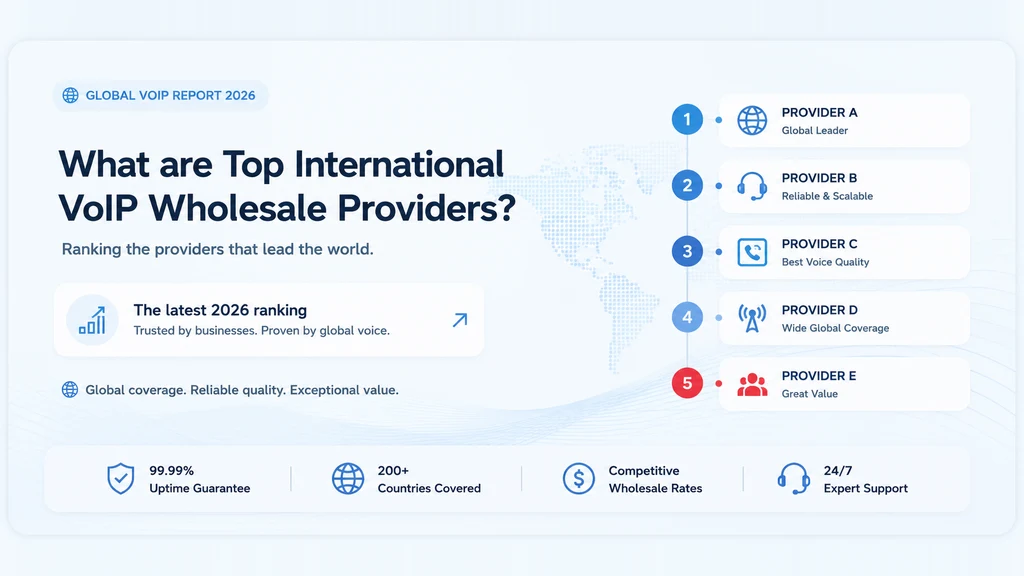
Many businesses communicate globally — with overseas offices, international customers, or remote teams. For them, the quality and cost of international calls comes down to one thing: the Wholesale Voice infrastructure under their communications platform. International VoIP wholesale providers run that infrastructure. They route calls across borders at bulk rates.
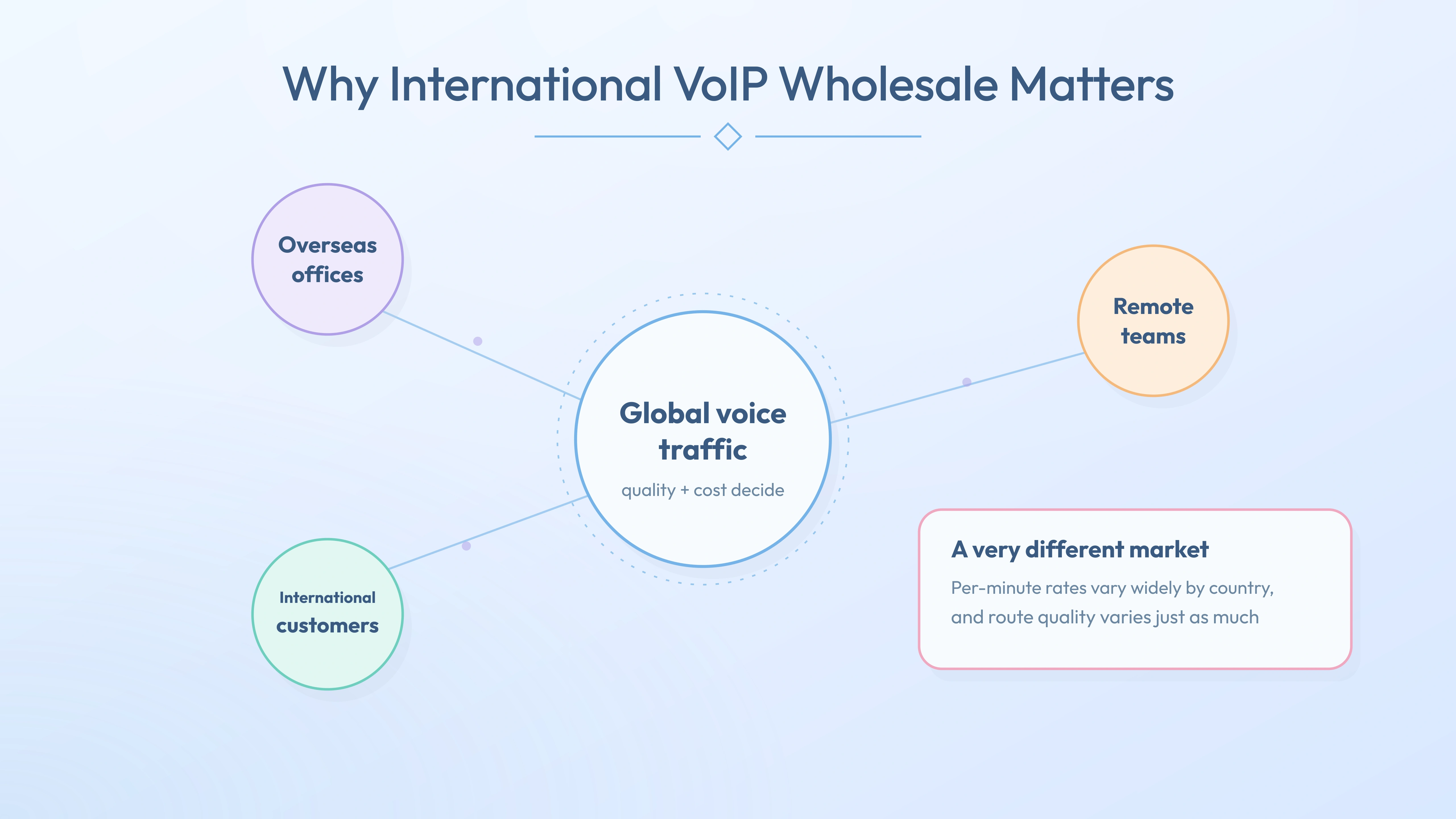
The international voice market works very differently from domestic calling. Per-minute rates vary a lot by country. Some cost a fraction of a cent, like the US, UK, and major Western markets. Others cost much more, such as parts of Africa, the Pacific Islands, and certain regulated markets. Route quality also varies widely between providers. On top of that, the commercial deals between international carriers change often.
What International VoIP Wholesale Providers Do
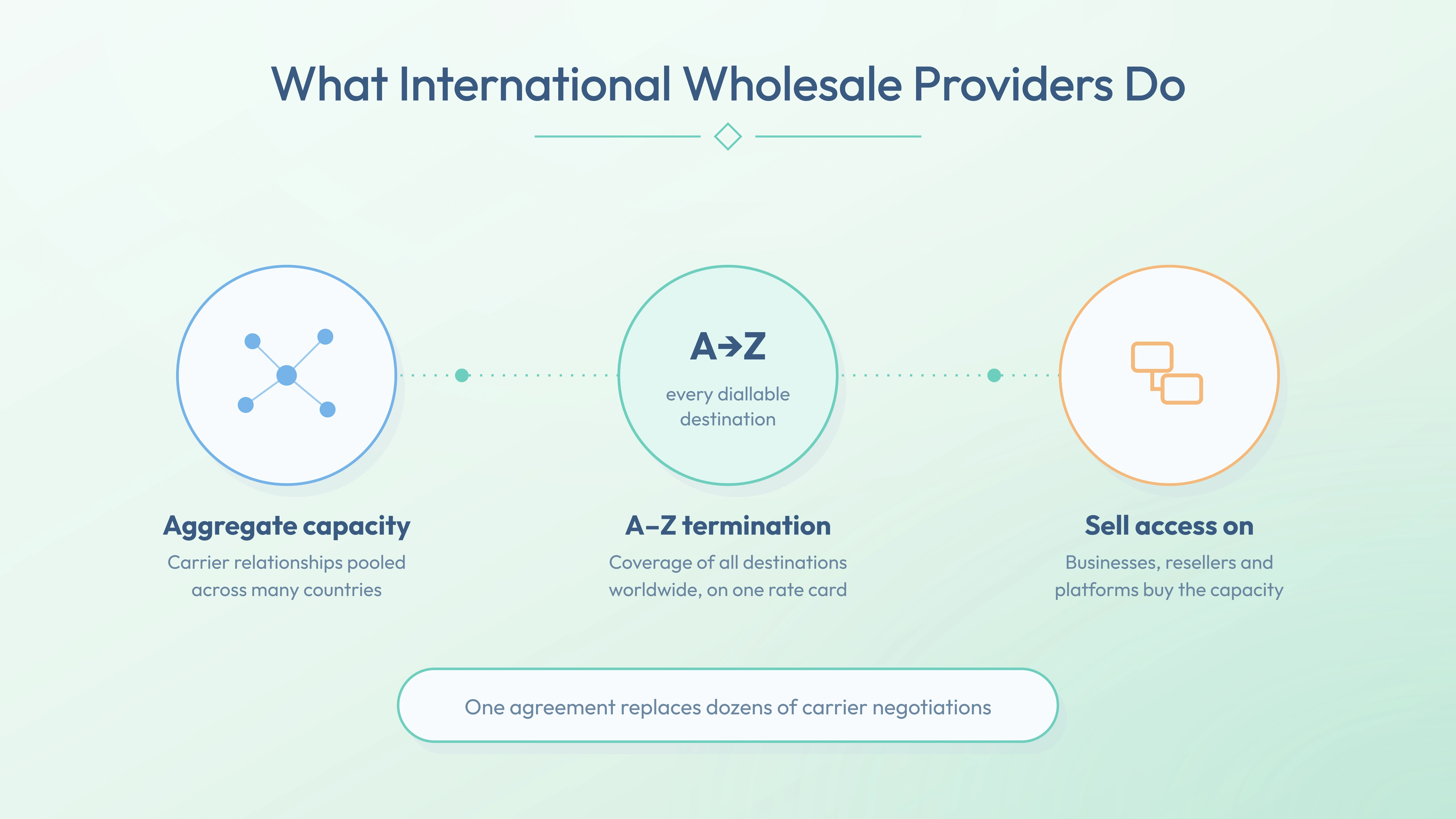
International wholesale providers pool carrier capacity across many countries. They then sell access to that capacity to businesses, resellers, and UCaaS platforms. To do this, they keep bilateral carrier agreements in each destination country, manage routing quality, and price each destination per minute.
A-Z Termination
The broadest international wholesale offering is A-Z termination. It covers every diallable destination in the world. True A-Z termination needs direct carrier relationships, or sub-carrier agreements, in nearly every country. Quality varies a lot between providers. Some reach all destinations through direct relationships. Others lean on resellers for harder-to-reach countries, which makes quality less predictable.
Key Features of Top International Wholesale Providers
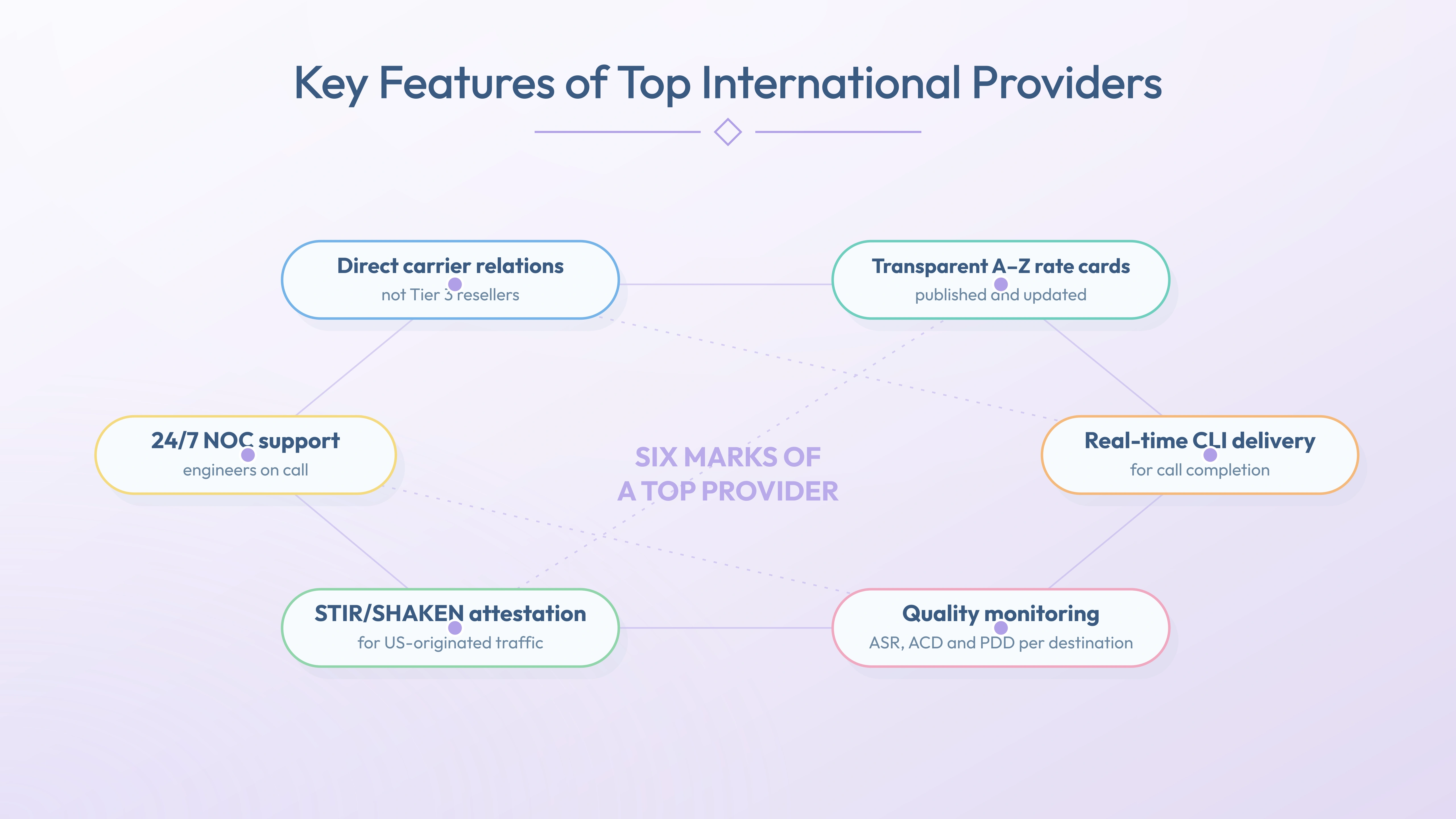
- Direct carrier relationships in major traffic destinations — not reliance on Tier 3 resellers.
- Transparent A-Z rate cards published and updated regularly.
- Real-time CLI (Caller Line Identification) delivery — important for international call completion rates.
- Quality monitoring with per-destination ASR, ACD, and PDD metrics.
- STIR/SHAKEN attestation for US-originated traffic.
- 24/7 NOC with documented escalation paths.
- Fraud detection systems monitoring for IRSF patterns in international traffic.
- Flexible interconnection — support for both SIP trunking and legacy TDM where required.
Get Wholesale VoIP rates with transparent wholesale pricing.
MeraTalk's International Wholesale Voice Infrastructure
MeraTalk delivers international voice through its wholesale carrier partnerships. Businesses can make and receive calls in many countries from a single cloud phone platform. Rate cards are transparent. MeraTalk's routing also monitors call quality per destination, and reroutes through higher-quality paths automatically when a route drops.
Some businesses need a direct wholesale international voice relationship — usually carriers, resellers, or very high-volume enterprises. For them, MeraTalk offers Wholesale Voice termination as a standalone product, with competitive A-Z rates and dedicated account management.
Provider, Carrier or Reseller: Who Are You Actually Buying From?
'International VoIP wholesale provider' covers three different kinds of supplier, and the label on a website does not always tell you which one you are dealing with.
- Carrier — owns or directly leases network and has its own interconnects to other carriers. It controls routing and can usually explain exactly how a route is delivered.
- Reseller or aggregator — buys capacity from one or more carriers and resells it. It can be flexible and inexpensive, but quality depends on the carriers behind it and it may not be able to fix a route problem itself.
- Platform provider — a UCaaS or cloud contact center vendor that bundles wholesale-grade routes into a subscription, so you buy a service rather than raw minutes.
Three questions help place a supplier. Who holds the interconnect on your top destinations? Can you see per-route quality data? When a route fails, who do you escalate to: the supplier, or an upstream carrier you never deal with? The answers show how much control the supplier really has.
Evaluating International VoIP Providers: A Practical Checklist
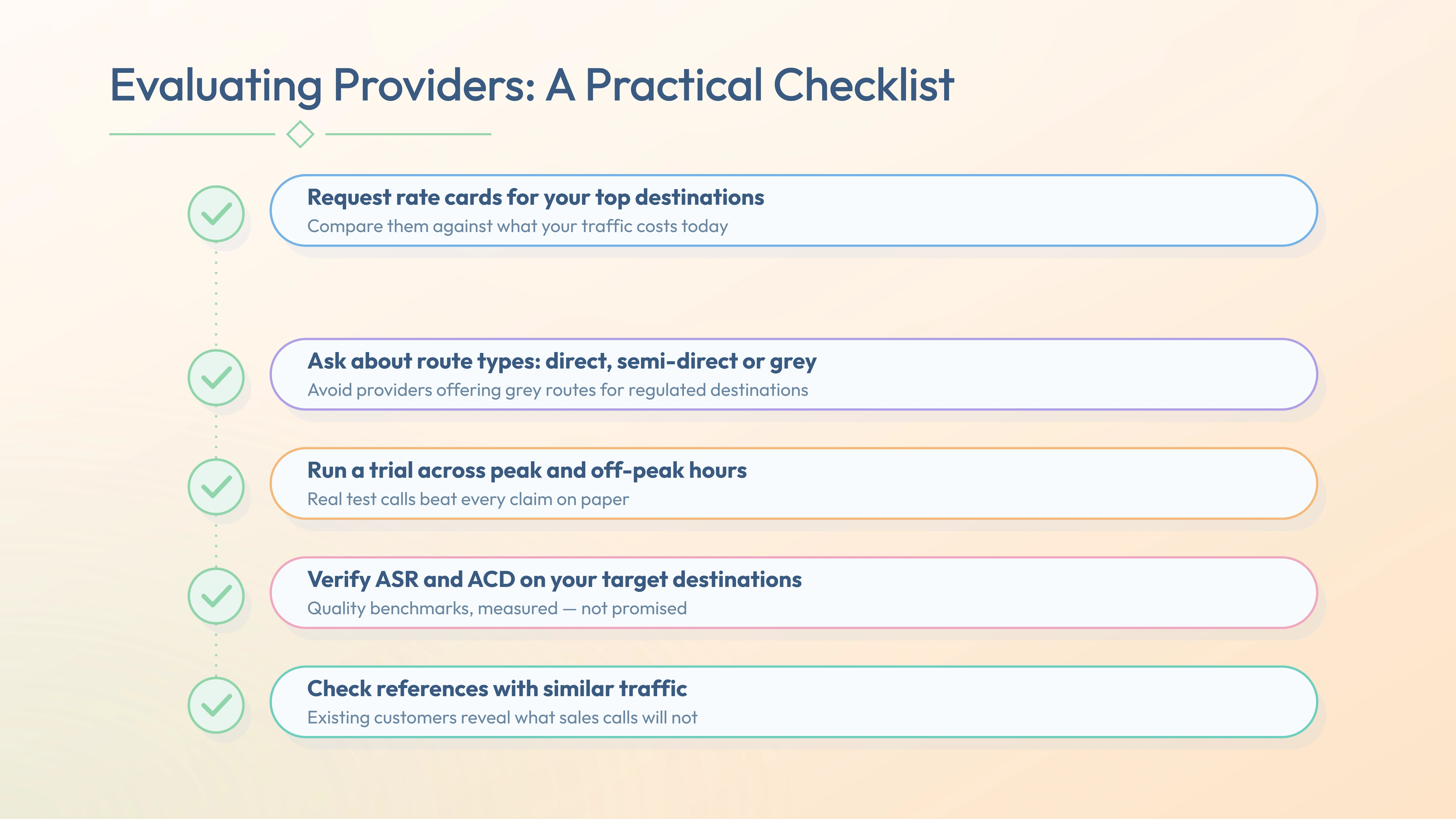
- 1Request rate cards for your top 20 call destinations and compare against your current costs.
- 2Ask specifically about route types: direct, semi-direct, or grey routes — avoid providers offering grey routes for regulated destinations.
- 3Request 30-day trial access and run quality tests across peak and off-peak hours.
- 4Verify ASR and ACD benchmarks on your target destinations.
- 5Check references from customers with similar international call profiles.
- 6Confirm STIR/SHAKEN attestation support for US traffic.
- 7Review fraud monitoring procedures and contractual liability for IRSF events.
Understanding Rate Deck Updates and Notice Periods
International termination pricing comes as a rate deck. This is a per-destination price list covering every diallable breakout a provider supports. Unlike domestic pricing, international rate decks change constantly. Destination carriers adjust interconnect fees. Regulators add surcharges. Currency swings ripple through cross-border settlements. The provider passes all of this downstream through rate deck updates.
The difference between a disciplined provider and a problematic one is how they communicate those updates. A good contract sets a minimum notice period for rate increases. It also requires a machine-readable format, so pricing systems can ingest changes automatically, and clear effective dates. Buyers with large volumes should check every new deck against their traffic forecasts before it takes effect. A small rate change on a high-volume destination can shift the economics of the whole relationship. For more, see diallable destinations.
- Confirm the contractual notice period for increases before signing
- Automate rate deck ingestion to avoid billing at stale prices
- Flag destinations where rates change frequently and review routing there first
CLI and Non-CLI Routes: What the Difference Means
Route quality in international wholesale often comes down to CLI delivery. CLI is whether the original caller's number reaches the called party intact. On a true CLI route, the recipient sees the real calling number. That improves answer rates and lets people call back. On non-CLI routes, the caller ID arrives missing, garbled, or swapped for a local number injected somewhere along the path.
This difference matters commercially. CLI routes cost more per minute because they use official carrier interconnects end to end. Non-CLI routes are cheaper, but they suit only traffic where the displayed number does not matter. Some calls are customer-facing — support callbacks, sales outreach, verification calls. For those, insist on CLI routes to your key destinations. And verify delivery with test calls, rather than trusting the route label alone.
Billing Reconciliation and Dispute Handling
In high-volume international traffic, small measurement differences add up fast. The buyer's switch and the provider's switch each record call detail records (CDRs). The two rarely match perfectly. Answer detection differs. Rounding increments differ. Even clock synchronization creates gaps. Mature wholesale relationships treat reconciliation as routine hygiene, not conflict.
A sound process compares CDRs on a regular cycle. It applies an agreed tolerance threshold and escalates only the variances that exceed it. The contract should spell out billing increments per destination, the dispute window after each invoice, and how agreed adjustments are credited. Providers that publish clear dispute procedures — and answer with their own CDR extracts — tend to run disciplined networks too. Billing behavior is a useful proxy for overall operational quality.
Capacity Planning for Cross-Border Traffic
International calling patterns are rarely flat. Traffic bunches into narrow windows, shaped by the time-zone overlap between the calling and called countries. Seasonal events add more spikes. Holidays, religious observances, and sporting finals can multiply volume to specific destinations for a few days at a time. Capacity planning means sizing your concurrent call paths, session limits, and bandwidth for those peaks — not for the daily average.
When you evaluate a provider, ask a few direct questions. How many simultaneous sessions does the interconnect support? Are bursts above the committed level allowed? How fast can capacity go up for a planned campaign? On your side, spread traffic across more than one interconnect. Keep a tested overflow route for top destinations. That way, one congested path cannot turn a busy day into a failed one.
Glossary of Key International Wholesale Terms
The international voice market has a vocabulary of its own. These are the terms that appear most often in rate decks, contracts, and quality reports:
- ASR (Answer Seizure Ratio) — the percentage of call attempts that result in an answered call; a core quality indicator per destination
- ACD (Average Call Duration) — the mean length of answered calls; unusually short ACD often signals route problems
- PDD (Post-Dial Delay) — the time between dialing and hearing ringback; long PDD causes callers to abandon
- Breakout — a specific destination or sub-destination in a rate deck, such as a country's mobile networks versus its fixed lines
- Bilateral — a direct two-way traffic exchange agreement between carriers
- IRSF (International Revenue Share Fraud) — fraud that pumps traffic to premium destinations to harvest settlement revenue
- RespOrg-equivalent registries and numbering authorities — the national bodies that govern number assignment in each destination country
Fluency in these terms makes rate negotiations faster and quality discussions far more precise.
Ready to get started with international voip wholesale providers?
Join thousands of businesses using MeraTalk for Wholesale Voice, VoIP, and phone number services.
Contact MeraTalk Today