Introduction
The 212 area code is one of the most recognised phone number prefixes in the world. It has been synonymous with Manhattan, New York City since 1947 — when it was one of only 86 original North American Numbering Plan (NANP) area codes established at the birth of the modern telephone numbering system, and, thanks to a rotary-dial quirk of the era, one of the fastest three digits a caller could physically dial.
Today, 212 numbers are scarce, prestigious, and widely associated with established New York City businesses. Understanding the 212 area code — where it covers, how it works alongside sibling codes like 646 and 332, and how to get a 212 number for your business — is the focus of this guide.
Key Takeaways
Covers 212 area code location in depth
Covers Manhattan phone number in depth
Covers New York City area code in depth
Covers get a 212 number in depth
Need a business phone number? Get a MeraTalk number in minutes, no contract required.
Get started free212 Area Code at a Glance
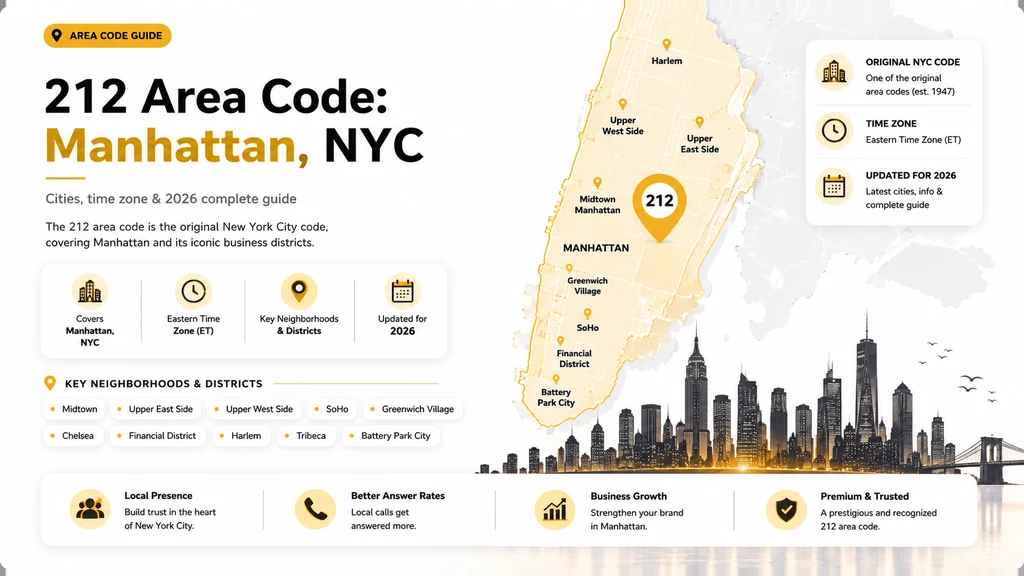
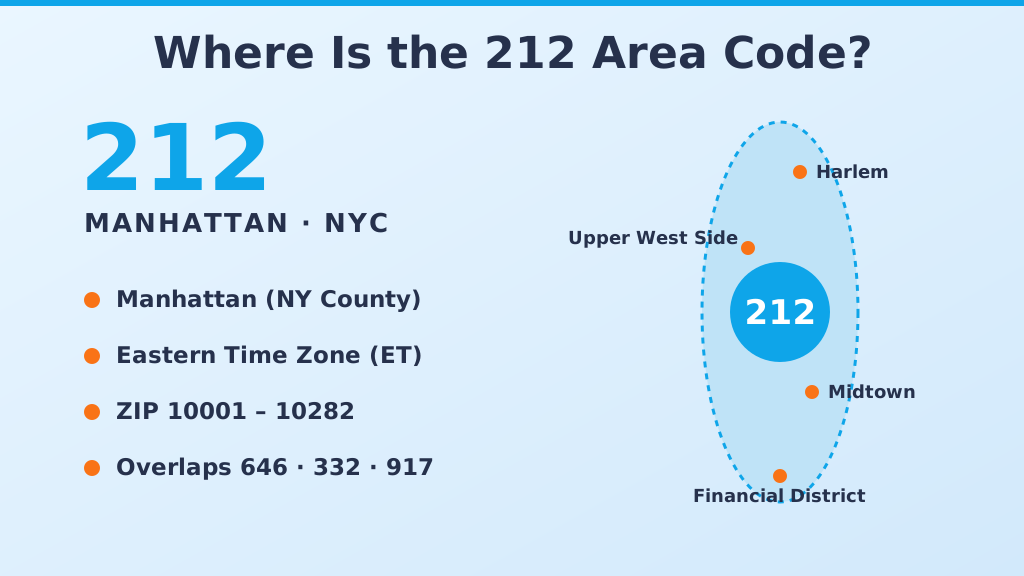
The 212 area code covers Manhattan in New York City, New York. It is one of the original 1947 area codes and runs on Eastern Time.
- Location: Manhattan (New York County), ZIP codes 10001 through 10282
- State: New York
- Main areas: Midtown, Financial District, Upper East Side, Upper West Side
- Time zone: Eastern Time (UTC-5 standard, UTC-4 daylight saving)
- Overlay or split: shares Manhattan with the 646 and 332 overlays; Brooklyn, Queens and Staten Island moved to 718 in 1984, the Bronx in 1992
- In service since: 1947, one of the original 86 area codes
- Dialing: ten-digit dialing mandatory in Manhattan since July 1, 1999
Where Is the 212 Area Code Located?
The 212 area code covers Manhattan (New York County), the most densely populated of New York City's five boroughs — home to roughly 1.66 million residents, a population that swells to an estimated 3.1 million on a typical workday once commuters, visitors and day-trippers are counted. In its earliest decades, 212 covered all five boroughs. Population growth and the explosion of mobile devices and fax machines in the 1980s and 1990s exhausted the number supply, leading to area code relief through overlays and splits.
Current 212 Coverage
- Manhattan (New York County) — the primary coverage area
- The Bronx (Bronx County) — covered by 212 until July 1, 1992, eight years after Brooklyn, Queens and Staten Island moved to the new 718 code in 1984
- New York City overall — served by an overlay of 212, 332, 646, 718, 347, 917, and 929
Time Zone
The 212 area code operates in the Eastern Time Zone (ET): UTC-5 standard time, UTC-4 daylight saving time (March–November). New York City observes daylight saving time, switching to EDT in spring and back to EST in fall.
Major Cities and ZIP Codes
The primary geography is Manhattan, covering ZIP codes 10001 through 10282. Key neighbourhoods include Midtown (10019, 10020, 10022), Lower Manhattan/Financial District (10004, 10005, 10006, 10007), Upper East Side (10021, 10065, 10075), and Upper West Side (10023, 10024, 10025).
History of the 212 Area Code
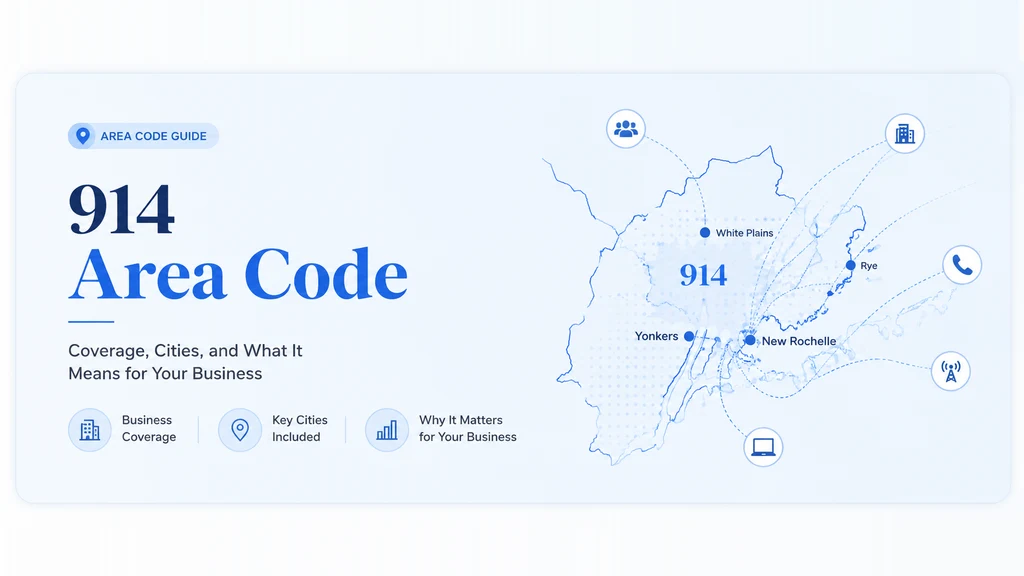
The 212 area code was one of the original 86 area codes created in 1947 as part of the North American Numbering Plan, jointly developed by AT&T and Bell Telephone Laboratories. New York was populous enough to need more than one region from day one, so the state launched with five area codes rather than a single statewide code — 212 for New York City, plus 315, 518, 716 and 914 covering the rest of the state.
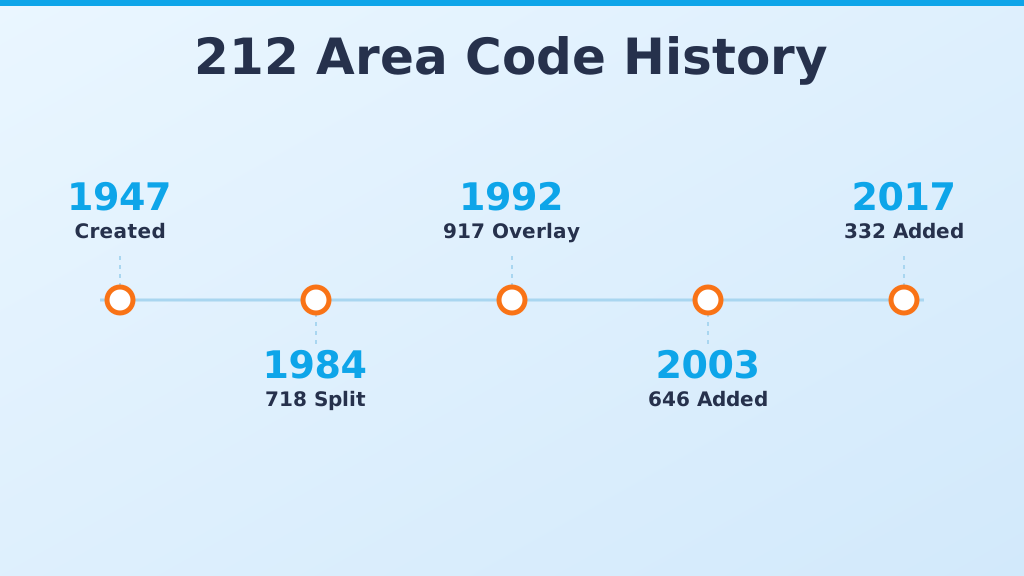
At launch, 212 covered all five boroughs of New York City — it never extended to the rest of the state, which had its own codes from 1947 onward. Brooklyn, Queens and Staten Island moved to the new 718 code on September 1, 1984 as fax machines and modems accelerated number exhaustion, but Manhattan and the Bronx both kept 212 for another eight years — the Bronx did not join 718 until July 1, 1992.
The choice of "212" specifically was not arbitrary. Telephones in 1947 were rotary-dial, and each digit took time to dial in proportion to its value — a 1 took one pulse, a 9 took nine. Planners assigned the fastest-to-dial codes to the country's busiest calling markets: New York got 212 (five total pulses), Los Angeles got 213, Chicago got 312, and Detroit got 313 — the four lowest-effort codes in the entire plan, reserved for the four highest-traffic cities. That legacy is why 212 still reads as the "original" New York number nearly eighty years later.
Subsequent Overlays
- February 4, 1992: 917 introduced as an overlay for all five boroughs, the first overlay area code in the entire North American Numbering Plan, primarily serving mobile phones.
- July 1, 1999: 646 introduced as a Manhattan overlay alongside 212, and mandatory ten-digit dialing began across Manhattan for the first time — every local call, even between two 212 numbers, now requires the full area code.
- October 1, 1999: 347 introduced as the first outer-boroughs overlay alongside 718.
- April 16, 2011: 929 introduced as a second outer-boroughs overlay alongside 718 and 347.
- June 10, 2017: 332 introduced as a second Manhattan overlay.
As a result, 212 numbers are now scarce. New phone lines issued in Manhattan today almost always receive a 646 or 332 number rather than a 212. The scarcity has made 212 numbers prestigious — associated with long-established New York City businesses and organisations.
Get a local number in this area code for your business — set up in minutes.
How to Call a 212 Area Code Number
Calling a 212 number follows standard US dialling conventions. Calling from elsewhere in the US (a long-distance call), dial 1 + 212 + the 7-digit number: 1-212-XXX-XXXX. For local calls inside Manhattan's overlay region, dial the ten digits; a leading 1 is generally not needed. From outside the US, dial your country's international exit code + 1 (the US country code) + 212 + the 7-digit number.
VoIP platforms like MeraTalk use E.164 format: +12125551234. The 212 area code is served by all major US carriers and VoIP providers, with no special dialling requirements.
Why Businesses Want a 212 Number
A 212 number signals New York City credibility in a way that newer overlays (646, 332) simply don't. For businesses in finance, media, law, and real estate — industries where New York presence implies seriousness — a 212 number carries real commercial weight.
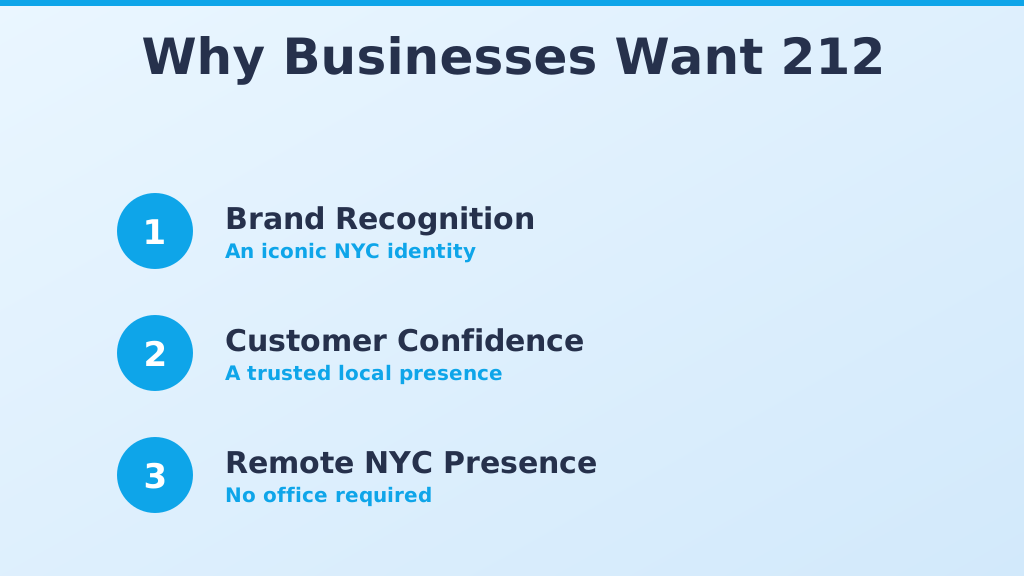
- Brand association: 212 is immediately recognisable as Manhattan.
- Customer confidence: Calls from familiar local area codes have significantly higher answer rates.
- Remote presence: A 212 number allows a business outside New York to project a credible New York City presence.
How to Get a 212 Number for Your Business
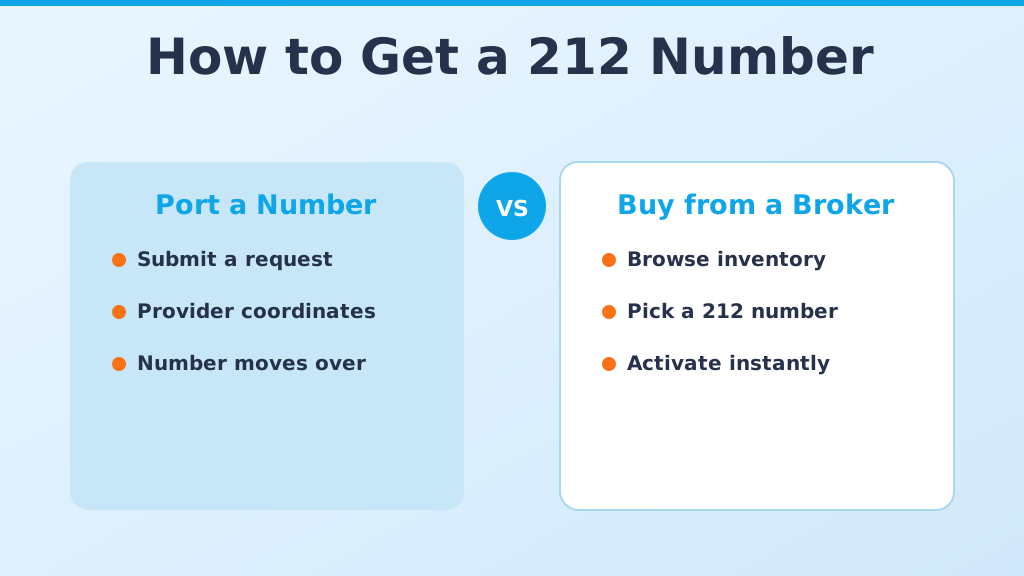
New 212 numbers are rarely issued by carriers today — the pool is effectively exhausted. But there are two ways to get one: port an existing 212 number to a cloud platform, or purchase one on a secondary market from a number broker.
If a 212 number isn't available or the premium isn't justified, 646 and 332 numbers are widely recognised as Manhattan numbers. MeraTalk can provision 646 and 332 numbers immediately, with full number search to find patterns that work for your business.
Common Phone Scams to Watch For
The prestige attached to Manhattan digits makes them a favorite disguise for phone fraud. Scammers spoof the prefix so a call appears to come from an established New York institution — a bank's fraud desk, a law office, a government agency, or a utility — counting on the caller ID alone to earn trust before a word is spoken.
- No agency, court, or utility demands immediate payment by gift card, wire transfer, or cryptocurrency.
- Banks never ask customers to read out one-time passcodes or move funds to a 'safe account' by phone.
- Impostor calls invoking legal trouble, jury duty fines, or immigration status are pressure tactics — hang up and verify through an official published number.
- Allow unfamiliar calls to reach voicemail; spoofed robocallers rarely leave a message.
A spoofed display does not mean the legitimate holder of those digits has been compromised — the ID is simply forged in transit. Suspicious calls can be reported to the FCC, which feeds carrier-level blocking. For more, see 212 area code.
Porting a Manhattan Number Between Providers
Because new issuance from the original Manhattan pool has effectively stopped, an existing number in that prefix is an asset worth protecting — and portability rules protect it well. The holder of an active number can move it to any carrier or cloud platform that serves the rate center, and the losing provider is required to release it once a valid port request arrives.
- 1Collect the account number, service address on file, and port-out PIN from the current carrier.
- 2Submit the port through the new provider, keeping the old line active until completion.
- 3Test inbound and outbound calls on the new platform before cancelling legacy service.
The one mistake that genuinely endangers scarce digits is cancelling service before the port completes — a disconnected number returns to the carrier pool and may be unrecoverable.
The Future of Manhattan's Numbering
Manhattan's numbering plan illustrates where dense urban markets are headed. With the original prefix exhausted and its overlays absorbing all new demand, the borough already operates as a multi-code territory where geography no longer maps to a single set of three digits — and numbering authorities project the overlay model, not further splits, as the pattern for future relief.
Two longer-term forces shape what comes next. VoIP has slowed exhaustion by letting one line serve many users through extensions, softphones, and shared routing, easing pressure on remaining inventory. At the same time, the secondary value of legacy digits keeps rising precisely because no new supply exists.
The practical takeaway for businesses: treat an established Manhattan number as a durable brand asset, and expect any newly issued line to arrive on an overlay — functionally identical, reaching the same island, dialed the same ten-digit way.
Conclusion
The 212 area code is the most iconic geographic area code in the United States — synonymous with Manhattan business presence since 1947. Its scarcity today makes it a prestige asset for established New York City businesses.
For businesses seeking a New York City phone presence, MeraTalk can provision 646 and 332 Manhattan overlay numbers immediately, or handle porting of an existing 212 number to the cloud platform. Search available New York City numbers at meratalk.com.
Ready to get started with 212 area code?
Join thousands of businesses using MeraTalk for Wholesale Voice, VoIP, and phone number services.
Contact MeraTalk Today