Introduction
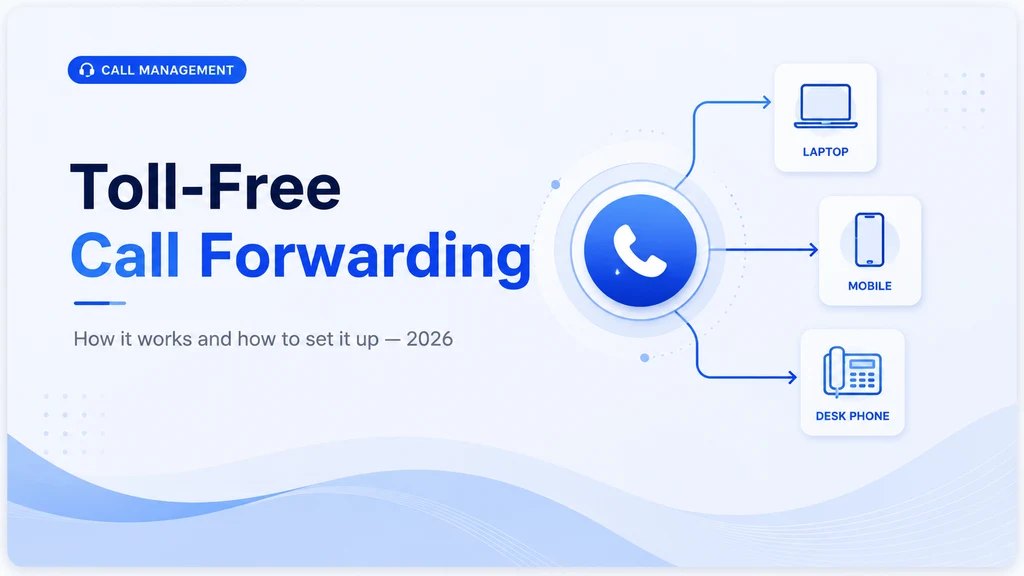
Toll-free call forwarding means that a call to an 800-family number is delivered to a destination you choose: a mobile, a desk phone, a softphone, a SIP address or a queue. The advertised number never changes; what changes is where the call lands, and that decision is made by rules you control.
Most guides stop at 'enter your destination number and save'. The harder questions come later: which forwarding pattern fits your business, what each forwarded minute costs, whether your team sees the caller's real number, and what breaks when a destination is busy or switched off. This guide is organised around those decisions.
Key Takeaways
Covers toll-free forwarding in depth
Covers 800 number forwarding in depth
Covers forward toll-free number in depth
Covers toll free call forwarding to cell phone in depth
Need a business phone number? Get a MeraTalk number in minutes, no contract required.
Get started freeHow a Toll-Free Call Actually Reaches Your Phone
Toll-free numbers are not tied to a physical line. Each number is assigned through the national toll-free database, which is administered by Somos, and a Responsible Organization (RespOrg) manages the number's records on the business's behalf. Those records tell the network which carrier should receive calls to the number; the carrier then applies its own routing rules to decide where the call goes.
A forwarded toll-free call therefore has two legs. The first leg is the inbound call from the caller to your toll-free number, and it is the leg the business pays for, because the called party carries the cost of a toll-free call. The second leg is the call your platform places to the forwarding destination. On a cloud platform both legs are handled in software, so rules such as time of day or caller area code are evaluated in the moment the call arrives.
The official background on how these numbers are administered is in the FCC's toll-free number guide at the Code of Federal Regulations, which is a useful reference when a carrier dispute turns on who is responsible for a number.
Five Forwarding Patterns and When Each One Fits
Almost every real configuration is a combination of these five building blocks.
1. Simple forward
Every call goes to one destination. It is the right starting point for a sole trader or a single-site shop. Its weakness is also obvious: if that phone is off or busy, the call has nowhere to go unless you add a fallback.
2. Time-of-day and holiday routing
Different destinations by hour, weekday or date: the office during opening hours, an on-call mobile in the evening, an answering service or voicemail overnight. Set the time zone explicitly on the number, because a rule written for 9 to 5 will fire at the wrong hour if the platform defaults to a different zone.
3. Geographic (area-code) routing
The caller's area code decides the destination, so calls from the West Coast reach the west-coast team and calls from the East Coast reach the east-coast team. It works for regional sales teams and field-service businesses. Remember that a mobile number's area code reflects where the number was issued, not where the caller is standing, so always define a default destination for area codes you did not list.
4. Failover chain
The platform tries destination one, and if it is busy, unreachable or unanswered after a set number of rings, tries destination two, then three, ending in voicemail or an overflow service. Keep the ring time per step short enough that the whole chain finishes before a caller gives up. Several short steps usually beat two long ones.
5. Ring group (simultaneous ring)
All listed destinations ring at once and the first to answer takes the call. It suits a small team where speed matters more than who answers. One caution: if any destination is a personal mobile with its own voicemail, that voicemail can answer first and capture the call. We cover that trap below.
What Toll-Free Forwarding Costs
Three cost items matter: the number's monthly fee, the per-minute charge for the inbound leg, and, where the destination is an ordinary phone number rather than a SIP address, the outbound leg to that destination. Forwarding to a SIP endpoint or softphone on the same platform commonly avoids the second leg; forwarding to a mobile or a landline usually does not.
For example, if a call lasts 4 minutes, you are billed for 4 inbound minutes on the toll-free leg and, if you forward to a mobile, 4 outbound minutes to that mobile. The same call can therefore be billed twice. This is an illustration of the billing mechanism, not a quoted rate, and providers differ in how they round partial minutes, so check the rate sheet for the billing increment (per second, per six seconds or per full minute).
Ring groups multiply the effect: while the group rings, each outbound attempt can create its own leg, and some providers bill only answered legs while others bill attempts differently. Failover chains and international destinations deserve the same scrutiny. Ask the provider two questions before you build a complex tree: are unanswered ring attempts billed, and is the forwarded leg billed at the destination's rate?
Get virtual phone numbers for your business — set up in minutes.
What Forwarding Does to Caller ID
When your platform places the second leg it chooses which number to present to your team. There are two common behaviours. The first passes through the original caller's number, so your agent sees who is calling and can return the call. The second substitutes your toll-free number, so every forwarded call looks the same on the screen.
Passing the caller's number through is more useful to your team, but it means the second leg is presented with a number your platform does not own, and some terminating networks may be more cautious with such calls. Presenting your own toll-free number is the more predictable option for delivery, but your team loses the caller's identity on the handset. Many platforms resolve this by showing the original number in a whisper message, a screen pop or the call log instead of in caller ID.
Decide which of these your team actually needs, then test it from a mobile and a landline. Also check the other direction: if an agent returns a call from the forwarded phone, which number will the customer see? Returning a call from a personal mobile can expose that number and send callbacks to the wrong place, so route return calls through the platform's click-to-call or a business outbound number.
Failure Modes to Test Before You Advertise the Number
- Forwarding loops: toll-free number A forwards to a mobile that has call forwarding to number A (or to a second toll-free number that forwards back). The call bounces until the network drops it. Never forward a toll-free number to another forwarded number without tracing the full path.
- Voicemail traps: a personal mobile that is off, out of coverage or declining calls sends the forwarded call to its own voicemail, and from the network's point of view the call was answered. Failover therefore never fires. Use a platform-side answer-detection or press-1-to-accept prompt, or forward to a SIP endpoint you control.
- Busy-line dead ends: a single destination with no fallback returns a busy tone. Always end every chain in something that answers, such as a mailbox, an overflow queue or an announcement.
- International forwarding charges: forwarding to a destination outside the US can be billed at a per-minute international rate and, depending on the plan, can be blocked altogether. Confirm that the destination country is allowed and priced before you set the rule.
- Time-zone and holiday errors: a schedule built in one time zone applied to a team in another sends calls to an empty office. Add holiday overrides explicitly rather than relying on someone to switch the rule by hand.
- Mobile-only reachability: a single employee's mobile as the only destination makes the whole company's phone line dependent on that person's battery and holiday.
A short test script catches most of these: call from a mobile, from a landline and from outside your area code; call during and outside hours; make the primary destination busy; switch the primary off; and confirm every path ends in a human or a mailbox.
Which Forwarding Setup Fits Which Business
| Business | Recommended pattern | Watch out for |
|---|---|---|
| Sole trader or freelancer | Simple forward with time-of-day voicemail | Personal mobile voicemail answering first |
| Small office, 2 to 10 staff | Ring group with failover to mailbox | Billing for every ring attempt on outbound legs |
| Regional service or sales team | Area-code routing with a default destination | Mobile area codes that do not match caller location |
| Out-of-hours emergency cover | Time-of-day rule with an on-call failover chain | Time zone and holiday errors |
| Call center or support operation | IVR or queue with overflow and after-hours routing | Peak-time overflow and per-minute cost of hold time |
| Seasonal or campaign line | Dedicated number with its own destination and reporting | Forgetting to retire or redirect the number after the campaign |
If a team's needs go past a ring group, for example agent states, queue priorities or reporting, you have moved from forwarding into call center territory, and a queue-based platform fits better than a longer chain of forwards.
How to Set Up Toll-Free Forwarding Step by Step
- 1Choose the number and prefix (800, 888, 877, 866, 855, 844 or 833). All work the same for forwarding.
- 2Decide the pattern from the table above and write it down as a short rule list before you open the dashboard.
- 3Provision the number and enter the primary destination, preferring a SIP endpoint or softphone where possible to avoid a second billed leg.
- 4Add failover steps and end the chain in a mailbox or announcement.
- 5Set the time zone, business hours and holiday overrides.
- 6Choose the caller ID presentation your team needs and enable call logs.
- 7Run the test script, then publish the number.
If you are moving an existing toll-free number, the sequence is the same, except that the number is transferred to a new RespOrg first. Build and test your rules on a temporary number before the port completes, so the cutover is a switch rather than a rebuild.
Toll-Free Numbers and Where They Fit Your Setup
Toll-free numbers are the right front door when callers are spread across the country and you want the cost of calling to sit with the business. A local number may suit a business whose customers are in one area and expect a local presence. Many companies run both and forward both to the same destination, which is a perfectly ordinary configuration.
MeraTalk provides toll-free and local virtual numbers on a cloud platform, with the forwarding patterns above configurable in a dashboard. Browse number options at meratalk.com/products/phone-number/toll-free-forwarding.
Conclusion
A good toll-free forwarding setup is not the one with the most rules; it is the one where every path ends in a person or a mailbox, the cost of each leg is understood, and the team sees the information it needs on the handset. Pick the simplest pattern that fits, test the failure modes, and review it whenever your team or hours change.
Ready to get started with toll free call forwarding?
Join thousands of businesses using MeraTalk for Wholesale Voice, VoIP, and phone number services.
Contact MeraTalk Today